Content distribution strategy
A content distribution strategy defines how a business will deliver content to specific buyers through owned, earned and paid channels, then measure its contribution to qualified leads and revenue. It should prioritise buyer intent, channel fit, repurposing, timing and conversion tracking rather than simply maximising reach, traffic or publishing frequency.
Most businesses do not have a content production problem. They have a distribution problem. Useful articles, videos and reports are published once, shared briefly and then abandoned before their intended buyers see them.
The solution is not to post everywhere. It is to connect content, audiences, channels and commercial outcomes through a repeatable system. This guide explains how Australian SMEs can build that system without wasting budget on vanity traffic.
Key takeaways
An effective content distribution strategy starts with commercial clarity, assigns every asset a defined audience and purpose, and uses channels according to buyer behaviour. Distribution should be planned before production, supported by tracking and refined using account data rather than generic posting schedules or assumptions about reach.
Define the buyer, buying stage and commercial objective before selecting channels.
Use owned channels as the foundation, earned channels for credibility and paid channels for controlled reach.
Build repurposing into the original brief instead of treating it as an afterthought.
Measure qualified actions, pipeline and revenue, not impressions in isolation.
Keep budget flat until tracking, targeting and buying intent are working properly.
Continue distributing proven assets while they remain accurate and commercially relevant.
Content distribution strategy summary
A sound distribution plan gives each channel a distinct job. It also defines how content moves from initial publication to repeated exposure, conversion and measurement. The table below shows the core decisions required before content enters production.
Decision | Question to answer | Practical output |
Profile | Who is the intended buyer? | ICP, buying role, problem and intent |
Objective | What commercial action should follow? | Enquiry, booking, subscription or sale |
Asset | What format best resolves the buyer's question? | Article, guide, video, case study or tool |
Channel | Where does that buyer seek or discuss the issue? | Search, email, social, partner or paid media |
Timing | When should the content appear again? | Launch, follow-up and evergreen schedule |
Measurement | How will contribution be assessed? | Source data, conversions, pipeline and revenue |
Improvement | What does performance data justify changing? | Creative, targeting, offer or channel allocation |
What is a content distribution strategy?
A content distribution strategy is a documented plan for placing, promoting and reusing content across the channels most likely to reach intended buyers. It connects each asset to an audience, buying stage, business objective, delivery schedule and measurement method, making distribution an accountable commercial process rather than a publishing checklist.
Content distribution begins after an asset is created, but distribution planning should begin before creation. That distinction matters. If a marketing team writes an article without knowing how it will reach buyers, the article may be difficult to adapt for email, social media, sales conversations or paid campaigns.
A complete strategy answers six questions:
Who needs this content?
What problem or buying question does it address?
Where does that audience already look for information?
Which format suits each selected channel?
What should the audience do next?
How will that action be connected to leads, sales or revenue?
Distribution is not the same as promotion. Promotion is one activity within distribution. A strategy also covers organic discovery, direct delivery, partner access, sales enablement, repurposing, timing and measurement.
This distinction prevents a common mistake: publishing a long article, posting its link on several social platforms and calling the work complete. A link repeated across channels is not a multi-channel strategy. Each channel has different audience expectations, formats and levels of intent.
Why content distribution matters more than publishing volume
Distribution determines whether valuable content becomes discoverable, credible and commercially useful. Publishing more assets cannot fix weak audience selection or poor channel fit. A smaller library of well-distributed, high-intent content can support search visibility, sales conversations, remarketing and email nurturing long after a high-volume publishing schedule has lost momentum.
Content only creates value when the right person encounters it in a useful context. A procurement manager searching Google for a supplier comparison has different intent from a passive LinkedIn user. Sending both people the same message overlooks where they are in the decision process.
This is why distribution should be pointed at buyers, not vanity traffic. Reach can indicate exposure, but it does not prove commercial value. A smaller audience containing actual decision-makers may be worth more than a large audience with no purchasing relevance.
Search content is especially useful when demand already exists. In our own work with a Queensland mortgage broker, the business ranked on page three for its primary keyword and relied on actively chasing leads. We focused organic search activity on its highest-intent keyword. Within six months, it reached position one, organic traffic increased by 312%, and search began generating more than 40 qualified leads per month. These figures come from 3P Digital's client results.
The lesson is not that search should always be the main channel. It is that distribution works when the channel matches how buyers express intent. For another business, direct email, industry partnerships or a sales team's one-to-one distribution may be more useful.
Which content distribution channels should you use?
The right channel mix combines control, credibility and targeted reach. Owned channels should usually form the foundation because the business controls the asset and audience relationship. Earned distribution adds third-party authority, while paid distribution accelerates access to defined audiences when tracking and economics support further investment.
Owned channels
Owned channels are assets the business controls. They include:
Your website and resource centre
Organic search landing pages
Email lists and newsletters
Webinars and events
Sales presentations and proposal content
Customer portals or knowledge bases
Company social profiles
Owned distribution compounds when content remains useful and discoverable. Search-led articles can attract demand over time. Email provides direct access to subscribers, subject to consent and spam requirements. Sales teams can reuse proof, comparisons and objection-handling content during active opportunities.
Ownership does not mean complete independence. Search engines and social platforms still control discovery algorithms. An email database and well-maintained website therefore provide stronger long-term control than a social following alone.
Earned channels
Earned distribution occurs when another person or organisation shares, references or features your content. Examples include media coverage, backlinks, podcast appearances, association newsletters, expert round-ups and customer recommendations.
Earned attention usually cannot be scheduled with certainty. It can, however, be designed for. Original research, useful tools, clear expert positions and well-supported analysis give publishers and industry participants a reason to cite the work.
Generic commentary rarely earns meaningful coverage. Before approaching a publisher, identify what your material contributes that its audience cannot already find elsewhere.
Paid channels
Paid distribution includes search advertising, social advertising, native placements, sponsorships and content syndication. It offers control over audience targeting and timing, but paid reach should not be confused with profitable demand.
Our position is direct: budget only scales where the tracked return justifies it. Hold spending flat until conversion tracking, search terms, audience exclusions and buying intent are properly managed. More spend can otherwise amplify weak positioning or poor traffic.
A paid campaign can distribute a guide to a defined professional audience. Search advertising can place a commercial comparison in front of active buyers. Remarketing can return relevant content to previous visitors. Each use requires a clear conversion path and appropriate privacy handling.
How to build a content distribution strategy
Build the strategy by moving through Profile → Plan → Perform. First define the buyer, market advantage and measurable objective. Then select content, channels, timing and conversion paths. Finally, execute, measure and improve distribution using qualified actions and revenue data rather than engagement metrics viewed without commercial context.
Profile: complete deep discovery
Start with the business, not a favourite channel. Document:
The ideal customer profile
Buying roles and internal influencers
High-value services or products
Problems that create urgency
Common objections and perceived risks
Language buyers use when searching or asking questions
Existing evidence, expertise and market advantage
This stage often reveals the advantage hiding in plain sight. A professional services firm may possess valuable specialist knowledge but describe itself using the same broad claims as every competitor. Distribution cannot compensate for an indistinct message.
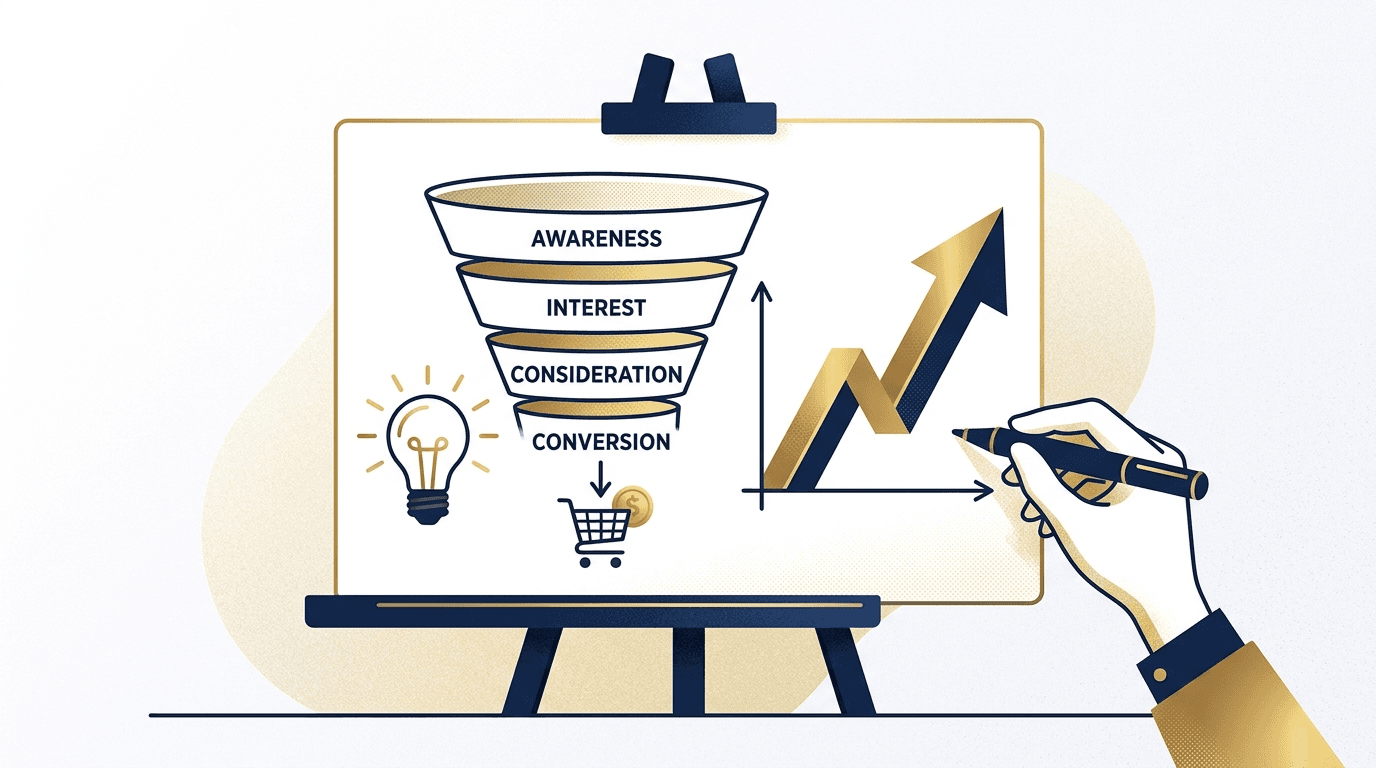
Map content to buying intent. Early-stage audiences may need problem education. Buyers comparing options need methods, costs, risks and proof. Buyers close to action need service detail, implementation expectations and a clear next step.
Plan: create the strategic blueprint
The plan should define a primary asset and its distribution derivatives. For example, one detailed guide could support:
A search-focused article addressing the core query
An email explaining one important finding
A LinkedIn document summarising the method
Short videos answering individual objections
A sales handout for active opportunities
A remarketing message linked to a relevant offer
Choose channels because the intended audience uses them in the relevant context. Do not select a platform merely because a competitor posts there.
Set a conversion objective for each asset. A high-intent service page may seek an enquiry. An educational guide may lead to a related case study or email subscription. A sales enablement document may help an existing opportunity progress rather than create a new session in analytics.
Your plan also needs ownership. Identify who approves the asset, adapts it, publishes each version, responds to engagement and reports performance. Distribution often fails between teams because everyone assumes someone else owns the next step.
Perform: execute and improve
Accountable execution means publishing, checking delivery, monitoring audience quality and making controlled changes. Use campaign parameters where appropriate, configure meaningful conversion events and connect marketing sources with CRM outcomes where systems allow.
Google's documentation explains how Search Console's Performance report shows queries, pages, countries and devices associated with Google Search visibility. Google Analytics traffic-source dimensions can help classify how users arrived. Neither platform should be treated as a complete revenue system, but together with CRM and advertising data they provide useful diagnostic evidence.
Review weak and strong signals separately. A low click-through rate may indicate a poor title or audience mismatch. Strong traffic with weak enquiries may indicate an intent, offer or landing-page issue. Qualified leads that become poor-fit opportunities may expose a Profile problem rather than a distribution problem.
How repurposing expands distribution without duplicating content
Repurposing means adapting one strong idea to suit different channels, formats and stages of the buying process. It is not copying identical text everywhere. Effective repurposing preserves the central insight while changing the framing, depth, creative treatment and next action to suit how each audience consumes information.
A detailed guide might contain several independent questions. Each can become a short video, email, sales response or social post. A webinar can become a transcript, article, presentation, objection library and follow-up sequence. A case study can become industry-specific proof within proposals and landing pages.
The original brief should identify these derivatives before production. That allows interviews, data collection and creative work to capture everything required at once. Retrofitting formats later often creates gaps, such as a video recorded without clean excerpts or an article lacking diagrams that sales teams could use.
Avoid mechanical repurposing. Automatically cutting an article into generic posts usually creates fragments without enough context to be useful. Every derivative still needs a clear audience, useful point and next step.
Also distinguish repurposing from updating. Repurposing changes the format or context. Updating keeps an existing asset accurate. Both belong in the distribution system, particularly for evergreen content that continues attracting qualified demand.
How should you schedule content distribution?
Content distribution should follow audience timing and asset relevance, not a single universal posting frequency. Plan an initial release, several contextually different follow-ups and an evergreen cycle for durable content. Pause or update material when facts, offers or regulations change, but continue distributing proven assets while they remain useful.
A practical schedule has three layers:
Launch distribution
Coordinate the website publication, subscriber email, relevant social versions and sales-team notification. If earned outreach is appropriate, prepare tailored pitches rather than sending a generic announcement.
Follow-up distribution
Revisit individual insights, objections or examples. A reader who ignored the original link may respond to a specific question later. Varying the angle provides another useful entry point without pretending the underlying asset is new.
Evergreen distribution
Continue circulating durable resources when buyer needs recur. Tax deadlines, recruitment cycles, seasonal purchasing and contract renewals may create predictable relevance. Other topics can be triggered by sales questions, search trends or policy changes.
Timing also depends on channel mechanics. Search visibility develops differently from email delivery or paid media. Evaluate each channel on an appropriate decision window. Do not stop a search programme because it lacks immediate reach, or leave a paid campaign unchecked because the broader content plan is quarterly.
How do you measure content distribution performance?
Measure content distribution from exposure through to commercial outcomes. Channel metrics help diagnose delivery, but qualified leads, opportunity progression, sales and tracked revenue determine value. Create a measurement chain linking the asset, channel, audience action and CRM result, then improve only the weakest verified part of that chain.
Use four measurement levels:
Distribution health
Check whether content was indexed, delivered, viewed or rejected. Relevant metrics include search impressions, email delivery, video views and paid reach. These indicate availability, not business success.
Engagement quality
Assess whether intended users consumed or interacted with the asset. Useful evidence may include engaged sessions, scroll behaviour, video completion, replies, downloads and return visits. Interpret these signals according to format and intent.
Conversion performance
Track meaningful actions such as calls, forms, bookings, trials, purchases and sales-qualified enquiries. Confirm that event definitions reflect real business value. A form submission should not automatically be treated as a qualified lead.
Commercial contribution
Connect distribution with opportunity quality, sales, revenue and acquisition cost where data permits. Attribution will never be perfect. Buyers can encounter several assets, use multiple devices and complete parts of the journey offline. Use attribution as decision support, not as false certainty.
Rebuild tracking before increasing budget. In a packaging ecommerce account, 3P Digital connected advertising spend with sales revenue, restructured campaigns around buying intent and added 85 negative keywords across May and June. From January to June 2026, $14,028 in spend produced $132,746 in tracked revenue, a 9.5x return. Every month exceeded 7x, with the best reaching 12.4x. These are 3P Digital account results.
That example concerns paid media, but the principle applies across content distribution. Straight from the account data, better measurement and traffic control can be more valuable than adding more activity.
Common content distribution mistakes
Most distribution failures come from unclear buyers, indiscriminate channel selection, identical cross-posting, weak conversion paths or incomplete tracking. These problems are often misdiagnosed as insufficient volume. Producing more content then increases workload without correcting why existing assets fail to reach, persuade or convert commercially relevant audiences.
Starting with channels
Choosing TikTok, LinkedIn or email before defining the buyer reverses the strategy. Channel execution should begin only after the business profile, buyer intent, market advantage and measurement foundations are clear.
Treating every channel equally
A channel can be valuable without deserving equal effort. Assign primary and supporting roles. Search may capture demand, email may nurture it, and social content may reinforce credibility.
Copying the same post everywhere
Cross-posting ignores user expectations. Adapt the opening, format, evidence and call to action. The central idea can remain consistent while its delivery changes.
Measuring reach without lead quality
Large impression totals can hide poor audience relevance. Review which assets and sources create qualified conversations, not only visits or reactions.
Ignoring consent and claims
Australian distribution must account for legal obligations. The Australian Communications and Media Authority explains that commercial electronic messages generally require consent, sender identification and a working unsubscribe facility. The ACCC also requires advertising claims to be accurate and not misleading. Content governance should cover both before publication.
Abandoning assets too quickly
A strong evergreen article should not disappear after launch week. Update it, reference it in relevant sales discussions and redistribute useful components when the buyer context returns.
Distribution debt is a more expensive problem than content scarcity
My contrarian view is that many businesses should temporarily reduce content production. They already possess useful articles, presentations, webinars, sales answers and customer evidence. Their real constraint is distribution debt: valuable material lacks defined audiences, conversion paths, repurposed formats, repeat schedules and reliable measurement.
Before commissioning another batch of articles, audit what already exists. Give each asset one of four decisions:
Distribute: The asset is accurate, useful and ready for a defined audience.
Adapt: The insight is valuable, but the format or framing does not suit the target channel.
Update: The asset addresses real demand but contains stale claims, examples or offers.
Retire: The content is inaccurate, duplicated, off-positioning or unsupported by demand.
Then score the retained assets qualitatively against buyer intent, commercial relevance, evidence strength and channel adaptability. Prioritise assets that answer high-intent questions and can support several points in the buying journey.
This approach changes content planning. Instead of asking, "What should we publish next?", ask, "Which buyer decision are we trying to influence, and what is the minimum useful content system required?"
A national recruitment firm we worked with had been paying heavily for job boards to attract candidate and client enquiries. We replaced much of that dependence with an SEO and content strategy designed around consistent inbound demand. It generated 574 leads at a 63.5% lower cost per lead, according to 3P Digital's client data.
The result came from matching content with existing demand and making it discoverable, not from chasing publishing volume. That is the commercial standard a distribution strategy should meet.
A practical content distribution workflow
A repeatable workflow turns strategy into routine execution without removing judgement. Begin with a buyer question, create one authoritative source asset, prepare channel-specific derivatives, release them in sequence and collect commercial feedback. Feed search, sales and customer evidence into the next distribution cycle rather than relying on an isolated content calendar.
Use this workflow for each priority topic:
Confirm demand: Review sales questions, search terms, customer interviews and account data.
Define the decision: Identify what the buyer should understand or do after consuming the content.
Create the source asset: Produce the most complete and defensible version of the idea.
Prepare derivatives: Adapt the insight for selected channels before launch.
Set conversion paths: Match calls to action with buyer readiness.
Distribute in sequence: Coordinate launch, follow-up and evergreen activity.
Collect feedback: Record search queries, replies, objections, lead quality and sales outcomes.
Improve the system: Update the asset, message, audience or channel based on evidence.
Keep governance proportionate. A small business may manage this in one planning document. A larger team may require approval stages, asset libraries, naming conventions and CRM integration. The principle remains the same: every distribution action needs an owner, audience, purpose and measurable next step.
Frequently asked questions about content distribution strategy
A content distribution strategy should be detailed enough to guide channel selection, repurposing, timing and measurement without becoming an inflexible publishing document. The questions below address the practical decisions business owners and marketing managers commonly face when building or correcting their approach.
What are the main types of content distribution?
The main types are owned, earned and paid distribution. Owned distribution uses assets you control, such as your website and email list. Earned distribution comes through third-party mentions or sharing. Paid distribution purchases targeted reach through advertising, sponsorships or syndication.
How many distribution channels should a business use?
There is no universal number. Use the smallest channel mix that reliably reaches buyers across discovery, evaluation and action. Most SMEs benefit from one primary demand channel supported by selected nurturing and credibility channels. Add channels only when ownership, suitable content and measurement capacity are available.
How often should content be redistributed?
Redistribute content while it remains accurate, relevant and useful to the intended audience. Use different angles rather than repeating an identical post. Timing should reflect buying cycles, seasonal demand, channel behaviour and performance evidence instead of an arbitrary universal frequency.
What is the difference between content distribution and content promotion?
Content promotion is the active amplification of an asset, often through social posts, outreach or advertising. Content distribution is broader. It includes organic discovery, direct delivery, repurposing, sales enablement, timing, channel selection and measurement across the asset's useful life.
Which metrics should a content distribution strategy track?
Track delivery and engagement for diagnosis, then qualified leads, opportunity progression, sales and revenue for commercial assessment. Useful metrics depend on the channel and objective. Avoid treating impressions, clicks or downloads as success unless they are connected to meaningful buyer behaviour.
Should paid distribution start immediately?
Only when the audience, message, conversion path and tracking are clear. Paid activity can test or accelerate distribution, but it also magnifies weak assumptions. Keep budget controlled until account data confirms relevant traffic and commercially useful outcomes.
Build distribution around commercial outcomes
A useful content distribution strategy makes every asset accountable to a buyer, channel, decision and measurable outcome. If your content calendar is busy but qualified demand remains inconsistent, return to Profile → Plan → Perform. Fix positioning and measurement before adding channels, production volume or advertising budget.
3P Digital helps Australian businesses connect content, SEO, paid media, analytics and conversion activity to leads and revenue. For a direct review of your current distribution system, go to /contact. No pitch. 15 minutes.
References
These references support the platform, compliance and measurement guidance in this article. They are primary resources from Google and Australian regulators. Businesses should review the full guidance and obtain professional advice where legal, privacy or regulatory obligations depend on their specific circumstances.
Australian Communications and Media Authority: Avoid sending spam
Australian Competition and Consumer Commission: Advertising and selling guide
Office of the Australian Information Commissioner: Australian Privacy Principles
FAQ_SCHEMA_JSON