Customer Journey Mapping for Australian Businesses: How to Optimise Every Touchpoint for More Conversions
Most Australian businesses track clicks and conversions. They know their cost-per-click, their form completion rate, and which ad creative is performing this month. What they don't know is what actually happens between first touch and sale — and that blind spot is quietly costing them revenue every single day.
Customer journey mapping closes that gap. It forces you to see your business the way your customer experiences it: as a sequence of moments, decisions, and interactions that either build confidence or erode it. When you map those moments properly, patterns emerge. You find the touchpoints where prospects go cold, the pages where trust breaks down, the follow-up sequences that arrive too late, and the messaging that speaks to the wrong stage of intent entirely.
This guide is built for Australian SMEs and marketing managers who are tired of optimising individual channels in isolation. I'll walk you through the five stages of the modern Australian buyer journey, how to build an accurate journey map using real data, and how we use this process at 3P Digital to find conversion opportunities that paid media budgets and SEO improvements alone will never uncover.
Key Takeaways
Customer journey mapping gives you a complete picture of how prospects move from awareness to purchase, something a standard funnel diagram cannot do.
Every Australian SME should map at least five journey stages: Awareness, Consideration, Decision, Onboarding, and Retention.
GA4, Hotjar, and your CRM together provide the data foundation for an accurate journey map — no guesswork required.
Drop-off points are almost always predictable once you layer behavioural data onto your map, and most can be fixed without increasing ad spend.
B2B and B2C journeys differ significantly in length, decision-making complexity, and the number of stakeholders involved.
Updating your journey map quarterly keeps it aligned with changing buyer behaviour, especially in a market as dynamic as Australia's in 2026.
Summary Table: Customer Journey Stages at a Glance
Journey Stage | Common Touchpoints | Key Metrics | Optimisation Actions |
Awareness | Google Search, Meta Ads, LinkedIn, Referrals, PR | Impressions, CPM, New Users, Brand Search Volume | Refine audience targeting, improve ad creative relevance, invest in thought leadership content |
Consideration | Website landing pages, Blog content, Case studies, Email nurture, Retargeting | Pages per session, Time on site, Return visit rate, Email open rate | Improve content depth, add social proof, tighten retargeting sequences |
Decision | Pricing pages, Contact forms, Phone calls, Live chat, Proposal/quote requests | Form completion rate, Call conversion rate, Cost per lead | Reduce friction on forms, strengthen CTAs, add risk-reversal copy (guarantees, testimonials) |
Onboarding | Welcome emails, Onboarding calls, Setup docs, Portal access | Onboarding completion rate, Time to first value, Support ticket volume | Automate key steps, set clear expectations upfront, assign a dedicated contact |
Retention | Review requests, Upsell emails, Account check-ins, Loyalty programs | NPS, Churn rate, Repeat purchase rate, LTV | Personalise communication, reward loyalty, surface new product/service relevance |
What Is Customer Journey Mapping (And Why Most Businesses Get It Wrong)
A customer journey map is a visual or documented representation of every interaction a prospect or customer has with your business, from the moment they first become aware of you through to long-term retention. It captures what they're doing, thinking, and feeling at each stage, along with the channels and touchpoints involved.
The reason most businesses get it wrong comes down to two problems.
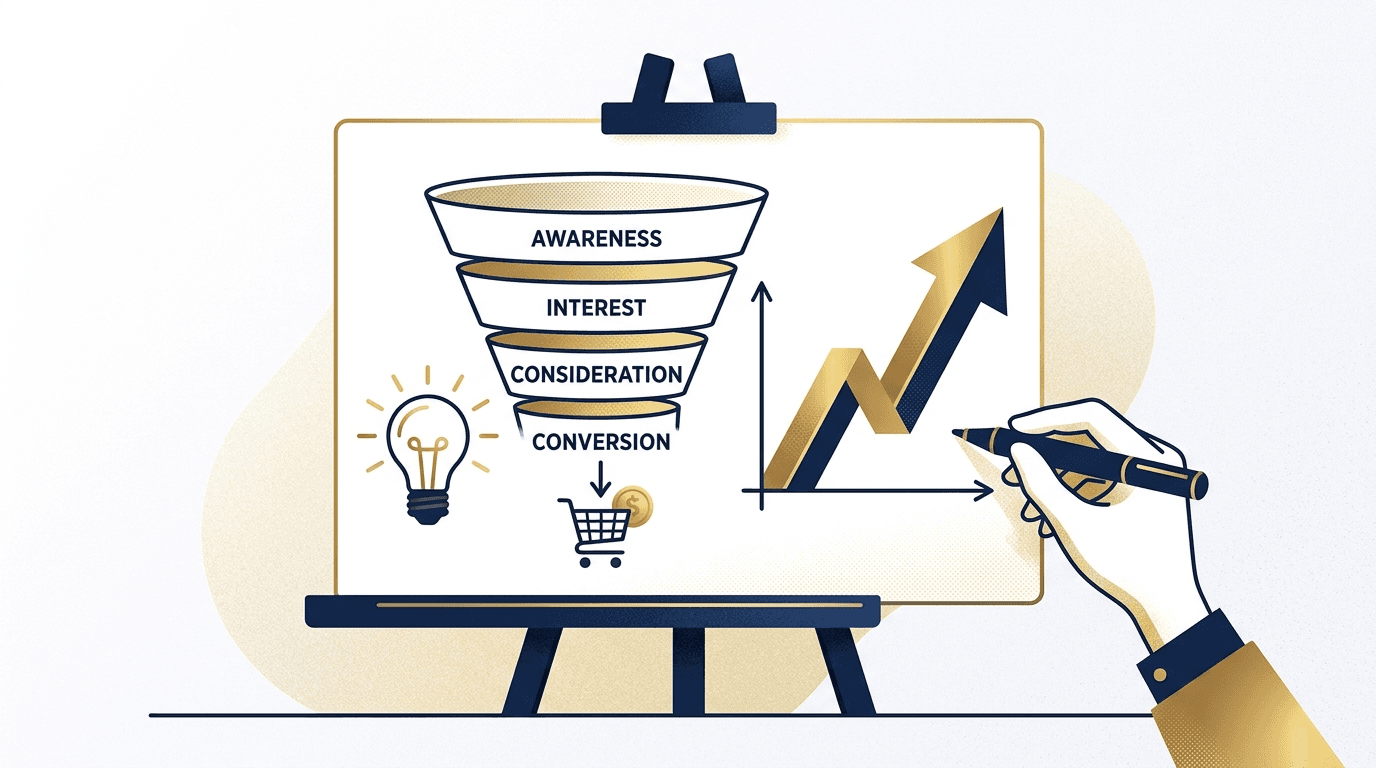
Problem one: they confuse a funnel with a journey map. A funnel is a linear, business-centric model. It describes how leads flow through your system. A journey map is customer-centric. It describes how your customer actually experiences your business, including all the messy, non-linear moments that funnels ignore. A prospect might see your Google ad, land on your website, leave without converting, research your competitors for two weeks, watch your LinkedIn video, get a referral from a colleague, and then call you directly. A funnel tells you they came from organic social. A journey map tells you the full story.
Problem two: they build journey maps from assumptions rather than data. Teams get into a room, draw boxes on a whiteboard, and decide what they think the customer experience looks like. The result is a polished document that bears little resemblance to what actually happens. Real journey mapping requires real data: GA4 behaviour flows, CRM pipeline data, heat maps, session recordings, customer interviews, and support ticket analysis.
When journey mapping is done properly, it becomes one of the most commercially powerful tools in your marketing toolkit. McKinsey research has consistently shown that companies excelling at customer journey management achieve revenue growth of 10 to 15 percent above their peers, alongside reductions in cost-to-serve. For Australian businesses competing in increasingly crowded digital markets in 2026, those margins matter.
The 5 Stages of the Modern Australian Buyer Journey
The Australian buyer journey has evolved considerably. Mobile-first research, the dominance of Google Search in purchase decisions, rising scepticism toward advertising, and the expectation of instant digital responsiveness have all reshaped how prospects move from problem-awareness to purchase.
Here are the five stages every Australian SME should map.
Stage 1: Awareness
This is the moment your prospect first encounters a problem they need to solve, and potentially discovers you as a solution. In Australia, Think with Google data shows that 83 percent of Australians research products and services online before purchasing, with the majority using Google Search as their starting point. That means your visibility at this stage is directly tied to your SEO positioning, your Google Ads presence, and the quality of your word-of-mouth and referral network.
Awareness touchpoints include: organic search listings, paid search and social ads, LinkedIn posts, podcast mentions, PR coverage, and referrals from existing clients. Key metrics here are impressions, branded search volume growth, new user acquisition, and CPM on paid channels.
Stage 2: Consideration
Once a prospect is aware of their problem and aware of you, they begin evaluating options. This stage is where most Australian SMEs haemorrhage potential customers without realising it. The prospect is visiting your website, reading your content, comparing you to competitors, checking your Google reviews, and deciding whether you're credible.
Consideration touchpoints include: your service pages, blog content, case studies, video content, retargeting ads, and email sequences triggered by initial site visits. The metrics that matter here are time on site, pages per session, return visit rate, and email engagement rates.
This is also where content quality becomes a direct commercial lever. Thin, generic service pages don't convert in 2026. Prospects in professional services, recruitment, mortgage broking, and fitness are reading deeply before they act.
Stage 3: Decision
The decision stage is where intent crystallises into action. The prospect has decided they want to solve their problem and they're deciding whether you're the right partner. This stage involves your pricing page, your contact form, your phone number, and your sales process.
Friction at this stage is catastrophic. A contact form with eight mandatory fields, a pricing page with no clear next step, or a phone line that goes to voicemail will kill conversions that your upstream marketing budget worked hard to generate. Our conversion optimisation services are specifically designed to identify and remove this friction.
Stage 4: Onboarding
Most businesses treat the sale as the finish line. In a healthy customer journey, it's the starting line for the relationship. Poor onboarding is one of the leading drivers of early churn across Australian service businesses. If a new client signs up and then hears nothing for five days, their confidence in their decision begins to erode immediately.
Onboarding touchpoints include: welcome emails, kick-off call invitations, portal access, progress updates, and expectation-setting documentation. Metrics here include onboarding completion rate, time to first value delivery, and early support ticket volume.
Stage 5: Retention and Advocacy
Retaining an existing customer costs significantly less than acquiring a new one. Bain and Company research estimates that increasing customer retention rates by just five percent increases profits by 25 to 95 percent. For Australian service businesses where customer lifetime value is high, this stage of the journey deserves as much attention as acquisition.
Retention touchpoints include: regular check-in calls, performance reporting, review requests, loyalty rewards, upsell or cross-sell emails, and referral incentive programmes. Key metrics include NPS score, churn rate, repeat engagement, and lifetime value.
How to Build Your First Journey Map: Step-by-Step Process
Building a useful journey map is a structured process. Here's how we approach it at 3P Digital.
Step 1: Define Your Ideal Customer Profile
A journey map is only as accurate as the customer it represents. Before mapping anything, you need a clearly defined Ideal Customer Profile (ICP) for each segment you serve. This means going beyond demographics to understand motivations, objections, decision-making triggers, and information sources. If you're serving multiple distinct segments, build a separate journey map for each one.
Step 2: List Every Touchpoint
Document every interaction point where your customer could potentially encounter your business. Include digital and offline touchpoints. Include intentional touchpoints (your ads, your emails) and unintentional ones (a Google review, a LinkedIn comment, a mention in an industry forum). This list will almost always be longer than you expect.
Step 3: Pull Your Data
Now layer real data onto each touchpoint. Use GA4 to analyse user flows, identify exit pages, and understand session behaviour. Use Hotjar for heat maps and session recordings to see how users actually interact with your pages. Pull your CRM pipeline data to see where leads stall or go cold. Review your email platform for open, click, and unsubscribe patterns. Our analytics services help clients set up and interpret exactly this kind of multi-source data picture.
This step is where assumptions get replaced by evidence.
Step 4: Identify Emotional States at Each Stage
This is the element most businesses skip, and it's the element that makes journey maps commercially actionable. At each stage, document what your prospect is feeling. Are they frustrated? Excited? Sceptical? Confused? Overwhelmed? The emotional state drives the communication strategy. A prospect in the consideration stage who is anxious about making the wrong decision needs risk-reversal messaging and social proof. A prospect in the awareness stage who is excited about a new opportunity needs inspirational, possibility-focused content.
Step 5: Map the Gaps and Friction Points
With touchpoints documented and data overlaid, the gaps become visible. Where are prospects dropping off? Where are they stalling? Where does the handoff between marketing and sales break down? Where does the customer experience a jarring inconsistency between your brand promise and the reality of dealing with your business?
Document every gap as a specific problem with a specific proposed solution.
Step 6: Prioritise and Act
Not all gaps are equal. Prioritise fixes based on the volume of prospects affected and the potential revenue impact of resolving the issue. A broken contact form at the decision stage is a higher priority than a slightly low email open rate in an awareness nurture sequence.
Tools and Data Sources for Accurate Journey Mapping (GA4, Hotjar, CRM)
The quality of your journey map is directly tied to the quality of your data. Here's the tool stack we recommend for Australian SMEs.
GA4 (Google Analytics 4)
GA4 is the non-negotiable foundation. Its event-based tracking model gives you a far more granular picture of user behaviour than Universal Analytics ever did. For journey mapping, the most useful GA4 reports include the User Journey report (which shows common paths through your site), the Funnel Exploration report (which lets you define a conversion funnel and see exactly where users exit), and the Path Exploration report (which reveals what users do after visiting key pages).
Set up custom events to track meaningful micro-conversions: video plays, scroll depth on key pages, file downloads, outbound clicks to your phone number or email. These micro-conversions tell the story of engagement between sessions. Understanding data attribution across these touchpoints is also critical — our guide on data-driven attribution models digs into this in detail.
Hotjar
Hotjar adds the qualitative layer that GA4 can't provide. Heat maps show you where users click, scroll, and ignore on your key pages. Session recordings let you watch real users navigate your site in real time — there is no faster way to identify friction than watching a prospect try and fail to find your contact information, or watching them abandon a form after hitting the phone number field.
Hotjar's survey tools also let you ask on-page questions to visitors. A simple "What stopped you from getting in touch today?" exit survey on your contact page can surface objections you never knew existed.
CRM Data
Your CRM is where the offline journey lives. Pipeline stage data shows you where leads stall. Lead source data (when tracked accurately) shows you which acquisition channels produce the highest-quality prospects. Deal velocity data shows you how long the average decision cycle takes for different segments, which informs your nurture sequence timing.
If your CRM data is messy or incomplete, that's a problem to fix before building your journey map — not something to work around.
Customer Interviews
No tool replaces a direct conversation with a real customer. Speak to your best clients and ask them to walk you through how they found you, what nearly stopped them from proceeding, and what made them confident in their decision. Even five interviews will surface patterns that months of analytics data might not reveal.
Identifying and Fixing Drop-Off Points That Kill Conversions
Once your journey map is built with real data, the drop-off points become hard to ignore. Here are the most common ones we encounter with Australian clients, and how to address them.
The Consideration-to-Decision Gap
This is the most common and most costly drop-off point. A prospect has visited your website, consumed some content, and demonstrated clear intent — but they haven't contacted you. The cause is almost always one of three things: insufficient trust signals, unclear next steps, or a mismatch between the content they've consumed and the offer being presented.
Fix it by: adding specific, named testimonials and case studies to your service pages; making your primary CTA contextually relevant to the content being consumed; and using retargeting ads that speak directly to the consideration stage rather than repeating the same awareness-level messaging.
The Form Abandonment Problem
In our experience working with Australian service businesses, contact form completion rates average between two and five percent of landing page visitors. Improving that rate by even one percentage point can double the volume of leads without changing your ad spend. Common culprits include too many required fields, unclear value exchange (what does the prospect get for filling in the form?), and lack of trust signals adjacent to the form itself.
The Post-Lead Stall
This drop-off happens after a lead is submitted but before a sale is closed. A prospect fills in your form on a Tuesday afternoon and doesn't hear from you until Thursday morning. By then, they've spoken to a competitor. Response time benchmarks in Australia have tightened dramatically in 2026. Prospects expect a response within hours, not days. Automating an immediate acknowledgement email with a clear outline of next steps is a minimum-viable solution. Our lead quality diagnostics guide explores the full picture of lead-to-close attrition in detail.
The Onboarding Drop-Off
Clients who churn in the first 90 days almost always do so because of an onboarding experience that didn't meet expectations. Map this stage explicitly and automate the key milestones: day one welcome, day three check-in, first week progress update, first month review. The goal is to manufacture moments of confidence early in the relationship.
How 3P Digital Uses Journey Mapping Inside the 3P Framework
At 3P Digital, customer journey mapping isn't a standalone exercise. It's embedded into the Profile stage of our proprietary 3P Framework (Profile, Plan, Perform).
During the Profile stage, we build a complete picture of who the client's ideal customer is, how they behave, what they need at each stage of their journey, and where the current experience is falling short. This informs everything that follows: the media strategy, the content architecture, the conversion optimisation priorities, and the analytics setup.
The reason we do it this way is simple. A business that spends money on SEO and paid media without understanding their customer journey is filling a leaky bucket. The Profile stage finds the leaks before the spend begins.
By the time we reach the Perform stage, we have a journey map that's grounded in real data, aligned with the ICP, and connected directly to revenue metrics. That's what allows us to optimise with precision rather than guesswork.
You can explore the full range of our work across industries on our case studies page.
Case Study 1: Recruitment Client — Mapping the Candidate-Employer Journey
One of our recruitment clients came to us with a familiar problem: high traffic, reasonable lead volume, but poor lead quality. Sales were spending too much time on candidates and employers who were never going to convert, and not enough time on their best-fit opportunities.
When we mapped their journey, we found two separate journeys running in parallel — one for employers seeking talent, and one for candidates seeking placement — with almost no differentiation in how the business communicated to each segment. The website treated both audiences identically. The follow-up sequences were the same. The intake forms asked neither group the right qualifying questions.
We rebuilt their journey map for each audience separately, identified the touchpoints where intent signals were strongest, and redesigned their intake process to surface high-intent behaviours early. On the employer side, we added a specific qualifying question about hiring timeline and team size. On the candidate side, we added availability and role-type questions that automatically segmented responses.
The result was a 34 percent improvement in lead quality scores within 90 days, measured by the percentage of leads that progressed past initial consultation. Importantly, total lead volume stayed consistent — we hadn't reduced demand, we'd improved its relevance.
This kind of outcome is only possible when you understand the full journey, not just the traffic sources.
Case Study 2: Professional Services Client — Touchpoint Audit Drives Conversion Lift
A professional services firm in financial planning came to us with declining enquiry rates despite stable traffic. Their Google Ads were performing well by platform metrics: strong click-through rates, reasonable CPCs. But conversions were dropping.
We ran a full touchpoint audit. Using GA4 funnel exploration, we found that 68 percent of users who visited the contact page were exiting without completing the form. Hotjar session recordings revealed why: the form asked for full financial details upfront, before any relationship had been established. The implicit message to the prospect was "give us sensitive information about your finances before we've earned your trust."
We recommended a two-step approach: replace the comprehensive form with a low-friction initial enquiry (name, email, one qualifying question), with detailed information collected during the follow-up call. We also added a short testimonial video adjacent to the new form from an existing client speaking specifically about the value of the initial consultation.
Within six weeks, contact form completions increased by 52 percent. The quality of those enquiries, measured by appointment-to-proposal rate, was higher than before because prospects who did submit felt more confident in the process.
One client summed it up well: "Before working with 3P Digital, we had data everywhere but no clear picture of what was actually happening with our customers. The journey mapping exercise gave us more strategic clarity in two weeks than we'd had in two years."
FAQs
What is customer journey mapping?
Customer journey mapping is the process of documenting every interaction a customer has with your business, from first awareness through to purchase and beyond. It captures what the customer is doing, thinking, and feeling at each stage, and maps the channels and touchpoints involved. Unlike a sales funnel, which is business-centric and linear, a journey map is customer-centric and reflects the non-linear, multi-channel reality of how modern Australian buyers actually behave.
How long does it take to build a customer journey map?
A basic journey map can be completed in one to two weeks if you have your data sources set up and accessible. A comprehensive map, including customer interviews, multi-segment analysis, and full data integration across GA4, Hotjar, and your CRM, typically takes three to four weeks. The time investment pays back quickly: most clients identify at least one significant conversion leak within the first map review that they can address immediately.
What tools do I need for customer journey mapping?
The core toolkit for Australian SMEs is GA4 for web behaviour data, Hotjar for visual behaviour data and on-page surveys, and your CRM for pipeline and lead-source data. Beyond these, customer interview recordings, email platform analytics, and social media engagement data add valuable layers. You don't need enterprise software to build a useful journey map — you need to use the tools you already have more deliberately.
How does journey mapping improve conversion rates?
Journey mapping improves conversion rates by identifying specific points where prospects disengage and diagnosing the reason. Once you know where drop-off is occurring and why, you can make targeted interventions: reducing form friction at the decision stage, strengthening trust signals at the consideration stage, improving onboarding communication to reduce early churn. These interventions are far more precise than broad channel optimisation because they address the actual reason prospects aren't converting, not just the volume of prospects entering the funnel.
Should I map B2B and B2C journeys differently?
Yes, significantly. B2B journeys in Australia are typically longer, involve multiple stakeholders, and require more educational content and social proof at the consideration stage. Decision cycles can stretch from weeks to months, and the nurture sequence needs to sustain engagement across that entire period. B2C journeys tend to be shorter and more emotionally driven, with higher sensitivity to friction at the decision stage and stronger responses to urgency and risk-reversal messaging. If your business serves both segments, build separate journey maps for each.
How often should I update my customer journey map?
At minimum, review and update your journey map quarterly. Australian consumer behaviour and digital platform dynamics shift quickly enough that a map built in January may be meaningfully outdated by July. Specific triggers that should prompt an immediate review include: a significant change in your product or service offering, a major platform algorithm update (Google, Meta, LinkedIn), a meaningful shift in your conversion metrics, or entry of a significant new competitor into your market.
What is the difference between a funnel and a journey map?
A funnel is a business-centric, linear model that describes how leads move through your sales system. It measures volume at each stage and shows where attrition occurs. A journey map is customer-centric and non-linear. It captures the actual lived experience of your customer, including the moments of doubt, the competitor research, the peer recommendations, and the emotional states that influence decisions. Funnels are useful for measuring conversion performance. Journey maps are essential for understanding and improving it.
How does 3P Digital approach customer journey mapping?
We embed journey mapping in the Profile stage of our 3P Framework (Profile, Plan, Perform). Before recommending any media spend, content strategy, or conversion optimisation tactic, we build a data-grounded picture of how the client's ideal customers actually behave, where their current experience falls short, and where the highest-value optimisation opportunities lie. This ensures that every tactical recommendation is connected to a real customer need at a specific stage of the journey, rather than being driven by channel-level metrics in isolation.
Ready to Map Your Customer Journey?
If you're running Google Ads, investing in SEO, or managing a content programme without a clear picture of your customer journey, you're optimising the parts while ignoring the whole. The businesses that win in 2026 are the ones who understand their customer's full experience and engineer every touchpoint to build confidence and reduce friction.
Contact 3P Digital today for a free strategy session. We'll show you where your customer journey is leaking revenue and what it would take to fix it.
References
Google Analytics 4 Help Centre (Google) — Official documentation for GA4 funnel exploration, path exploration, and user journey reporting. Used as the primary reference for GA4-based journey analysis recommendations in this article.
Hotjar Journey Mapping Guide (Hotjar) — Hotjar's published resource on using heat maps, session recordings, and surveys to build qualitative customer journey data. Referenced for the qualitative tooling recommendations in the Tools section.
The CEO Guide to Customer Experience (McKinsey and Company) — McKinsey's research-backed analysis of how companies that excel at customer journey management outperform peers by 10 to 15 percent in revenue growth. Cited in the opening section on the commercial value of journey mapping.
Forrester Customer Experience Index (Forrester Research) — Annual benchmarking research on customer experience quality and its correlation with revenue, retention, and loyalty outcomes. Used to support claims about the financial impact of CX optimisation.
Think with Google Australia — Consumer Insights (Google Australia) — Google's published research on Australian online consumer behaviour, including the statistic that 83 percent of Australians research online before purchasing. Cited in the Awareness stage section.