Enterprise SEO Services in Australia: How to Scale Organic Growth Across Large Sites and Generate Qualified Leads in 2026
Most enterprise SEO programs fail before they deliver a single qualified lead. Not because the tactics are wrong, but because the sequencing is. Organisations with thousands of pages, multiple stakeholders, and complex site architectures throw execution at the problem before they have profiled their ideal customer, audited what is actually broken, or built a roadmap tied to revenue outcomes. The result is months of activity, impressive-looking reports, and no discernible improvement in cost per acquisition.
Here is the position I hold that most agencies will not say out loud: activity without accountability is not marketing, it is cost. Renting attention through paid channels creates dependency and rising costs with no compounding return. Every dollar you put into Google Ads or job boards stops working the moment the budget stops. Organic authority, built systematically through technical excellence, content architecture, and earned trust, keeps working after the campaign spend ends. Across more than 250 clients, the average organic traffic increase we have achieved is 312%. Our best recorded return on SEO investment is 46:1, delivered to an automotive dealership group over 12 months. Those numbers exist because of a sequenced approach, not a busy one.
This guide is written for marketing managers, heads of growth, and business owners at mid-market and larger Australian organisations. If you are managing a complex website with hundreds or thousands of pages, competing in a crowded vertical, and tired of agencies that deliver impressions instead of enquiries, this is the framework you need. I will walk through what makes enterprise SEO genuinely different, why most programs stall, and how to sequence Profile, Plan, and Perform to turn organic search into your lowest-cost, highest-return lead generation channel.
Key Takeaways
Enterprise SEO is not standard SEO at higher volume. It requires governance, technical architecture management, and stakeholder coordination that small-site tactics cannot address.
Most enterprise SEO programs fail because of bad sequencing: execution without a clear profile of the ideal customer and a plan tied to measurable outcomes produces noise, not growth.
The 3P Framework (Profile, Plan, Perform) sequences every engagement so that technical audits, content architecture, and reporting all connect back to qualified leads and lower acquisition cost.
Compounding organic growth is a strategic asset. Unlike paid media, it keeps delivering after spend stops, reducing cost per acquisition over time rather than increasing it.
The right enterprise SEO partner will report on qualified leads, revenue influence, and cost per acquisition, not impressions, keyword rankings, or session volume alone.
Evaluating a partner on retention rate and verified ROI evidence matters. Our 98% client retention rate exists because we only succeed when clients succeed.
Enterprise SEO vs Standard SEO: Key Differences at a Glance
Dimension | Standard SEO | Enterprise SEO |
Site scale | Tens to hundreds of pages | Hundreds to tens of thousands of pages |
Stakeholders | One or two decision-makers | Cross-functional teams, legal, IT, brand |
Technical complexity | Moderate, manageable manually | Crawl budget, log file analysis, faceted navigation, hreflang, JS rendering |
Content governance | Ad hoc publishing | Structured workflows, template governance, editorial calendars |
Reporting | Traffic and rankings | Revenue influence, cost per acquisition, lead quality by channel |
Risk | Individual page issues | Site-wide template errors, index bloat, canonical misconfiguration at scale |
Timeline to compounding returns | 3-6 months typically | 6-18 months depending on domain authority and technical debt |
Primary agency skill required | On-page and link building | Systems thinking, technical depth, stakeholder management |
What Makes Enterprise SEO Different
Enterprise SEO is not standard SEO applied to a bigger website. The discipline is categorically different, and agencies that treat it as a volume exercise consistently underdeliver. Here is what changes at scale.
Site Architecture and Crawl Efficiency
When a site reaches thousands of pages, Google cannot and will not crawl every one of them with equal frequency. Crawl budget becomes a genuine constraint. If your most important commercial pages sit four or five clicks from the homepage, Googlebot may visit them infrequently, which means ranking signals accumulate slowly and indexing lags behind publishing. For large Australian e-commerce sites, national service providers, and multi-location businesses, this is not theoretical. It is the difference between a new service page ranking within weeks or sitting dormant for six months.
Managing crawl efficiency at enterprise scale requires log file analysis to see what Googlebot is actually doing on the site, not just what you assume it is doing. It requires auditing internal link depth, eliminating orphaned pages, resolving canonicalisation issues across paginated content, and ensuring that faceted navigation does not create millions of near-duplicate URLs that dilute crawl budget across low-value combinations.
Stakeholder Complexity and Governance
A sole operator can implement an SEO recommendation in an afternoon. An enterprise marketing team must route the same recommendation through IT for development resourcing, legal for compliance review, brand for tone alignment, and leadership for prioritisation against competing projects. In practice, this means that a technical fix identified in January may not land in production until March or April, by which time a new audit has surfaced three more issues.
Enterprise SEO programs that succeed build governance into the engagement from day one. That means working within the client's sprint cycles, producing implementation-ready briefs rather than abstract recommendations, and maintaining a prioritised backlog that allows the internal team to action items in order of revenue impact rather than effort.
Template-Level Impact
One of the most powerful and most dangerous characteristics of enterprise sites is template dependency. A single change to a page template can propagate across thousands of URLs simultaneously. A misconfigured canonical tag on a product listing template can de-index an entire category. A title tag pattern that is too generic across service pages can cannibalise rankings across the entire domain.
This cuts both ways. When you identify a high-impact optimisation at the template level, a single implementation can improve thousands of pages at once. That leverage is why enterprise SEO, done well, can produce results that dwarf what any individual page optimisation achieves. But it requires the technical confidence to know when to act at scale and when a site-wide change needs controlled rollout and monitoring.
Competitive Intensity
Large Australian organisations typically compete in mature, high-intent verticals: financial services, property, recruitment, retail, automotive, health, and professional services. These are categories where domain authority gaps between established players and newer entrants are significant, where Google's YMYL (Your Money or Your Life) quality standards apply, and where thin or duplicate content is penalised aggressively. Competing at this level requires a fundamentally different content and authority strategy to what works in lower-competition niches.
Why Enterprise SEO Programs Fail: Bad Sequencing and the Accountability Gap
I have seen the same failure pattern repeat across organisations of every size. A business invests in an enterprise SEO engagement, the agency delivers keyword research, some on-page optimisations, a few blog articles per month, and a monthly report showing traffic trending upward. Twelve months later, the marketing manager cannot draw a line between that traffic and a single qualified lead. The program is cancelled. The next agency inherits a site with a year of content that was not mapped to buyer intent and a technical debt backlog that nobody actioned.
This is not a resource problem. It is a sequencing problem.
Execution Without Strategy Is Noise
The 3P Framework exists because of exactly this failure mode. Profile, then Plan, then Perform. In that order, without exception. When organisations skip straight to Perform, which is where most agencies start because it is where deliverables are visible, they are producing activity without direction. Publishing content without first profiling the ideal customer and mapping their search behaviour means writing for keywords rather than for buyers. Optimising pages without first auditing the technical foundation means decorating a leaking structure.
I worked with a national recruitment firm that had been relying on expensive job board spend to source both candidates and clients. Costs were rising and there was no compounding return on the investment. When we profiled their ideal candidate and client search behaviour properly, we found the organic opportunity they were missing was substantial. We replaced the job board dependency with an integrated SEO and content strategy designed to attract high-intent searches. The result was 574 leads generated at 63.5% lower cost per lead compared to their previous channels. The difference was not better tactics applied to the same strategy. It was a different sequencing: profile the buyer first, then plan the content and architecture around that profile, then execute.
Vanity Metrics and the Accountability Gap
Most agencies hide behind vanity metrics because their incentives are not aligned with client outcomes. If an agency is paid for deliverables, impressions, and rankings, that is what they will optimise for. Organic sessions can increase 40% while lead volume stays flat, because the traffic being generated is informational rather than commercial. Keyword rankings can improve significantly for terms that buyers never actually search. Dashboards can look healthy while revenue-generating pages stagnate.
Our standard at 3P Digital is different. Every engagement is anchored to qualified enquiries, lower cost per acquisition, and compounding organic growth that connects to revenue. That is what our pay-per-performance model is built around. We only succeed when clients succeed. That alignment changes everything about how a program is designed and reported.
Profile: The Foundation That Everything Else Depends On
Profiling is the work that most agencies skip or do superficially. It is also the work that determines whether the entire program delivers qualified leads or just traffic.
Technical Auditing at Enterprise Scale
A genuine enterprise technical audit is not a Semrush crawl exported to a spreadsheet. It involves log file analysis to understand actual crawler behaviour, not assumed behaviour. It involves identifying crawl budget leakage through paginated content, faceted navigation, and session parameter URLs. It maps canonical architecture across the full URL set, identifies index bloat from near-duplicate or thin pages, and assesses Core Web Vitals performance at template level rather than page by page.
For large Australian sites, this audit also needs to account for local SEO architecture. If you are a national business with service areas across multiple cities and suburbs, how your location pages are structured, how they interlink, and whether they carry unique content or are thin templates determines whether you rank in Brisbane, Melbourne, and Perth simultaneously or not at all. Our technical SEO services address this at the architecture level, not the individual page level.
Ideal Customer Profile Development
Content without a buyer map is guesswork. ICP development in an enterprise context means going beyond demographic segmentation to map the specific search behaviours, intent signals, and decision-stage triggers of the buyers who generate the highest-value conversions. For a professional services firm, that might mean separating the research-stage queries of a marketing manager from the decision-stage queries of a CFO and building content architecture that intercepts both at the right moment.
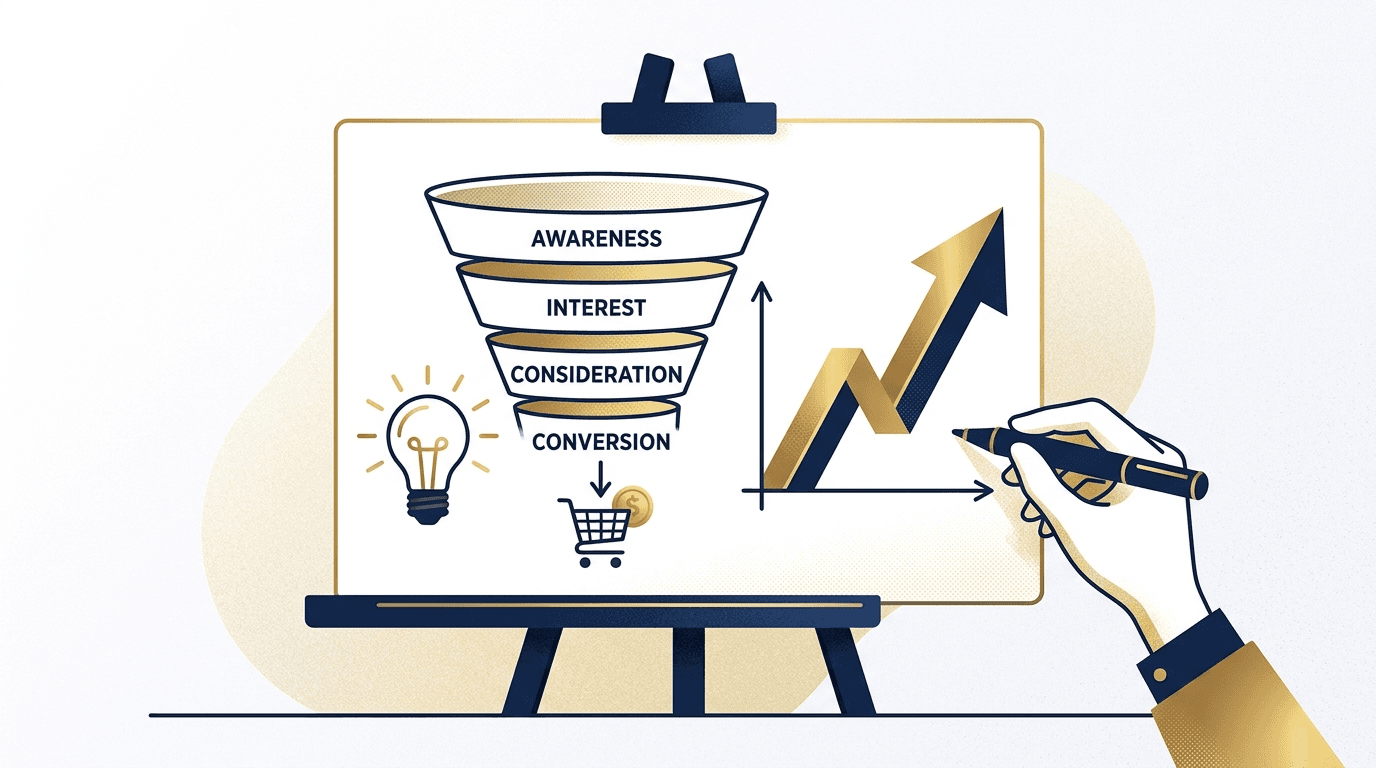
I think about this as the difference between chasing leads and having them come to you. When you have profiled your ideal customer properly and mapped their search journey across awareness, consideration, and decision stages, your content architecture becomes a systematic lead generation engine rather than a content calendar.
Page Cluster Prioritisation
Not all pages on an enterprise site deserve equal attention. Prioritisation at the profile stage means identifying which page clusters drive qualified commercial intent, which templates are underperforming relative to their traffic potential, and which keyword sets have the highest probability of generating revenue-attributable conversions. This prioritisation determines where the Plan phase concentrates effort and budget.
For a Queensland mortgage broker we worked with, this profiling exercise revealed that their primary keyword was generating almost no organic leads because they were stuck on page three. The real opportunity was not obscure long-tail keywords. It was dominating the primary term with a combination of on-page optimisation, local authority building, and high-intent content aligned to buyer search behaviour across the mortgage funnel. Within six months, they were in position one for their primary keyword and generating 40 or more qualified leads per month from organic search alone, a 312% increase in organic traffic.
Plan: Building a Roadmap Around Measurable Outcomes
Once the Profile phase establishes what the site needs and who it is serving, the Plan phase translates those findings into a sequenced roadmap with measurable milestones and clear accountability. This is where enterprise SEO programs separate from generic digital marketing retainers.
Internal Linking at Scale
Internal linking is one of the highest-leverage SEO activities available at enterprise scale and one of the most neglected. A well-structured internal linking architecture passes PageRank efficiently to commercial pages, surfaces relevant content to users at the right decision stage, and signals topical authority to Google across related content clusters.
At enterprise scale, internal linking cannot be managed page by page. It requires a systematic approach: identifying pillar pages, mapping supporting content clusters, auditing existing anchor text for diversity and relevance, and building linking patterns into content templates so that new pages are automatically connected to the right cluster on publication. This kind of structural work is invisible in a monthly deliverables report, which is one reason most agencies skip it. The impact on rankings and lead quality is not.
Content Governance and Editorial Architecture
Large sites often have years of accumulated content published without a coherent strategy. The Plan phase must address this directly. Content governance means establishing which pages should be consolidated, which should be retired, which should be expanded, and which need to be created from scratch. It means building an editorial calendar that is sequenced by commercial priority rather than publication convenience.
For enterprise organisations, content governance also means establishing clear ownership. Who approves new content? What is the review process for updating existing pages? How does the legal or compliance team interact with the publishing workflow without creating six-week delays on every update? Building this into the Plan means the Perform phase does not stall on organisational friction.
Connecting the Roadmap to Revenue Outcomes
A plan without revenue milestones is a content calendar, not a strategy. Every roadmap we build at 3P Digital maps deliverables to projected impact: which cluster improvements are expected to drive qualified leads, over what timeframe, at what conversion rate assumption. This is not guesswork. It is grounded in the profile data, the keyword volume, and the competitive gap analysis from the audit.
This approach means that at any point in the engagement, the marketing manager can see not just what has been done but what the work is projected to deliver and whether actual results are tracking to plan. That is measurable growth, not vanity metrics.
Perform: Execution, Reporting, and Tracing Organic Growth to Revenue
Execution without the Profile and Plan foundations is where most enterprise SEO budgets disappear without traceable returns. With them, the Perform phase becomes a compounding engine.
Technical Implementation Cadence
Enterprise technical SEO is not a one-time project. Core Web Vitals degrade as sites are updated. New content creates new crawl issues. Site migrations introduce canonical errors. JavaScript framework updates affect rendering. Sustaining technical health at enterprise scale requires a continuous monitoring and remediation cadence, not a point-in-time audit.
Our technical SEO services include log file monitoring, crawl health dashboards, and a prioritised remediation backlog that is maintained throughout the engagement. This ensures that technical debt does not silently accumulate while content work is consuming the team's attention.
Content Production and Optimisation
Content at enterprise scale is not about volume. It is about commercial precision. High-intent service page optimisation means that each page is built around a specific buyer intent signal, contains the depth and specificity that Google's quality raters look for in YMYL categories, and is structured to convert the visitor who lands on it rather than simply attract them.
For our SEO services, this means every piece of content produced in the Perform phase traces back to a keyword cluster identified in the Profile phase and a priority level set in the Plan phase. There is no content for content's sake.
We are also building AI search optimisation into enterprise content frameworks as part of the Perform phase in 2026. Google's AI Overviews and other generative search interfaces are changing which content surfaces for high-intent queries. Structuring content for AI search optimisation is no longer optional for enterprise organisations competing for top-of-results visibility.
Reporting That Connects to Revenue
Our reporting framework for enterprise clients does not lead with organic sessions or keyword ranking tables. It leads with qualified leads generated from organic search, revenue influenced by organic touchpoints, cost per acquisition from organic versus paid channels, and the trend in those figures over time.
The compounding argument becomes visible in this reporting over 12 to 18 months. As organic authority builds, cost per acquisition from organic search falls while paid media cost per acquisition typically rises due to auction competition. The crossover point, where organic is generating more qualified leads at lower cost than paid, is the moment the organisation owns its lead generation rather than renting it.
Our analytics and data practice is built specifically to surface this crossover for enterprise clients, connecting Google Analytics 4, CRM data, and Search Console into a unified view of organic contribution to pipeline.
The Compounding Advantage Over Paid Media
I want to be direct about this because it is the argument that changes how enterprise organisations think about SEO investment. Paid media, including Google Ads, job boards, and display networks, operates on a rental model. The moment spend stops, traffic stops. Over time in competitive verticals, cost per click rises as more advertisers compete for the same inventory. The organisation becomes dependent on continuous spend increases to maintain lead volume.
Organic authority operates differently. A well-optimised page that earns topical authority and links does not stop ranking when you stop paying. The asset appreciates over time rather than depreciating. The recruitment firm case I mentioned earlier illustrates this precisely. By replacing job board spend with an organic SEO and content strategy, they generated leads at 63.5% lower cost and created an asset the business owns rather than a tap that stops the moment the invoice is not paid.
The automotive dealership group that achieved a 46:1 return on their SEO investment did so over 12 months of sustained compounding. Month one results were modest. By month 12, the organic channel was generating service and parts enquiries at a fraction of the cost their paid campaigns had required. That is the nature of compounding organic growth: the returns are back-weighted, which is why organisations that abandon enterprise SEO programs at the nine-month mark consistently miss the inflection point.
How to Evaluate an Enterprise SEO Partner in Australia
Choosing an enterprise SEO partner is a meaningful decision. The wrong choice costs twelve months of budget and an opportunity cost that is hard to recover. Here is what to demand in the evaluation process.
Reporting Transparency and Revenue Attribution
Any enterprise SEO agency worth engaging must be able to show you, at the initial briefing stage, how they connect organic search activity to qualified leads and revenue outcomes. If the proposal leads with keyword rankings and domain authority scores without a clear path to cost per acquisition and lead volume, that is the methodology you will be managed against for the duration of the engagement. Ask explicitly: how will you report on qualified leads, not just traffic? What is the attribution model for organic touchpoints in the conversion path?
In major Australian cities like Sydney and Melbourne, the enterprise SEO market is crowded. Our guides to identifying the best SEO agencies in Sydney and Melbourne include evaluation criteria that go beyond case study cherry-picking to verified retention rates and ROI evidence.
ROI Evidence and Client Retention
Ask for verified ROI evidence from clients in comparable industries, at comparable site scale, in the Australian market. Australian search behaviour, competitive landscapes, and Google algorithm weightings are distinct from the US and UK contexts. Case studies from those markets do not validate capability in Australia.
Our 98% client retention rate across more than 250 clients is the metric I am most proud of at 3P Digital, because it reflects a simple truth: clients who see measurable results stay. Agencies that lead with retention rates are making a claim about outcome consistency, not just service quality. Ask any prospective agency for their retention figure and ask them to explain the methodology behind it.
Technical Depth and Tooling
Enterprise SEO requires a different technology stack to small-site SEO. Screaming Frog at scale, log file analysis tools such as Botify or Oncrawl, JavaScript rendering validation, Search Console API integration for bulk data analysis, and CRM-connected attribution reporting are baseline requirements. Ask specifically how the agency manages crawl budget analysis, how they handle JavaScript-heavy sites, and what their process is for catching template-level errors before they propagate at scale.
Strategic Sequencing, Not Deliverable Volume
The clearest signal that an agency understands enterprise SEO is whether their proposal is sequenced around outcomes or around deliverables. A proposal that lists monthly content pieces, technical recommendations, and link building targets without a clear Profile phase, a Plan tied to commercial milestones, and a reporting framework built on revenue attribution is a deliverables contract, not a strategic engagement. The 3P Framework is the sequencing answer to this problem.
The 3P Digital Difference: Profile, Plan, Perform
Every enterprise SEO engagement at 3P Digital begins with the same question: what does a qualified lead look like for this organisation, and what is the search behaviour of the buyer who generates it? Everything that follows, the technical audit, the content architecture, the internal linking strategy, the reporting framework, is designed to answer that question with a measurable, traceable result.
Our pay-per-performance model is not a marketing statement. It is a structural commitment to the fact that we only succeed when clients succeed. That alignment removes the incentive to deliver activity without outcomes and focuses every engagement on the metrics that matter: qualified leads, lower acquisition cost, and compounding organic growth.
For Australian enterprise organisations that are ready to move from renting attention to owning organic authority, the 3P Framework provides the sequencing that makes that shift measurable and sustainable.
If you are managing a complex website and need to understand your enterprise SEO opportunity, the starting point is a strategy session built around your specific profile. We will map the technical baseline, identify the highest-priority page clusters, and build a roadmap tied to revenue outcomes, not activity reports.
Book a strategy session with 3P Digital and receive a profile-led roadmap using the 3P Framework, tied to measurable revenue outcomes for your organisation.
Frequently Asked Questions
What is enterprise SEO and how does it differ from standard SEO?
Enterprise SEO refers to search engine optimisation applied to large, complex websites, typically those with hundreds to tens of thousands of pages, multiple stakeholders, and significant technical architecture requirements. The key differences from standard SEO are site scale, technical complexity (crawl budget management, faceted navigation, JavaScript rendering), the need for content governance across large page sets, and the requirement for multi-stakeholder management across IT, legal, brand, and marketing teams. Tactics that work for a ten-page service site do not scale to an enterprise domain without fundamental structural and governance changes.
How long does enterprise SEO take to show results?
For most enterprise organisations in competitive Australian verticals, meaningful organic lead generation improvements begin to appear between six and twelve months into a well-sequenced program. Full compounding returns, where organic is outperforming paid media on cost per acquisition, typically manifest between twelve and eighteen months. The timeline depends on the technical debt inherited at engagement start, the competitive gap in domain authority, and the speed at which technical recommendations can be implemented through internal development cycles. Organisations that abandon programs before the twelve-month mark consistently miss the compounding inflection point.
What does an enterprise SEO audit include?
A genuine enterprise SEO audit covers technical architecture (crawl budget analysis, log file analysis, canonicalisation, index health, Core Web Vitals at template level), content architecture (page cluster mapping, keyword cannibalisation, thin or duplicate content identification, intent alignment), internal linking structure, site speed and rendering performance, local SEO architecture for multi-location businesses, and competitive gap analysis in target keyword clusters. It should also include an ideal customer profile review to ensure that the technical and content findings are prioritised by commercial impact rather than technical severity alone.
How do you measure ROI from enterprise SEO?
ROI from enterprise SEO is measured by connecting organic search conversions to revenue outcomes through CRM-integrated attribution. The primary metrics are qualified leads generated from organic search, revenue influenced by organic touchpoints in the conversion path, cost per acquisition from organic compared to paid channels, and the trend in those figures over time. Organic sessions, keyword rankings, and domain authority are useful diagnostic signals but are not ROI measures. If an agency reports primarily on those metrics, the engagement is not being managed against revenue outcomes.
Why do large Australian organisations need a locally-experienced enterprise SEO agency?
Australian search behaviour, competitive landscapes, and regulatory contexts differ materially from the US and UK markets where much enterprise SEO methodology is developed. Google's Australian index, local search signals for suburb-level targeting, ACCC compliance considerations for claims made in content, and the specific competitive dynamics of verticals like financial services, recruitment, and property in Australia all require local expertise. Case studies from overseas markets do not validate the capability to compete effectively in Australian SERPs.
How does enterprise SEO integrate with paid media?
Enterprise SEO and paid media should be planned together rather than in silos. In the short term, paid media fills the lead gap while organic authority is being built. In the medium term, SEO data (which keywords convert, which content attracts high-intent buyers) improves paid media targeting and Quality Scores. In the long term, compounding organic growth reduces dependence on paid media spend, lowering blended cost per acquisition across the full acquisition mix. The goal is not to replace paid media overnight but to build an organic asset that reduces the organisation's dependency on rented attention over time.
What is the 3P Framework and how does it apply to enterprise SEO?
The 3P Framework is 3P Digital's proprietary engagement sequencing model: Profile, then Plan, then Perform. In an enterprise SEO context, Profile means auditing the technical baseline, developing the ideal customer profile, and mapping high-priority page clusters to commercial intent. Plan means building a sequenced roadmap tied to revenue milestones, internal linking architecture, and content governance. Perform means executing against that plan with continuous technical monitoring, precision content production, and reporting that connects organic activity to qualified leads and cost per acquisition. The framework exists because execution without the first two phases produces activity without traceable outcomes.
How do we get started with an enterprise SEO program at 3P Digital?
The starting point is a strategy session focused on your specific site and commercial objectives. We will review your current technical baseline, map your highest-priority keyword clusters against your ideal customer profile, and outline the Profile, Plan, Perform sequencing for your engagement. From that session, you receive a profile-led roadmap tied to measurable revenue outcomes. You can book a session through our website at 3pdigital.com.au/contact.
References
Australian Bureau of Statistics (ABS), Business Conditions and Sentiments Survey, 2026, ABS quarterly survey data on Australian business investment in digital channels, used to contextualise enterprise marketing spend patterns in the Australian market.
Google Search Central Documentation, Crawl Budget Management, 2026, Google's official guidance on how Googlebot allocates crawl resources across large sites, including recommendations for reducing crawl waste on enterprise domains with faceted navigation and paginated content.
Google Search Quality Evaluator Guidelines, 2026 edition, Google's published framework for assessing content quality under E-E-A-T (Experience, Expertise, Authoritativeness, Trustworthiness) principles, particularly relevant for YMYL categories including financial services, health, and legal content common in Australian enterprise sectors.
ACCC Digital Platform Services Inquiry, 2026 update, Australian Competition and Consumer Commission inquiry reports on the digital advertising market in Australia, providing context on the rising cost of paid media inventory and structural dynamics of the Australian search advertising market.
3P Digital Internal Client Data, 2026, Aggregated performance data across 250-plus client engagements, including average organic traffic increase of 312%, best recorded SEO ROI of 46:1 (automotive dealership, 12-month campaign), and 98% client retention rate. Used for all first-party statistics cited in this article.
Semrush State of Search Report, Australia, 2026, Annual analysis of Australian SERP volatility, keyword competition trends, and organic click-through rate benchmarks by industry vertical, referenced for competitive intensity context in high-value Australian search categories.