Google Ads for B2B Lead Generation in Australia: How to Structure Campaigns That Actually Deliver Qualified Leads in 2026
Most B2B Google Ads accounts waste 40-60% of their budget on clicks that were never going to convert. Not because the keywords are wrong. Not because the ads are poorly written. Because the entire campaign structure is borrowed from B2C playbooks that assume a short buying cycle, a single decision-maker, and an immediate conversion event. B2B buying is none of those things.
I've audited hundreds of Google Ads accounts across Australian B2B companies, from professional services firms in Brisbane to national recruitment businesses and SaaS providers. The same problems appear in almost every one: generic keyword targeting that attracts researchers and students, landing pages designed for product sales rather than lead capture, and conversion tracking that only measures form fills rather than the downstream pipeline events that actually matter. The result is an account that looks active but performs poorly. Plenty of clicks, minimal qualified leads, and a growing sense that Google Ads "doesn't work for B2B."
It does work. But it requires a fundamentally different approach. This guide covers everything a B2B business in Australia needs to build, structure, and optimise Google Ads campaigns that generate measurable pipeline in 2026, from campaign architecture and keyword frameworks to offline conversion tracking, bidding strategy, and how to tie spend directly to revenue.
Key Takeaways
B2B Google Ads campaigns require separate structures for search, remarketing, and competitor targeting. A single campaign blending all three is almost always underperforming.
Negative keyword management is the single highest-leverage lever for improving lead quality in B2B. Most accounts review negative keywords monthly at best. They should be reviewed weekly in the first three months.
Offline conversion tracking via CRM integration with Google Ads and GA4 is not optional for serious B2B lead gen. Without it, you are optimising toward form fills, not pipeline.
Average B2B cost per lead (CPL) in Australia ranges from $50 to $250 depending on industry, deal size, and buying cycle length. Professional services and enterprise software skew toward the higher end.
Strategic clarity before execution is what separates profitable B2B campaigns from expensive ones. Knowing your ideal customer profile (ICP), their search behaviour, and their conversion triggers is the foundation everything else is built on.
Budget precision beats budget volume. Tighter targeting, thorough negative keyword lists, and conversion-focused landing pages consistently outperform higher spend with loose targeting.
Summary Table: B2B Google Ads Campaign Types at a Glance
Campaign Type | Recommended Budget Split | Expected CPL Range (AUD) | Conversion Window | Primary Goal |
Search (High Intent) | 50-60% | $80-$250 | 7-30 days | Direct lead capture |
Search (Mid Intent / Research) | 10-15% | $120-$400 | 30-90 days | Top-funnel entry, retargeting seed |
Competitor Targeting | 10-15% | $100-$300 | 14-45 days | Steal market share, brand-aware traffic |
Remarketing (Display / Search) | 15-20% | $40-$120 | 30-90 days | Re-engage warm audiences |
Performance Max (Selective Use) | 0-10% | Variable | Variable | Scale after signal maturity |
Why B2B Google Ads Fails With a B2C Approach
The core problem is structural misalignment. B2C campaigns are designed around a single buyer, a short consideration phase, and an immediate conversion event, usually a purchase. B2B is the opposite: multiple stakeholders, consideration cycles that can run three to twelve months, and conversion events that happen off-platform entirely.
When you apply B2C structures to B2B, you end up with campaigns optimised for volume rather than quality. Google's Smart Bidding algorithms are powerful, but they need the right signal to optimise toward. If your conversion event is a form submission, the algorithm will find people who fill out forms. That sounds logical until you realise that population includes students doing research, job seekers, competitors checking your pricing, and consultants gathering market intelligence. None of those people are buying.
The fix is not to abandon Google Ads. The fix is to give the algorithm better signals and build the account structure around B2B buyer behaviour rather than against it.
The B2B Buying Cycle Changes Everything
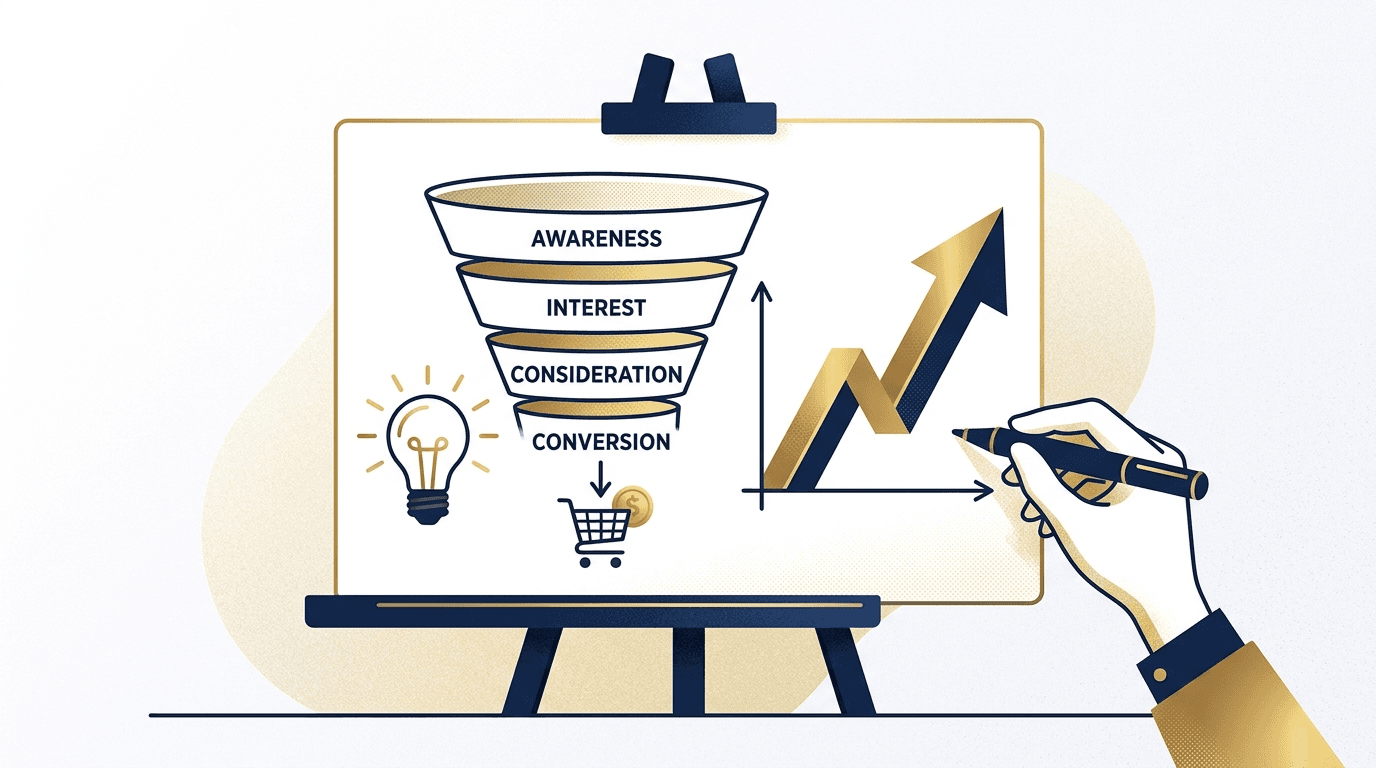
A B2B prospect searching for "HR software for medium business Australia" is probably three to six months away from signing a contract. They need to evaluate vendors, build an internal business case, get budget approved, and involve procurement. The journey from first click to closed deal routinely involves five to ten touchpoints across search, content, and direct sales contact.
This means your Google Ads account needs to serve multiple stages of that journey simultaneously. A high-intent search campaign captures prospects who are ready to shortlist. A mid-intent content campaign reaches researchers who are still defining requirements. Remarketing campaigns re-engage everyone who has already visited but hasn't converted yet. Each layer has a different message, a different landing page, and a different success metric.
Running one catch-all campaign with a single bid strategy and a homepage landing page is not a B2B Google Ads strategy. It's a B2C campaign with B2B keywords bolted on, and it will underperform accordingly.
Wasted Spend in B2B Accounts: What the Data Shows
WordStream's B2B PPC benchmarks consistently show that B2B campaigns carry higher average CPCs than B2C equivalents, ranging from $3 to $15+ per click in competitive Australian markets like professional services, software, and recruitment. At those prices, every irrelevant click is expensive. A campaign generating 500 clicks per month with 40% irrelevant traffic is burning $600 to $3,000 per month on zero-return activity, before you even account for the opportunity cost of showing your ads to the wrong people.
The accounts I audit that are wasting the most tend to share three characteristics: they're running broad match keywords without adequate negative keyword lists, they have a single destination URL for all ad traffic, and they're measuring conversions at the form fill level only. Fixing those three things alone typically cuts wasted spend by 30-40% within 60 days.
Campaign Structure for B2B Google Ads in Australia
The right structure is the foundation. Every optimisation decision flows from it. Here's how I recommend building a B2B Google Ads account from scratch or restructuring an existing one.
Layer 1: High-Intent Search Campaigns
High-intent search campaigns target keywords that indicate an active buying decision. These are your commercial keywords: terms that include words like "provider," "agency," "software," "solution," "pricing," "quote," "cost," "hire," and location modifiers like "Australia," "Melbourne," "Sydney," or specific state references.
Examples for a professional services firm might include:
"business advisory services Brisbane"
"tax consulting firm Melbourne"
"CFO services for SME Australia"
"outsourced accounting firm pricing"
These campaigns should carry 50-60% of your total budget. They are where your most ready-to-convert prospects are searching, and where your cost per lead will be most directly tied to revenue.
Use phrase match and exact match keyword types here. Broad match in high-intent campaigns is a budget drain in B2B unless you have extensive negative keyword lists and robust conversion signal maturity.
Layer 2: Mid-Intent Research Campaigns
Mid-intent campaigns target prospects who are defining their problem or exploring solutions, but aren't yet shortlisting vendors. Keywords here tend to be more informational: "how to choose HR software," "what does a CFO service cost," "benefits of outsourced payroll."
The goal of these campaigns is not an immediate lead. The goal is to get the prospect into your ecosystem, typically via a content offer, a guide download, or a webinar registration, so you can retarget them later. Allocate 10-15% of budget here.
Landing pages for mid-intent traffic should offer something of value in exchange for contact details. A guide, a checklist, or a benchmark report works well. The form should be shorter than a full contact form: first name, business email, and company name is enough at this stage.
Layer 3: Competitor Targeting Campaigns
Competitor campaigns bid on branded keywords of your direct competitors. Someone searching for "[Competitor Name] pricing" or "[Competitor Name] alternative" is actively evaluating options. They already understand the category; they just haven't committed to a vendor.
These campaigns require careful ad copy. You cannot use a competitor's name in your ad text (ACCC guidelines apply, and Google's trademark policies restrict direct use in ads), but you can position your offer clearly as an alternative. "Switching is easier than you think" or "See why [industry] firms choose us" angles work well.
Expect higher CPCs on competitor keywords and slightly lower conversion rates than pure intent keywords, but the lead quality tends to be high because these are vendor-aware buyers. Allocate 10-15% of budget here.
Layer 4: Remarketing Campaigns
Remarketing is where B2B Google Ads earns its keep over the medium term. Given that most B2B buyers need multiple touchpoints before converting, remarketing lets you maintain visibility with prospects who have already shown intent by visiting your site.
Build audience segments based on behaviour:
All site visitors (last 30 days)
Visited pricing or services pages (last 30 days)
Started but did not complete a contact form
Downloaded a content offer but did not request a consultation
Visited the site more than twice in 30 days
Each segment gets different messaging. Someone who viewed your pricing page and left needs reassurance about value and ROI. Someone who downloaded a guide needs a nudge toward a consultation. Treat these as separate conversations, not one generic "come back" message.
Allocate 15-20% of budget to remarketing. Your CPL here will typically be 40-60% lower than cold search campaigns because you're talking to warm audiences.
A Note on Performance Max for B2B
Performance Max (PMax) campaigns have their place in B2B Google Ads, but that place is not in early-stage accounts. PMax requires significant conversion signal volume to perform well. In B2B, where conversion volumes are inherently lower than B2C, PMax campaigns often underperform until the account has accumulated enough offline conversion data to give the algorithm meaningful signals.
If you're running PMax, limit it to 10% of budget or less, exclude your branded terms (to avoid cannibalising existing search campaigns), and feed it offline conversion data via CRM integration. Without offline signals, PMax will optimise toward form fills and produce the same quality problems as any other poorly-signalled campaign.
Keyword Strategy: Commercial Intent Tiers and Negative Keyword Frameworks
Keyword selection in B2B Google Ads is not about volume. The highest-volume keywords in any B2B category are almost always dominated by researchers, students, and people who will never buy. Commercial intent is what matters.
The Three Tiers of B2B Keyword Intent
Tier 1: Ready to Buy These keywords include commercial modifiers that signal purchase readiness. "Hire," "pricing," "quote," "proposal," "agency," "firm," "provider," "vendor," "solution" paired with your service or product category. These are your priority.
Tier 2: Evaluating Options Keywords that include comparison or evaluation language: "best," "top," "review," "vs," "alternative," "comparison." These prospects are in vendor selection mode. Worth targeting with strong social proof and differentiation messaging.
Tier 3: Researching the Problem Informational keywords: "how to," "what is," "benefits of," "guide to." These have high volume and low commercial intent. Target selectively with content-focused landing pages and lower bids.
Building a Negative Keyword Framework
Negative keywords are the most underused lever in B2B Google Ads. The goal is to exclude every query that is unlikely to come from a genuine buyer. Here are the core negative keyword categories every B2B account should have:
Career and Job-Seeker Terms: "jobs," "career," "salary," "interview," "resume," "how to become," "qualifications for," "certificate."
Research and Academic Terms: "assignment," "essay," "study," "definition," "meaning," "wikipedia," "textbook," "free course."
Competitor Brand Terms (if not running competitor campaigns): Add competitor names as negatives to your non-competitor campaigns to prevent cannibalisation.
DIY and Hobbyist Terms: "template," "DIY," "free tool," "how to do it yourself" (depending on your service).
Geography Exclusions: If you only service specific states or territories in Australia, add irrelevant states as location-level negatives and also as keyword-level negatives to catch any geographic term appearing in queries.
Review your search terms report weekly for the first three months of a new B2B campaign. New irrelevant queries will surface constantly, especially if you're running any phrase or broad match keywords. Build your negative keyword list proactively.
Ad Copy That Qualifies Prospects Before the Click
In B2B Google Ads, a click from the wrong person costs the same as a click from the right one. The job of your ad copy is not just to generate clicks; it's to attract the right clicks and actively deter the wrong ones.
Qualification in Headlines
Include specifics that naturally filter out irrelevant audiences. "For businesses with 20+ staff" tells an individual solopreneur they're not the target. "Enterprise-grade CRM for Australian banks" communicates industry and scale simultaneously. "Starting from $2,500/month" qualifies on budget without a click ever happening.
These qualifiers will reduce your click-through rate. That's the point. A lower CTR with higher quality traffic is a better outcome than a high CTR with unqualified visitors.
Responsive Search Ads: Structure for B2B
Use responsive search ads (RSAs) with at least 10-12 headline variations and four description variations. Pin your most critical qualifying information to headline position one or two so it consistently appears. Headline position three and descriptions can rotate freely for Google's machine learning to find winning combinations.
Test these headline angles specifically for B2B:
Outcome-focused: "Cut Payroll Processing Time by 60%"
Social proof: "Trusted by 200+ Australian Manufacturers"
Specificity: "ISO-Certified Accounting Firm, Melbourne"
Qualifier: "For Teams of 10-500 Employees"
Urgency (genuine, not artificial): "Accepting New Clients from [Month]"
Ad Extensions for B2B
Every B2B search campaign should use sitelink extensions to direct traffic to specific, relevant pages: case studies, pricing, individual service pages, and your team or about page (credibility). Call extensions are essential if your sales process includes phone consultations. Lead form extensions work well for gated content offers and mid-funnel offers.
Structured snippets allow you to list specific services, industries served, or certifications. For a professional services firm, this might be: "Audit, Tax Advisory, CFO Services, Business Restructuring." These add context and filter clicks before they happen.
Landing Page Requirements for B2B Lead Generation
Sending B2B Google Ads traffic to your homepage is one of the most expensive mistakes you can make. Homepages are designed to orient visitors across all your services. Lead generation landing pages are designed to do one thing: convert a specific visitor with a specific need.
Every campaign type needs a dedicated landing page, and ideally, every major keyword theme has its own variant. Here is what every B2B landing page must include.
Above the Fold
A headline that mirrors the search intent of the keyword that triggered the ad. If someone searched "outsourced HR services Brisbane," the headline should reference outsourced HR and ideally Brisbane.
A sub-headline that states the primary outcome or benefit.
A single, clear call to action. Not three competing CTAs. One.
Trust signals: logos of clients or industries served, a certification badge, or a brief social proof statement.
Body Content
A concise explanation of what you do and who it's for. Three to five sentences maximum before you get to specifics.
Three to five key benefits phrased as outcomes, not features. "Reduce time-to-hire by 40%" outperforms "Integrated ATS platform."
One or two client results or case study snippets with specific numbers. Vague testimonials do very little. "We saved significant time" is less credible than "We reduced our monthly reporting from three days to four hours."
A secondary CTA mid-page for longer landing pages.
Form Design for B2B
Form length depends on where the prospect is in the buying cycle. For high-intent campaigns, you can ask for: first name, last name, business email, company name, phone number, and one qualifying question ("How many employees does your business have?" or "What's your current challenge?").
For mid-intent content campaigns, keep it to three fields: name, business email, company name. You can qualify further in the follow-up sequence.
Always use a business email field, not a generic email field, and consider adding a note that personal email addresses are not accepted if lead quality is a major concern. This sounds small but it filters a meaningful number of non-business enquiries.
For deeper guidance on landing page structure and conversion rate optimisation, our conversion optimisation service covers this in detail.
Conversion Tracking Setup: Offline Conversions and CRM Integration
This is where most B2B Google Ads accounts leave the most money on the table. If your conversion tracking stops at the form submission, you are flying blind. The algorithm is optimising toward form fills, many of which will never become qualified leads, and you have no visibility into which keywords, ads, or audiences are actually driving pipeline.
Offline conversion tracking solves this. It allows you to import conversion events that happen outside Google Ads, specifically in your CRM, back into the platform so the algorithm can optimise toward revenue-correlated signals rather than form fills.
Setting Up Offline Conversion Tracking
The technical process involves four steps:
Enable auto-tagging in Google Ads so every click receives a unique GCLID (Google Click Identifier).
Capture and store the GCLID in your CRM alongside each lead record. Most modern CRMs (HubSpot, Salesforce, Zoho) can do this natively or with a simple custom field and form hidden input.
Define your offline conversion events: "Lead Qualified" (MQL), "Sales Meeting Booked" (SQL), "Proposal Sent," "Deal Closed." Each one should be a distinct conversion action in Google Ads.
Upload conversion data via the Google Ads offline conversion import tool or an automated integration. HubSpot, for example, has a native Google Ads integration that can push conversion events automatically when a contact stage changes in the CRM.
Connecting GA4 to Google Ads
GA4 and Google Ads should be linked from day one. This allows you to import GA4 conversion events (session engagement, content downloads, video views) as secondary conversions in Google Ads, giving the algorithm supplementary signals without replacing your primary CRM-based conversions.
GA4 also provides attribution data across the full B2B journey. A prospect who clicks a Google Ad, reads three blog posts, and fills out a form six weeks later will show multi-touch attribution data in GA4 that a simple last-click conversion model would completely miss.
Our analytics service handles the full GA4 and Google Ads integration as part of our engagement setup, because tracking is not an optional extra. It's the foundation the entire optimisation process relies on.
Budget Allocation Across Campaign Types
Budget allocation is not a set-and-forget decision. It should shift as the account matures and as you accumulate data about which campaign types are generating the best pipeline outcomes.
Month 1-3: Foundation Phase
In the first three months, concentrate budget in high-intent search campaigns (60-70%) and remarketing (20-25%). The goal is to gather data on what converts, build your remarketing audiences, and establish a negative keyword library. Mid-intent and competitor campaigns can run on minimal budgets during this phase, primarily for data collection.
Month 3-6: Optimisation Phase
Once you have 60+ conversion events across your primary conversion actions, shift budget toward the campaign types and keyword themes producing the best MQL-to-SQL ratios. This is where offline conversion data from your CRM becomes critical. If high-intent brand-adjacent keywords are producing more SQLs than pure category keywords, shift budget accordingly.
Month 6+: Scale Phase
With mature conversion data and a refined negative keyword list, this is when it becomes appropriate to experiment with broader targeting, higher-budget competitor campaigns, and potentially Performance Max if signal volume supports it.
Minimum Viable Budgets for Australian B2B Google Ads
I'm often asked what the minimum budget is for B2B Google Ads in Australia. The honest answer is that it depends on your CPC landscape. For professional services in metro areas, minimum effective daily budgets tend to be $50-$100 per campaign to generate enough data for meaningful optimisation. For less competitive B2B categories (trade services, regional markets), $30-$50 per day per campaign can work.
Total monthly budget minimums for a meaningful B2B Google Ads program in Australia: $3,000 to $5,000 per month. Below that, the data accumulation rate is too slow to optimise effectively, and the algorithm doesn't have enough conversion signal to bid intelligently.
Bidding Strategies for Lead Quality vs Volume
Bidding strategy in B2B Google Ads should evolve alongside the account. There is no single correct approach; the right strategy depends on where you are in the data accumulation journey and what you are optimising for.
Manual CPC: The Starting Point
For new accounts or accounts with fewer than 30 conversions per month, manual CPC gives you control while the account builds conversion history. Set bids based on keyword commercial intent: higher for tier-one buyer-intent keywords, lower for mid-intent research keywords.
Manual CPC is not a long-term strategy. It is a data-gathering phase before Smart Bidding has enough signal to outperform human adjustments.
Target CPA: Optimising for Lead Volume
Once you have 30-50 conversions per month in a campaign, Target CPA (Cost Per Acquisition) bidding becomes viable. Set your target CPA based on your acceptable cost per form submission or lead event. The algorithm will adjust bids in real time to hit that target.
The risk with Target CPA in B2B is that it optimises toward your conversion event, and if your conversion event is a form fill rather than a qualified lead, you'll get volume at the expense of quality. This is why offline conversion data is so important: feed the algorithm MQL or SQL signals rather than form fill signals, and Target CPA becomes a genuinely powerful tool.
Target ROAS: For Accounts With Revenue Data
If you have offline conversion tracking set up with deal value imported back to Google Ads, Target ROAS (Return on Ad Spend) becomes viable. This tells the algorithm to prioritise high-value opportunities over volume, which is often what B2B campaigns need.
For a professional services firm where deal sizes range from $5,000 to $50,000, Target ROAS bidding can meaningfully shift budget toward the keyword and audience combinations that produce larger deals. Without revenue data feeding back into the platform, this strategy is not possible.
Maximise Conversions: Use With Caution
Maximise Conversions bidding drives volume with no regard for cost efficiency. It will spend your entire daily budget and push bids up to generate conversions. In B2B, this typically produces inflated CPCs and mixed lead quality. Use it only in initial data-gathering phases with a hard daily budget cap, and move to Target CPA as soon as conversion volume allows.
Case Study: B2B Professional Services Firm, Qualified Enquiries Up 247%
A B2B professional services firm I worked with was relying entirely on referrals and manual outreach. Inbound enquiry volume was too low and too inconsistent to support their growth targets. They had run Google Ads previously but abandoned it after three months because "it wasn't generating quality leads."
When I audited their previous Google Ads account, the structural issues were immediately apparent. All traffic was directed to the homepage. Negative keywords were essentially non-existent: the search terms report showed clicks from students, job seekers, and researchers. There was no remarketing. The single conversion action was a contact form submission with no downstream tracking.
We rebuilt the account from the ground up using the 3P Framework: starting with a thorough ICP (Ideal Customer Profile) exercise to define exactly who they needed to reach, what those buyers searched at each stage of consideration, and what they needed to hear before converting.
The rebuilt account included three high-intent search campaigns targeting specific service lines, a remarketing campaign for site visitors who had reached the services or case studies page, and offline conversion tracking connected to their CRM so we could import "consultation booked" and "proposal sent" events back into Google Ads.
Over the following twelve months, qualified inbound enquiries increased by 247%. The firm went from chasing leads to having them come to us, which was exactly the shift they needed to support their growth targets. The improvement was not driven by increased spend. It was driven by strategic clarity before execution: knowing who they were targeting, what those buyers needed to hear, and building a campaign structure that served that journey precisely.
You can read more about our approach to B2B digital marketing on our B2B digital marketing strategy page.
Case Study: Recruitment Firm, 63.5% Reduction in Cost Per Lead
A national recruitment firm was spending heavily on job boards to source both candidates and clients. Rising costs and unpredictable lead volume made planning and scaling nearly impossible. The job boards were a transactional channel with no brand building and no owned audience.
We conducted a full digital overhaul, covering SEO, paid media, and conversion rate optimisation. On the Google Ads side, the brief was clear: replace the most expensive, lowest-quality lead sources with targeted paid search that could be measured against downstream pipeline.
The keyword strategy separated candidate-facing campaigns from client-acquisition campaigns, because the two audiences search completely differently and need completely different messaging and landing pages. Negative keyword lists were built separately for each campaign type. Remarketing audiences were segmented by whether visitors had shown candidate intent or client intent, based on which page sections they had visited.
Offline conversion tracking pulled "candidate placed" and "client contract signed" events from their ATS and CRM respectively, giving us genuine pipeline signal rather than form fill data.
The outcome: 574 leads generated with a 63.5% lower cost per lead compared to their previous job board spend. That's not a marginal improvement. That's a structural shift in how the business acquires its pipeline.
If you want to see more results like this, our case studies page covers a range of industries and campaign types.
Client Perspective
"Before working with 3P Digital, our Google Ads account was generating enquiries, but we couldn't tell which ones were worth pursuing. After they restructured the campaigns and connected our CRM to the tracking, we finally had visibility into which keywords were actually contributing to closed deals. That changed how we allocated budget entirely. We're spending less and winning more."
Measuring What Matters: MQL Cost, SQL Cost, and Pipeline Contribution
The metrics most Google Ads reports lead with, impressions, clicks, CTR, average CPC, are operational indicators. They tell you whether the machine is running. They don't tell you whether the machine is creating value.
For B2B lead generation, the metrics that matter are further down the funnel.
Marketing Qualified Lead (MQL) Cost
An MQL is a lead that meets your defined qualification criteria: right company size, right industry, right budget signal, right seniority. Your CRM should have a stage or field that marks when a lead becomes an MQL. Cost per MQL is calculated as: total Google Ads spend divided by number of MQLs generated from that spend in the period.
In Australian B2B markets, acceptable cost per MQL varies significantly by deal size. For a business where average deal value is $10,000, a $300 cost per MQL is reasonable. For a business where average deal value is $100,000, a $1,500 cost per MQL can still be profitable. The benchmark that matters is the ratio between your MQL cost and your average deal value, not the absolute number.
Sales Qualified Lead (SQL) Cost
An SQL is an MQL that has been validated by your sales team as a genuine opportunity. Cost per SQL is the number that most directly correlates to revenue, because SQLs are the leads that enter your pipeline and progress toward a deal. Tracking cost per SQL requires CRM integration and offline conversion tracking. Without it, this metric simply doesn't exist in your data.
Import your SQL stage change as an offline conversion event in Google Ads. Once you have enough SQL data (typically 30+ events per campaign), you can move to Target CPA bidding at the SQL level. The algorithm will then optimise toward generating SQLs directly, not form fills.
Pipeline Contribution
Pipeline contribution is the total value of deals in your CRM that are attributed to Google Ads as a source. This is the metric that justifies ad spend at the executive level. A campaign generating $50,000 in pipeline from $5,000 in spend is producing a 10:1 pipeline ROI, which is a strong result in most B2B categories.
GA4 provides multi-touch attribution data that helps you understand Google Ads' contribution across the full buying journey, not just the last click. For B2B with long buying cycles, this attribution perspective is essential. A prospect who clicked an ad in March, engaged with three blog posts in April and May, and converted via direct visit in June will be attributed entirely to direct traffic under last-click models. Multi-touch attribution correctly distributes credit to the Google Ads touchpoint that initiated the journey.
Our paid media service is built around this full-funnel attribution model, because activity reports versus results is the central question every B2B marketing budget deserves a clear answer to.
Hero Stats: B2B Google Ads Benchmarks for Australia in 2026
To contextualise performance expectations, here are the benchmarks I use when evaluating B2B Google Ads accounts in the Australian market:
Average CPC for B2B professional services keywords in Australia: $4.50 to $14.00
Average conversion rate (form fill) for B2B landing pages: 2% to 8% (well-optimised pages reach the upper end)
Average cost per lead (form fill) for Australian B2B: $50 to $250
Average MQL-to-SQL conversion rate: 20% to 40% (varies by lead quality and sales process)
Average cost per SQL in Australian B2B: $150 to $800 depending on industry
Accounts with offline conversion tracking: fewer than 20% of B2B Google Ads accounts in Australia
Accounts using remarketing as part of a structured B2B campaign: fewer than 35%
The gap between the top and bottom performers in B2B Google Ads is almost never about budget. It's about structure, tracking, and strategic clarity. The accounts achieving results like a 247% increase in qualified enquiries are not spending twice as much. They are doing the work correctly from the foundation up.
If you want an honest assessment of where your account sits against these benchmarks, a free strategy session is the right starting point.
Google Ads vs LinkedIn Ads for Australian B2B: Which Channel Wins?
This question comes up in almost every initial B2B conversation. The honest answer is that they serve different stages of the same journey, and the right answer depends on your ICP and your buying cycle.
Google Ads captures active demand. Someone typing "outsourced CFO services Sydney" is telling you exactly what they need, right now. That intent signal is Google's advantage, and it's a significant one for B2B categories where buyers search before they buy.
LinkedIn Ads generates demand. LinkedIn allows you to reach specific job titles, company sizes, and industries with content even when those people are not actively searching. This is powerful for long-cycle B2B sales where you need to build familiarity before a prospect enters the active search phase.
For most Australian B2B businesses, Google Ads should be the primary lead generation channel and LinkedIn Ads should be a supporting demand-generation layer. The exception is highly niche B2B categories where search volume is genuinely too low to sustain a Google Ads program, in which case LinkedIn becomes the primary channel.
Running both channels with connected attribution (GA4 as the measurement layer) gives you the clearest picture of how demand generation on LinkedIn eventually converts through Google Ads search campaigns. This integrated approach is what we build in our full-funnel B2B engagements, and it consistently outperforms either channel in isolation.
Our Pay-Per-Performance Model and Why It Changes Everything
I want to be direct about how 3P Digital approaches B2B Google Ads engagements, because it's genuinely different from how most agencies operate.
Most agencies charge a flat retainer regardless of what the campaigns produce. Their reporting focuses on activity: ad spend managed, impressions delivered, clicks generated. These are real numbers, but they are not results. A campaign generating 10,000 clicks and zero qualified leads is a failing campaign, not a successful one, regardless of how professionally the monthly report is formatted.
We operate on a pay-per-performance model where our success is directly tied to client results, not activity volume. That means our incentive is always to drive measurable growth, not to protect a retainer by producing impressive-looking but commercially hollow metrics. We only succeed when you succeed.
This is why the 3P Framework starts with Profile, not execution. Before a single campaign goes live, we establish who the ideal customer is, what they search, what they need to hear, and how a conversion will be tracked back to revenue. That strategic work at the front end is what makes every dollar work harder in the execution phase.
Our 98% client retention rate reflects what happens when both parties are invested in the same outcome. Clients who achieve results like 574 additional leads, 63.5% lower cost per lead, and 247% increases in qualified enquiries don't leave. They scale.
If you're ready to stop settling for activity reports and start measuring results, get in touch with us or book a free strategy session.
FAQs
What is a realistic budget for B2B Google Ads in Australia?
The minimum effective total monthly budget for a B2B Google Ads program in Australia is $3,000 to $5,000 per month. Below that threshold, daily budgets per campaign become too low to gather conversion data at a meaningful rate, and the algorithm cannot bid intelligently without sufficient signal. For competitive B2B categories like financial services, enterprise software, and legal services, effective programs typically require $7,000 to $15,000+ per month to generate enough lead volume for meaningful optimisation. The right budget for your business depends on your average CPC landscape, your target lead volume, and your deal economics. A $200 cost per lead is unviable for a $1,000 average deal but entirely reasonable for a $50,000 one.
How long does it take to see results from B2B Google Ads?
Expect three to six months before a B2B Google Ads program reaches optimised performance. The first month is typically setup, structure, and initial data collection. Months two and three involve active negative keyword expansion, bid refinement, and landing page testing. By month four to six, with sufficient conversion data feeding back from your CRM, Smart Bidding strategies become viable and lead quality typically improves meaningfully. This timeline assumes a minimum viable budget, proper conversion tracking, and an actively managed account. Accounts that are set up and left to run without weekly management consistently underperform.
Is Google Ads or LinkedIn Ads better for B2B lead generation?
Google Ads captures active demand from buyers who are already searching for your solution. LinkedIn generates demand by reaching potential buyers before they are actively searching. For most Australian B2B businesses, Google Ads should be the primary lead generation channel because it targets buyers with demonstrated intent. LinkedIn works best as a complementary demand-generation layer that seeds your Google Ads remarketing audiences and builds brand familiarity during long buying cycles. The two channels work better together than either does in isolation, with GA4 providing the cross-channel attribution data to measure each channel's contribution to closed deals.
How do I track offline conversions from Google Ads in B2B?
Offline conversion tracking requires four steps: enabling auto-tagging in Google Ads so every click receives a GCLID (Google Click Identifier), capturing and storing that GCLID in your CRM alongside each lead record, defining offline conversion events (MQL, SQL, proposal sent, deal closed) as conversion actions in Google Ads, and importing those conversion events back to Google Ads via the offline conversion import tool or an automated CRM integration. Most modern CRMs including HubSpot, Salesforce, and Zoho support this natively or through available integrations. Once offline conversions are flowing into Google Ads, you can shift Smart Bidding from form fill optimisation to pipeline-level optimisation, which is where the biggest quality improvements tend to come from.
Does Quality Score matter for B2B Google Ads campaigns?
Quality Score matters, but its importance in B2B is often overstated relative to campaign structure and conversion tracking. Quality Score is a composite metric that reflects expected CTR, ad relevance, and landing page experience. In B2B, where qualifying language in ad copy intentionally reduces CTR, your Quality Score on some keywords will naturally be lower than in B2C campaigns. That is acceptable if the trade-off is higher lead quality. Focus on landing page experience (strong Quality Score component that is within your control) and ad relevance (match ad copy closely to keyword intent). Do not sacrifice lead quality by broadening ad copy to improve CTR, because the Quality Score improvement will be offset by a decline in MQL rate.
Does broad match work for B2B Google Ads?
Broad match can work in B2B, but only with two conditions in place: an extensive negative keyword list built before the campaign launches, and strong offline conversion data feeding the algorithm. Without both conditions, broad match in B2B produces large volumes of irrelevant queries that drain budget and lower lead quality. Google's broad match algorithm has improved significantly with machine learning, and with mature conversion signals it can find intent-matched queries you would not have identified manually. However, for accounts in the first three to six months, or accounts with fewer than 30 conversions per month, phrase match and exact match will consistently outperform broad match on lead quality metrics.
What is a good cost per lead for B2B Google Ads in Australia?
Australian B2B cost per lead benchmarks range from $50 to $250 for form fill conversions, and $150 to $800 for sales-qualified leads depending on industry and deal size. Professional services, enterprise software, and financial services sit at the higher end of these ranges due to higher CPCs and longer buying cycles. Trade services, regional businesses, and lower-competition B2B categories can achieve lower CPLs. The most important benchmark is not the absolute CPL but the ratio between your CPL and your average deal value. A $400 CPL is excellent for a business with a $50,000 average contract value. Context is everything.
Should B2B companies use Performance Max campaigns?
Performance Max (PMax) is not recommended as a primary campaign type for early-stage B2B Google Ads accounts. PMax requires significant conversion signal volume to perform well, and B2B accounts with inherently lower conversion frequencies often find that PMax underperforms dedicated search and remarketing campaigns in the first six to twelve months. Once an account has accumulated substantial offline conversion data (particularly MQL and SQL events), PMax can be introduced as a supplementary campaign at 10% or less of total budget. Always exclude branded terms from PMax to prevent cannibalisation of your branded search campaigns, and ensure it has access to offline conversion data rather than just form fill signals.
References
Google Ads Help Centre, Google LLC, Official documentation covering campaign types, Smart Bidding strategies, offline conversion import, and Quality Score components. The authoritative technical reference for Google Ads configuration and algorithm behaviour.
WordStream B2B PPC Benchmarks Report, Industry benchmarks for average CPC, CTR, conversion rates, and cost per lead across B2B categories in Australian and global markets. Published annually with category-level breakdowns for professional services, software, and financial services.
Australian Digital Advertising Report, Interactive Advertising Bureau Australia (IAB Australia), Annual industry report covering digital advertising expenditure, channel allocation trends, and performance benchmarks for Australian advertisers. Includes specific data on search advertising growth and B2B digital investment trends.
Google Ads Offline Conversion Tracking Documentation, Google LLC, Technical guide covering GCLID capture, CRM integration methods, conversion action setup, and best practices for importing offline events into Google Ads for Smart Bidding optimisation.
HubSpot State of Marketing Report, Annual global marketing benchmark report with specific data on B2B lead generation costs, MQL-to-SQL conversion rates, and the impact of CRM-integrated attribution on campaign performance measurement.