LinkedIn Ads vs Google Ads for B2B Lead Generation in Australia: Which Channel Delivers Better ROI in 2026
Most B2B marketers are not running two paid media channels well. They are running two channels poorly, splitting budget, attention, and optimisation time across platforms that require fundamentally different strategies, creative approaches, and success metrics. The result is mediocre performance on both, a CPL that looks acceptable on paper but generates pipeline that never closes, and a growing sense that paid media just does not work for B2B.
It does work. But the channel has to match the problem you are actually trying to solve.
Google Ads and LinkedIn Ads are not interchangeable. They operate on completely different demand mechanics. Google captures intent that already exists. LinkedIn creates intent among audiences who do not yet know they need what you offer. If your ICP is actively searching for your solution, Google is your first call. If your ICP does not know your category exists yet, or you need to reach a specific job title at a specific company size in a specific industry, LinkedIn is where you start. This guide will give you an honest, data-backed framework for making that decision in the Australian B2B market in 2026, including real numbers from campaigns we have run at 3P Digital.
Key Takeaways
Google Ads captures existing demand through search intent; LinkedIn Ads builds demand by targeting specific job titles, industries, and company sizes
Cost per lead varies dramatically by platform, industry, and offer type — Australian B2B benchmarks put LinkedIn CPL between $80 and $400 and Google CPL between $40 and $250 depending on sector
Lead quality from LinkedIn typically converts from MQL to SQL at a higher rate than Google, but volume is lower and upfront cost is higher
The best platform depends on your deal size, sales cycle length, ICP specificity, and whether your buyers are actively searching for your solution
Running both channels together with a sequential strategy produces better results than either channel in isolation
Attribution and measurement setup is non-negotiable — without it, you are optimising on vanity metrics and making budget decisions based on incomplete data
Platform Comparison: LinkedIn Ads vs Google Ads for Australian B2B
Factor | LinkedIn Ads | Google Ads |
Primary mechanic | Demand creation | Demand capture |
Targeting precision | Job title, seniority, industry, company size, skills | Keywords, intent signals, audience lists |
Avg. Australian B2B CPL | $120 to $400 | $60 to $200 |
Lead quality (MQL to SQL) | Higher (60 to 75%) | Moderate (30 to 55%) |
Minimum viable monthly budget | $3,000 to $5,000 | $2,000 to $4,000 |
Sales cycle fit | Long cycle, complex sale | Short to medium cycle, clear search term |
Best for ABM | Yes | Limited |
Creative requirement | High (video, thought leadership) | Moderate (ad copy, landing page) |
Time to meaningful data | 4 to 8 weeks | 2 to 4 weeks |
Best-fit scenarios | SaaS, consulting, recruitment, finance, professional services targeting specific personas | Any B2B with clear search intent, product-led solutions, local services |
How Google Ads Works for B2B Lead Generation
Search Campaigns: Capturing Active Buyers
Google Search is the most straightforward B2B paid media channel conceptually. Someone types a query. You bid to appear. If your ad is relevant and your landing page converts, you get a lead. The challenge is that the simplicity of the model hides a huge amount of complexity in execution.
For B2B, Google Search campaigns work best when your buyers are actively researching a solution and they know what to search for. Think: "HR software for small business Australia", "recruitment agency Melbourne manufacturing", or "commercial mortgage broker Brisbane". These searches have commercial intent baked in. The user is in the market. They are comparing options. If you can appear at the top of that results page with a compelling offer, you will get leads.
The problem for many B2B businesses is keyword volume. If you are selling niche enterprise software or a specialised professional service, the monthly search volume for your core keywords in Australia might be 100 to 500 searches per month. That is not enough traffic to build a reliable lead pipeline from search alone, especially at the conversion rates typical in B2B (landing page conversion rates of 2 to 5% are common).
Keyword strategy for B2B Google Ads needs to account for three layers: problem-aware searches ("how to reduce employee churn"), solution-aware searches ("employee retention software"), and brand/competitor searches ("[Competitor] alternative"). Each layer requires different ad copy, different landing pages, and different bid strategies.
Display and Remarketing Campaigns
Google Display is largely underutilised in B2B, but remarketing through Display is genuinely effective when layered on top of search. If someone has visited your pricing page or your case studies page, serving them a retargeting ad with a specific offer (free audit, case study download, consultation booking) keeps you in their consideration set during what can be a 30 to 90 day buying process.
Display prospecting for B2B cold audiences is less reliable. The targeting options (in-market audiences, custom intent audiences) are broad compared to LinkedIn, and you will burn budget on impressions that reach the wrong people. Use Display for remarketing, not for cold prospecting.
Performance Max for B2B: Proceed with Caution
Google's Performance Max campaigns have been pushed heavily by Google reps since 2023, but for B2B lead generation, they require careful management. PMax optimises for conversion volume, which sounds good until you realise that in B2B, form fills from unqualified leads look the same as form fills from genuine buyers at the conversion event level. Without strong audience signals and proper conversion value settings, PMax can optimise towards low-quality leads at the expense of the high-quality pipeline you actually need. Our recommendation: use PMax as a supplement to, not a replacement for, a well-structured search campaign, and feed it strong first-party audience signals from your CRM.
How LinkedIn Ads Works for B2B Lead Generation
Why LinkedIn Is Different
LinkedIn's fundamental advantage for B2B is targeting precision at the professional identity level. You are not targeting based on browsing behaviour or keyword inference. You are targeting based on who someone actually is at work: their job title, their seniority level, the industry they work in, the size of their company, the skills on their profile, and even the groups they belong to. For businesses with a tightly defined ICP — say, CFOs at ASX-listed companies, or HR Managers at professional services firms with 50 to 200 employees — there is no other platform that gets you in front of that exact person with this level of confidence.
You can explore our thinking on LinkedIn marketing for B2B growth in more detail, but the short version is this: LinkedIn is a demand creation channel. Your audience is not searching for you. You are interrupting them in a professional context, which means your creative and your offer need to earn their attention rather than capitalise on existing intent.
Sponsored Content and Thought Leadership Ads
Sponsored Content (single image ads, video ads, carousel ads, and document ads) running in the LinkedIn feed is the most common and often the most effective LinkedIn ad format for B2B. The key is that the content needs to provide genuine value before asking for anything. A case study, an insight-led article, a framework, a benchmark report — these outperform "Book a Demo" cold ads by a significant margin in our experience.
LinkedIn's Thought Leadership Ads, which promote posts from individual profiles rather than company pages, have shown strong performance for clients in consulting and professional services. They feel native to the feed, carry personal credibility, and generate higher engagement rates than branded company page content.
LinkedIn Lead Gen Forms
Lead Gen Forms pre-populate with the user's LinkedIn profile data and allow them to submit their details without leaving the platform. They consistently outperform external landing page campaigns in terms of raw conversion rate — form completion rates of 10 to 15% versus 2 to 5% for landing pages are typical. However, lead quality warrants attention. Because the friction is so low, you will occasionally get leads from people who clicked accidentally or were mildly curious rather than genuinely interested. Pairing Lead Gen Forms with a strong qualifying question (company size, timeline, specific challenge) significantly improves downstream quality.
InMail and Conversation Ads
Sponsored InMail (now Message Ads) and Conversation Ads deliver directly to LinkedIn inboxes. They work well for high-value ABM plays where you are reaching a specific list of named accounts, but they have high CPM rates and audience fatigue sets in quickly. Use them sparingly and with highly personalised, relevant messaging rather than generic outreach.
Cost Comparison: Australian B2B Benchmarks in 2026
Cost benchmarks are where most B2B marketers get into trouble because they compare headline CPCs without accounting for lead quality, sales cycle fit, or downstream conversion rates. A $40 lead from Google that converts to a closed deal at 2% is worse than a $180 lead from LinkedIn that converts at 8%.
That said, here are realistic Australian B2B benchmarks based on our client data and industry reporting:
LinkedIn Ads (Australia):
Average CPC: $8 to $18 depending on audience competitiveness
Average CPL (Lead Gen Form): $80 to $180 for SME-focused campaigns
Average CPL (landing page, high-value offer): $150 to $400 for enterprise-focused campaigns
Minimum viable monthly budget to generate meaningful data: $3,000 to $5,000
Google Ads (Australia, B2B):
Average CPC for competitive B2B keywords: $4 to $25 (higher for legal, finance, SaaS categories)
Average CPL: $60 to $200 depending on keyword intent and landing page quality
Minimum viable monthly budget: $2,000 to $4,000
The important caveat here is that these are starting ranges. Industry, offer type, landing page quality, and targeting efficiency all shift these numbers significantly. A recruitment agency running Google Ads on high-intent search terms with a well-optimised landing page can achieve $50 to $80 CPL. A SaaS company running LinkedIn Ads to senior decision-makers at enterprise accounts might accept $300 to $500 CPL because the deal size justifies it.
For a more detailed breakdown of our B2B lead generation strategies and cost frameworks, we cover this in depth.
Lead Quality: MQL to SQL Conversion Rates
Volume of leads is a vanity metric. Pipeline generated is what matters. This is where LinkedIn often outperforms Google in pure B2B contexts, even when the CPL is higher.
In our experience running paid media campaigns for Australian B2B clients, LinkedIn leads in professional services and SaaS contexts convert from MQL to SQL at rates of 55 to 75%. Google leads for the same clients typically convert at 30 to 50%, with higher variance depending on keyword intent quality.
Why the difference? LinkedIn leads come from people who have been reached based on their professional identity. If your ICP targeting is right, the person who submits a form is the decision-maker or influencer you were trying to reach. Google leads come from anyone who types the right keyword, which includes researchers, students, competitors, and people who are not remotely close to buying.
This does not make Google inferior. It means you need to qualify Google leads faster and not allocate the same sales resource to every inbound. A strong lead scoring model that accounts for company size, job title, and engagement depth helps separate the genuine buyers from the noise.
When to Choose Google Ads for B2B
Google Ads is the right starting point when:
Your buyers are actively searching for a solution. If people are typing queries that clearly signal buying intent around your offering, Google Search is your most efficient channel. The intent is already there. You are meeting demand, not creating it.
Your sales cycle is 30 to 90 days or less. Shorter cycles mean the buyer who searches today is ready to buy within weeks. Google captures that urgency well.
Your offer is clearly defined and category-aware. If buyers know what category you are in and are comparing vendors, Google is where they go to find you.
Your budget is constrained and you need leads quickly. Google can deliver qualified leads within days of launching if your campaign structure and landing pages are solid. LinkedIn typically takes 4 to 8 weeks to optimise effectively.
You are targeting by geography or service type. Google's local and geographic targeting is excellent for professional services firms that serve specific regions or cities.
When to Choose LinkedIn Ads for B2B
LinkedIn Ads is the right channel when:
Your ICP is highly specific. If you need to reach Senior HR Managers at financial services firms with 200 to 1,000 employees in Sydney, LinkedIn can hit that audience with a precision that Google simply cannot match.
Your buyers do not know they have the problem yet. If your product or service solves a problem that the market does not yet have a name for, there is nothing to search for. You need to create awareness before you can capture intent. LinkedIn lets you do that at scale with the right people.
You are running an ABM strategy. LinkedIn's Company List targeting lets you upload a list of named accounts and serve ads exclusively to people who work at those companies. For enterprise sales teams with a target account list, this is transformative.
Your deal size justifies a higher CPL. If an average client is worth $50,000 or more, a $300 CPL with a 10% close rate gives you a $3,000 cost per acquired customer. That math works at almost any deal size above $20,000.
You want to build brand authority and trust in your category. LinkedIn Thought Leadership content compounds over time. Your target audience sees your insights repeatedly, builds familiarity with your expertise, and when they are ready to buy, you are already the most credible option in their mind.
For a full view of how we integrate LinkedIn into broader B2B digital marketing strategy, see our strategy framework.
How to Run Both Channels Together: The Sequential Strategy
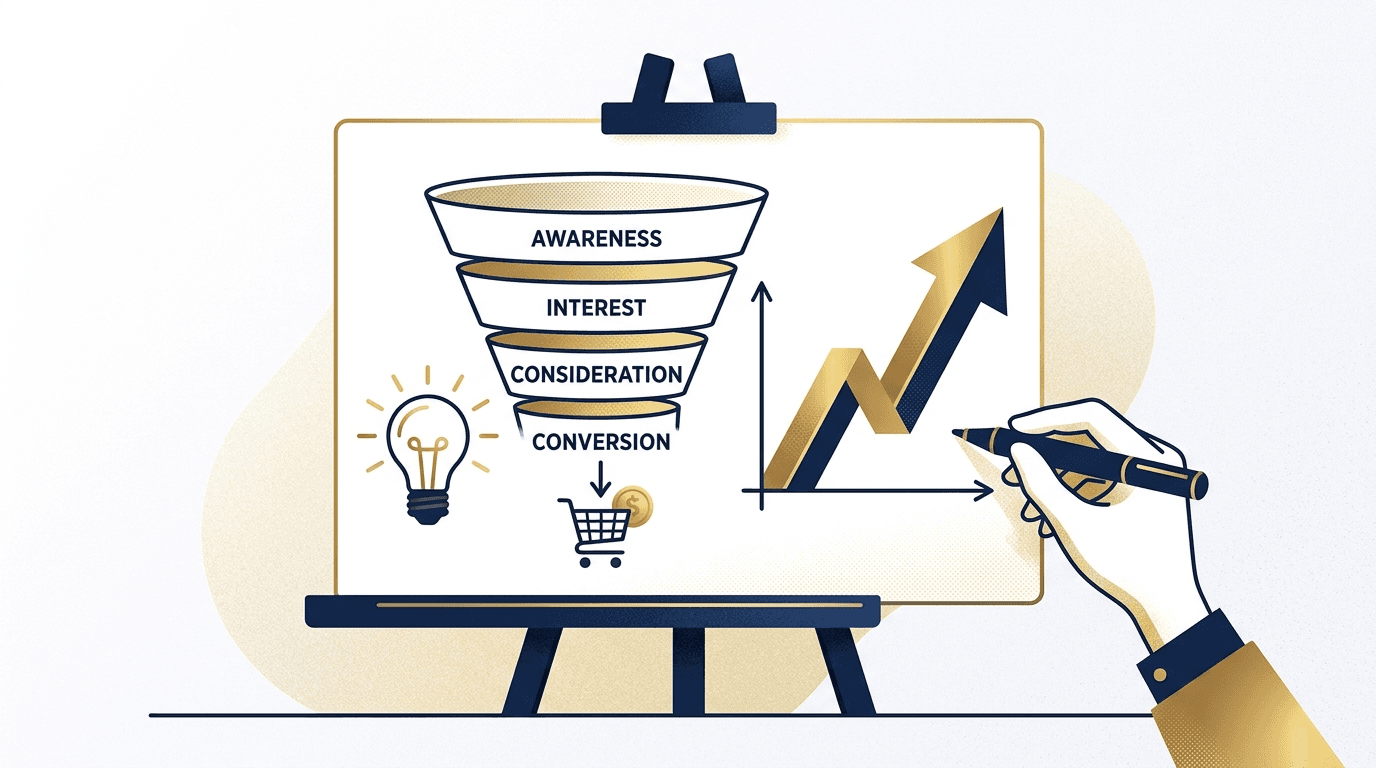
The most sophisticated B2B paid media approach in 2026 is not picking one channel. It is running them in sequence, using each platform for what it does best.
Stage 1: LinkedIn Awareness and Demand Creation Run LinkedIn Sponsored Content campaigns to your ICP with high-value content: insights reports, frameworks, thought leadership. The goal is not leads yet. The goal is to build a warm audience of people who have engaged with your content, visited your website, or watched your videos.
Stage 2: LinkedIn Lead Gen for Warm Audiences Retarget your Stage 1 engaged audience with a higher-intent offer: a free audit, a strategy session, a benchmark report download. Because they have already consumed your content, conversion rates are significantly higher and lead quality improves markedly.
Stage 3: Google Remarketing to LinkedIn-Warmed Traffic Use Google Display remarketing to stay visible to your LinkedIn-warmed audience as they browse the web. Serve them case studies, testimonials, and specific use case content that addresses objections and reinforces your authority.
Stage 4: Google Search to Capture Intent Signals As your LinkedIn campaigns build brand awareness, you will see a lift in branded and category-level searches. Google Search captures those intent signals from people who are now actively researching after being exposed to your LinkedIn content.
This sequential approach does not require a massive budget. We have run it effectively for clients at $6,000 to $10,000 per month combined spend by being disciplined about audience segmentation and creative sequencing.
Case Study 1: Recruitment Agency, Melbourne
A mid-sized recruitment agency in Melbourne came to us running Google Ads spend of $4,500 per month with a CPL of $195 and a MQL to SQL conversion rate of around 28%. The leads were coming in but the sales team was frustrated — most leads were from HR coordinators rather than HR Directors, and deals were taking too long to close.
We restructured their Google Ads to focus exclusively on high-intent, decision-maker-relevant keywords and moved lower-funnel keywords to negative lists. We then layered in a LinkedIn campaign targeting HR Directors and Heads of Talent Acquisition at companies with 100 to 500 employees in Melbourne and Sydney, running a benchmark report as the lead magnet followed by a sequence of case study content.
After 90 days: Google CPL came down to $145 (due to tighter keyword focus and improved landing page quality), LinkedIn CPL settled at $210, but LinkedIn leads converted from MQL to SQL at 68% versus 41% for Google post-restructure. Combined pipeline value generated in month three was 2.3x what they had been generating from Google alone. Total ad spend increased by $3,000 per month but revenue pipeline increased by 140%.
Case Study 2: B2B SaaS, Sydney
A Sydney-based SaaS company selling compliance management software to the financial services sector had been running LinkedIn Ads for six months with a CPL of $380 and zero clear attribution to closed revenue. The marketing team was under pressure to justify the spend.
The core issue was measurement, not the channel. They had no CRM integration, no pipeline-stage tracking, and were reporting on lead volume rather than opportunity value. We rebuilt their analytics and attribution setup to connect LinkedIn lead data through to their CRM and then to closed-won revenue. We also restructured the campaign from a cold conversion play to a sequential awareness-to-conversion funnel.
After implementing pipeline-stage attribution and running the sequential strategy for 12 weeks: LinkedIn CPL dropped to $290 as targeting precision improved, MQL to SQL conversion rate was confirmed at 71%, and the 14 SQLs generated in the quarter produced three closed deals with an average contract value of $28,000. That is $84,000 in new revenue from approximately $12,500 in LinkedIn ad spend over the quarter, a 6.7x return on ad spend when measured correctly.
The channel was not the problem. The measurement was.
"Before 3P Digital, we were judging our LinkedIn campaigns on lead volume and CPL alone. Once they connected our ad data to our CRM and built out proper attribution, we could see that LinkedIn was actually delivering our highest-value clients. We went from questioning the spend to doubling it." — Marketing Manager, B2B SaaS, Sydney
Measurement and Attribution for B2B Paid Media
B2B attribution is hard. Sales cycles are long, buying committees have multiple members, and the touchpoints between first ad impression and closed deal can span months. Most off-the-shelf attribution models — last click, first click — are built for e-commerce and are actively misleading in B2B contexts.
Here is what functional B2B attribution requires:
CRM integration. Every lead from every paid channel needs to flow into your CRM with the source, campaign, and offer clearly tagged. If your leads are sitting in a spreadsheet or only in the ad platform, you cannot measure downstream quality.
Pipeline-stage tracking. You need to know not just that a lead came in, but whether it became an SQL, an opportunity, a proposal, and a closed deal. Your paid media reporting should show CPL by stage, not just top-of-funnel cost.
Multi-touch attribution. Use a model (linear, position-based, or data-driven if you have volume) that gives credit to multiple touchpoints. A LinkedIn ad that generated awareness and a Google search ad that captured the final conversion both deserve credit.
Revenue-linked ROAS. Ultimately, your paid media investment should be measured against revenue generated, not lead volume. Cost per acquired customer and return on ad spend at the deal level are the metrics that boards and business owners care about.
Our analytics service is built specifically around this kind of B2B revenue attribution.
Making the Final Decision: A Framework
If you are trying to decide where to start or where to allocate more budget, use this decision framework from our 3P Framework methodology:
What is your average deal size? Under $10,000: start with Google. Over $25,000: LinkedIn should be in the mix from day one.
How specific is your ICP? If you can define your buyer by job title, company size, and industry, LinkedIn targeting will deliver. If your buyer is defined primarily by search behaviour, Google wins.
Is there active search demand? Use Google Keyword Planner to check monthly search volumes for your core terms in Australia. If the numbers are there (500 or more searches per month across your keyword set), Google Search is viable.
What is your monthly budget? Under $2,500: focus on one channel completely. $2,500 to $6,000: one primary channel with remarketing on the other. Over $6,000: run the sequential strategy across both.
How long is your sales cycle? Under 60 days: Google first. Over 90 days: LinkedIn and a sequential approach.
If you want a tailored recommendation based on your specific business, book a free strategy session and we will work through the numbers with you.
FAQs
What is the minimum budget for LinkedIn Ads in Australia for B2B?
The practical minimum to generate meaningful data from LinkedIn Ads in Australia is $3,000 to $5,000 per month. LinkedIn's minimum daily budget per campaign is low (around $10 per day), but at that spend level, you will not accumulate enough data to optimise effectively or reach your ICP with sufficient frequency to drive action. B2B buying decisions require multiple touchpoints. Below $3,000 per month, LinkedIn campaigns often underdeliver not because the platform is wrong for you, but because you are not spending enough to build the frequency needed to move buyers through awareness to intent. We typically recommend a 90-day minimum commitment at adequate budget to fairly evaluate the channel.
Which platform should a small B2B business in Australia start with?
For most small B2B businesses (under $5,000 per month in paid media budget), Google Ads is the better starting point. The reason is speed to data and lower minimum viable budget. If you have clear search demand for your service, Google can deliver qualified leads within the first few weeks, allowing you to validate your offer, your landing page, and your sales process before adding LinkedIn into the mix. Once you have a proven funnel and a clear ICP, LinkedIn becomes the logical next investment for reaching decision-makers at scale. Start narrow, prove the model, then expand.
How do I measure ROI on B2B paid media?
ROI on B2B paid media should be measured at the pipeline and revenue level, not the lead level. The core metrics to track are: cost per qualified lead (after sales qualification, not just form fills), cost per sales opportunity, cost per acquired customer, and revenue attributed to each channel over a 90 to 180 day window. This requires CRM integration, consistent lead tagging by source and campaign, and a multi-touch attribution model. Vanity metrics like impressions, clicks, and raw CPL without downstream qualification data will lead you to the wrong conclusions about which channel is actually growing your business.
Should I use LinkedIn Lead Gen Forms or send traffic to a landing page?
This depends on your goal. LinkedIn Lead Gen Forms deliver higher raw conversion rates (typically 10 to 15%) because the friction is low and the data pre-populates from the user's profile. For top-of-funnel offers like content downloads, benchmark reports, or webinar registrations, Lead Gen Forms are excellent. For bottom-of-funnel offers like consultations, audits, or product demos where lead quality is paramount, a landing page with a qualifying question set often produces better downstream results even if the conversion rate is lower. The ideal approach is to test both, then compare not just CPL but MQL to SQL conversion rate for each path before deciding where to concentrate spend.
What are the best remarketing strategies for B2B paid media?
The most effective B2B remarketing strategies layer audiences by engagement depth. At the top level, you remarket to all website visitors. At the middle level, you remarket to high-intent visitors: pricing page viewers, case study readers, contact page visitors. At the bottom level, you remarket to people who started but did not complete your conversion action. Each audience segment should receive different creative and offers matched to their stage in the funnel. On LinkedIn, you can also remarket to people who engaged with your LinkedIn content or watched a video. On Google Display, you can create audience lists from CRM data and serve ads to existing prospects who are in your pipeline but have not yet closed. Multi-platform remarketing that follows a buyer across both LinkedIn and Google is significantly more effective than single-platform remarketing.
When should I pause a paid media channel?
Pausing a channel should be a data-driven decision, not an emotional one. Before pausing, confirm that: you have run the channel for a minimum of 8 to 12 weeks with adequate budget, you have reviewed performance at the pipeline level (not just CPL), and you have eliminated execution issues (poor creative, weak offer, misaligned targeting, broken tracking) as the cause of underperformance. Channels often underperform because of setup problems rather than fundamental unsuitability. That said, if after 90 days of optimised spend with solid tracking you are generating no SQLs and no pipeline movement, it is reasonable to pause and reassess. Redirect budget to the channel that is performing and revisit the underperforming channel once you have a stronger offer or a more refined ICP.
Which industries in Australia get the best results from LinkedIn Ads?
In the Australian market, LinkedIn Ads consistently delivers strong results for: professional services (consulting, legal, accounting, HR), financial services and fintech (particularly when targeting compliance, operations, or finance decision-makers), SaaS and technology (especially mid-market and enterprise-focused products), recruitment and workforce solutions, and commercial real estate and property services. Industries where LinkedIn underperforms relative to its cost include trades and field services, retail and consumer goods, and businesses where the buying decision is made by owners of very small businesses (under 10 employees), as this audience is harder to target reliably on LinkedIn. If your ICP works in a corporate or professional environment, LinkedIn is very likely the right primary demand creation channel.
How does 3P Digital approach LinkedIn Ads versus Google Ads strategy for B2B clients?
We start by mapping the client's ICP, deal size, and sales cycle against our channel selection framework before recommending any spend allocation. We do not have a preferred platform — we have a preferred outcome, which is qualified pipeline at a cost that makes commercial sense. In practice, most of our B2B clients end up running both channels, with Google capturing active search intent and LinkedIn building demand among their target accounts. We use our 3P Framework (Profile, Plan, Perform) to first define the ICP with precision, then design the channel strategy and funnel architecture, and then manage and optimise campaigns with full CRM attribution from day one. If you want to see how this applies to your business specifically, get in touch or book a free strategy session.
References
LinkedIn Marketing Solutions B2B Benchmark Report (2025/2026) — LinkedIn's official benchmarking data for B2B advertisers covering CPL ranges, Lead Gen Form conversion rates, and audience engagement metrics across industries. Published by LinkedIn Marketing Solutions and regularly updated with platform-wide performance data.
Google Ads Help Centre: B2B Advertising Best Practices — Google's official documentation covering campaign types, bidding strategies, Performance Max guidance, and conversion tracking setup for lead generation advertisers. Available through the Google Ads Help Centre and updated in line with platform changes.
HubSpot State of Marketing Report 2026 — Annual global survey of marketing professionals covering channel performance, budget allocation trends, lead quality metrics, and attribution approaches. The report includes B2B-specific data on MQL to SQL conversion benchmarks and paid media ROI measurement practices.
Demand Gen Report: B2B Buyer Behaviour Benchmarks 2026 — Research publication covering B2B buyer journey data, including channel influence at different stages of the sales cycle, content consumption patterns, and the role of paid media in multi-touch attribution models for enterprise and mid-market B2B sales.
WordStream Australian Google Ads Benchmark Report — Industry-level CPC and conversion rate benchmarks for Google Ads across multiple verticals in the Australian market, covering professional services, SaaS, financial services, and recruitment categories with updated 2026 data.
Salesforce State of the Connected Customer Report 2026 — Global research on B2B buyer expectations, decision-making committee structures, and the role of digital channels in the modern B2B purchase journey. Includes data on average sales cycle lengths by deal size and industry segment.