Real Estate Digital Marketing in Australia: Proven Strategies to Generate Vendor and Buyer Leads in 2026
Australian real estate is one of the most fiercely contested local search verticals in the country. In capital city suburbs, you can have dozens of licensed agents competing for the same handful of listings, each spending tens of thousands annually on portal placements that deliver diminishing returns. The median REA Group listing cost for a standard residential campaign has climbed significantly over the past three years, yet most principals still treat portal spend and letterbox drops as the backbone of their marketing strategy. That is a costly mistake in 2026.
The agencies pulling ahead right now are the ones investing in owned and earned digital channels: local SEO that ranks their suburb pages above portal aggregators, paid media campaigns engineered specifically for vendor appraisal requests, content that builds genuine authority before a vendor ever picks up the phone, and websites optimised to convert the traffic they are already receiving. This is not theory. These are the mechanics that are generating measurable results for real estate businesses across Australia right now.
This guide covers every layer of a high-performance real estate digital marketing strategy. Whether you are a sole operator in a regional market or a principal running a multi-office agency in a metro area, you will leave with a clear picture of where to invest, what to measure, and how to build a lead generation engine that does not depend on a third-party portal raising its prices every six months.
Key Takeaways
SEO consistently delivers the lowest cost-per-lead across all real estate digital marketing channels when measured over a 12-month horizon
Google Business Profile optimisation is non-negotiable for any agent competing in local search and is frequently overlooked by competitors
Paid media on Google and Meta must be segmented by audience intent — vendor campaigns and buyer campaigns require entirely different creative, targeting, and conversion architecture
Content marketing, specifically market reports and suburb insights, builds the vendor trust that wins listing presentations before they begin
Most real estate agency websites are leaking leads at the conversion stage — appraisal form design, page speed, and social proof are chronically underinvested
The 3P Framework (Profile, Plan, Perform) provides a structured pathway from brand clarity to consistent, measurable lead generation
Channel Comparison: Real Estate Digital Marketing in Australia
Channel | Typical Cost Per Lead (AUD) | Time to Results | Difficulty | Best For |
Local SEO | $20–$80 | 4–12 months | High | Long-term vendor and buyer leads |
Google Ads (Search) | $80–$220 | 2–4 weeks | Medium | Appraisal requests, motivated vendors |
Meta Ads (Facebook/Instagram) | $40–$120 | 1–3 weeks | Medium | Vendor lead nurturing, brand awareness |
REA Group / Domain Listings | $200–$600+ | Immediate | Low | Buyer enquiries on active listings |
Email Marketing | $10–$40 | 2–8 weeks | Low | Database reactivation, past client referrals |
Content Marketing | $15–$60 | 6–18 months | High | Vendor trust, organic search rankings |
Letterbox / Print | $150–$400 | 4–8 weeks | Low | Brand recall in hyper-local areas |
Why Real Estate Marketing Is Shifting Digital in Australia
The structural shift away from traditional real estate marketing is not a trend to watch — it has already happened. The question is whether your agency has caught up.
CoreLogic data from early 2026 shows that Australian residential property transaction volumes remain significant despite interest rate pressure, with over 500,000 dwellings changing hands annually. That volume represents an enormous pool of vendor and buyer intent signals, most of which now originate online. Google processes billions of property-related searches in Australia each year, with queries like "how much is my house worth [suburb]", "best real estate agent [suburb]", and "houses for sale [suburb]" generating consistent, high-intent search volume across every capital city and major regional centre.
REA Group's investor reports confirm that portal audiences are growing, but the cost of premium placement for agents is rising faster than inflation. Agencies relying solely on REA and Domain are effectively renting an audience — the moment they stop paying, the visibility disappears. Worse, portal search results increasingly surface the portal's own data products (automated valuations, suburb profiles) ahead of individual agency pages, meaning agents are paying to appear on a platform that is simultaneously competing with them for vendor attention.
The shift to digital is also demographic. Research consistently shows that vendors aged 35 to 55 — the cohort responsible for the majority of residential listings — research agents extensively online before making contact. They read Google reviews, visit agency websites, watch agent video content, and check suburb market reports. If your digital footprint does not reflect competence and local authority at each of those touchpoints, you are losing listings before the conversation starts.
For a deeper breakdown of what this means strategically, visit our real estate digital marketing service page.
Local SEO for Real Estate Agents
Local SEO is the single highest-return long-term investment available to Australian real estate agents. It is also the area where most agencies have done the least work, which means the competitive opportunity is significant.
Google Business Profile Optimisation
Your Google Business Profile (GBP) is the most visible piece of real estate (no pun intended) you control in local search. When a vendor in Paddington searches "real estate agent Paddington", the local pack — those three listings that appear above organic results — drives a disproportionate share of clicks. Ranking in that pack requires a well-optimised GBP.
The fundamentals are not complicated, but they are consistently ignored. Your GBP needs to be claimed and verified, populated with accurate NAP (name, address, phone) data that matches your website exactly, loaded with high-quality photos of your team and office, and updated with posts at least weekly. Service area settings should reflect your actual operating geography rather than a default radius. The review count and average rating are significant ranking factors — agents with 50-plus reviews at 4.7 stars or above consistently outrank competitors with similar on-page SEO.
Beyond the basics, GBP Q&A sections can be seeded with common vendor questions and authoritative answers. The "products" section can be used to highlight service offerings like appraisals and property management. These are small incremental gains, but they compound.
Suburb-Specific Landing Pages
The most impactful SEO investment for most agencies is the development of dedicated, content-rich suburb pages. Not thin placeholder pages that say "We sell houses in [Suburb]. Contact us today." — substantive pages of 800 to 1500 words covering local market data, recent sales history, school zones, infrastructure developments, and genuinely useful buyer and vendor information.
Why does this work? Because Google's local search algorithm rewards relevance and depth. A page that comprehensively addresses what a vendor in Mosman, or Toorak, or New Farm needs to know about selling in their specific suburb will outrank a generic agency homepage every time. These pages also attract long-tail queries with serious intent — searches like "average days on market Mosman 2026" or "best streets to buy in New Farm" are not high volume, but they signal exactly the kind of research-mode behaviour that precedes a listing or purchase decision.
For technical implementation guidance, our real estate SEO strategies page covers schema markup, internal linking architecture, and page speed requirements in detail.
Schema Markup for Real Estate
Schema markup (structured data) tells Google precisely what your page is about and can enhance your search listings with rich results. For real estate agencies, the most relevant schema types include LocalBusiness, RealEstateAgent, and Review schemas. Implementing these correctly takes a developer an hour or two but can meaningfully improve click-through rates from organic results. Our property listing optimisation resource covers the technical specifics.
Paid Media Strategy for Real Estate
Paid media is where real estate agencies can generate leads quickly, but it is also where budget gets wasted fastest when campaigns lack strategic architecture. The critical mistake most agents and their generalist marketing suppliers make is treating vendor leads and buyer leads as the same audience. They are not, and conflating them destroys campaign efficiency.
Google Ads for Vendor Appraisal Requests
Google Search campaigns targeting vendor intent are among the most effective paid media available to Australian real estate agencies. Queries like "free property appraisal [suburb]", "sell my house [suburb]", and "property valuation [suburb]" indicate a person actively considering selling. These are high-intent, low-volume searches that justify a higher cost per click because the conversion value is significant.
A well-structured Google Ads campaign for appraisal generation should be tightly geo-targeted to your actual service area, not a broad radius. Ad copy should lead with a specific value proposition — "Free Market Appraisal in 48 Hours" outperforms "Contact Our Experienced Team" because it answers the vendor's immediate question. Landing pages need to be dedicated conversion pages, not your homepage, with a short appraisal form, a clear headline, and social proof in the form of recent sales results or client testimonials.
Bid strategy matters. For agencies with limited budget, manual CPC or target CPA bidding tends to outperform broad automated strategies until the campaign has sufficient conversion data (typically 30 to 50 conversions). Smart Bidding is powerful, but it needs data to work.
For a full walkthrough of our approach, see our paid media services page.
Meta Advertising for Vendor Lead Generation
Facebook and Instagram advertising operates differently from Google because the audience is not actively searching — they are being interrupted. That changes the creative and offer requirements entirely.
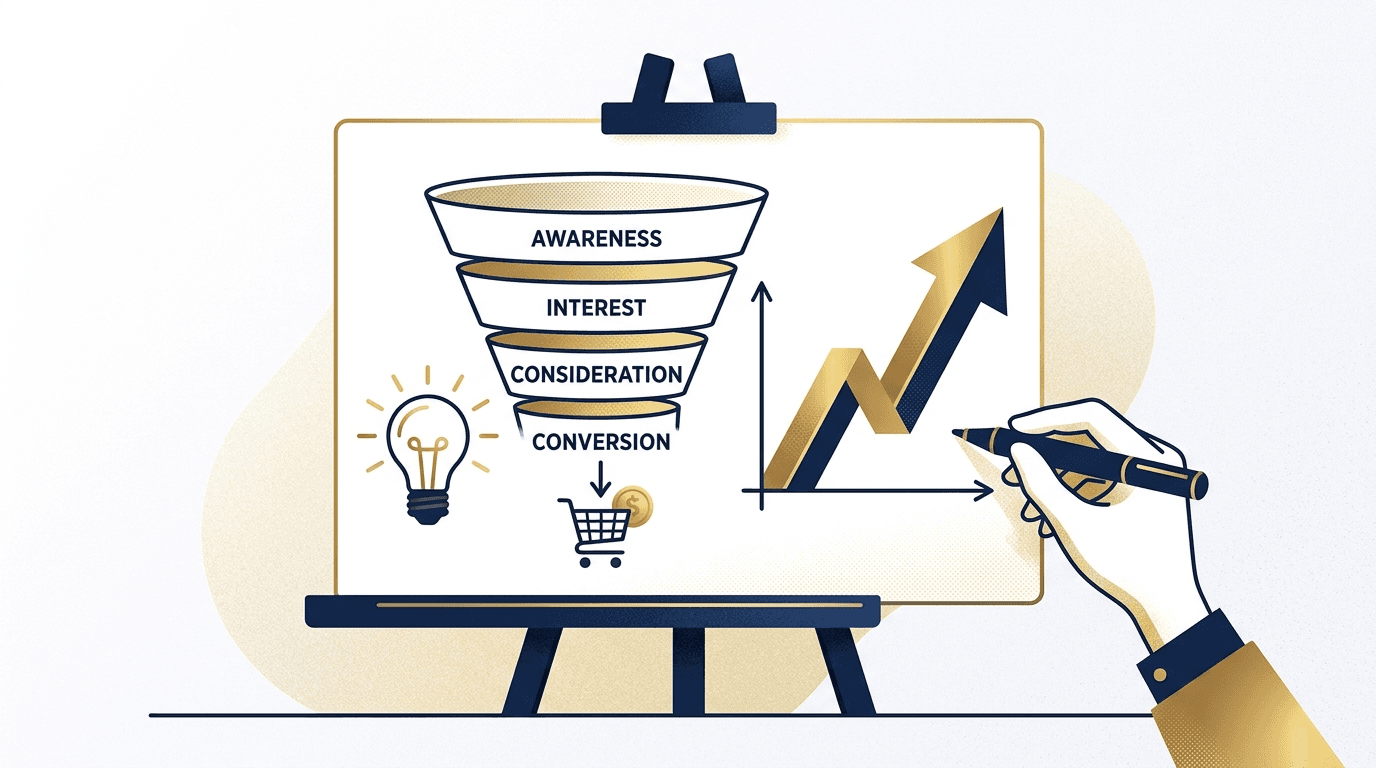
The most effective Meta strategy for vendor lead generation in real estate uses a multi-touch funnel. Top of funnel content — suburb market update videos, "what's your home worth" hook content, recent sold results — builds brand familiarity with homeowners in the target postcode. Middle of funnel audiences (people who have engaged with your content or visited your website) are then retargeted with a direct response offer: a free appraisal, a downloadable suburb report, or a comparison of recent sales.
Audience targeting on Meta should leverage Custom Audiences built from your existing database and Lookalike Audiences modelled from past vendor contacts. Broad interest targeting ("property", "real estate") is generally too shallow for efficient vendor lead generation in competitive metro markets.
Compliance note: Meta's Special Ad Categories apply to housing-related advertising in some contexts. Work with a specialist who understands these restrictions to avoid campaign rejections.
Retargeting Architecture
Most real estate agencies have no retargeting in place. This is a significant missed opportunity. Website visitors who viewed your suburb pages or started but did not complete an appraisal form are high-intent prospects. A properly configured retargeting campaign across Google Display and Meta will re-engage these visitors with relevant messaging at a fraction of the cost of prospecting campaigns.
Content Marketing That Wins Vendor Listings
Content marketing in real estate is not about publishing blog posts for their own sake. It is about building the digital evidence of local expertise that makes a vendor choose your agency over the one next door.
Suburb Market Reports
A quarterly suburb market report — covering median sale prices, days on market, auction clearance rates, and vendor discounting trends — serves multiple strategic functions. It drives organic search traffic from research-intent queries. It provides shareable content for social media. It generates email open rates far above industry average because it is genuinely useful to the audience. And critically, it positions your agency as the local authority before a vendor has made first contact.
These reports do not need to be elaborate. A well-structured PDF of four to six pages, or a dedicated on-site page updated quarterly, is sufficient. The data can be sourced from CoreLogic, your state's land registry, or your own internal CRM if you have sufficient transaction volume.
Case Studies and Sold Results Content
Vendors want evidence, not promises. A detailed case study of a recent sale — the starting price expectation, the marketing strategy employed, the number of inspections, the competition generated at auction or through the negotiation, and the final result against expectations — is one of the most persuasive pieces of content an agent can produce.
These case studies serve dual SEO value: they target long-tail queries like "sold results [suburb] 2026" while providing the social proof that moves a vendor from research to contact. Published consistently across your website and social channels, they become a compounding asset.
Video Content
Video consumption continues to grow across all Australian demographic groups. For real estate, the highest-performing video content formats are suburb walkthrough videos ("What it's like to live in [Suburb] in 2026"), agent profile videos that convey personality and expertise, and short-form sold result announcements for Instagram Reels and TikTok. The production quality bar has lowered significantly — a well-lit, clearly spoken video shot on a recent iPhone performs competitively against expensive agency productions when the content is substantive.
For a structured approach to real estate content strategy, our content marketing services team can develop an editorial calendar aligned to your listing cycle.
Website Conversion Optimisation for Real Estate
The single most common issue we identify when auditing real estate agency websites is this: the traffic is there, but the conversion rate is terrible. An agency spending $5,000 per month on Google Ads and SEO, but converting only 1.2% of website visitors into appraisal requests, is leaving an enormous number of leads on the table. Improving that conversion rate to 3% would triple lead volume without increasing the marketing budget.
Appraisal Form Design
Most real estate agency appraisal forms ask for too much information. Name, phone, email, address, number of bedrooms, bathrooms, car spaces, estimated value, preferred selling timeline, and "how did you hear about us?" — all on the first contact. Every additional field reduces completion rates. Strip appraisal request forms back to three to five fields maximum for the initial capture. Qualify further in the follow-up call.
Form placement matters too. The appraisal CTA should be above the fold on the homepage, prominent on every suburb page, and accessible from the navigation on every page of the site. Do not make vendors hunt for it.
Page Speed and Core Web Vitals
Google's Core Web Vitals are a confirmed ranking factor. More importantly for conversion, every additional second of page load time on mobile increases bounce rate significantly. Real estate websites tend to be image-heavy and plugin-bloated, which creates page speed problems that kill both rankings and conversions. A technical SEO audit that addresses image compression, server response times, and render-blocking scripts will typically yield measurable improvements in both traffic and leads within 60 days.
Social Proof Architecture
Vendors visiting your website are looking for evidence that you deliver results. The most effective social proof elements are: Google review count and rating (displayed prominently, not buried in a footer), specific sold results with address, price, and days on market, and written or video testimonials from identifiable past clients (not anonymous "John S" reviews). Trust signals like professional association memberships and media mentions add credibility for higher-end market segments.
Case Studies: Real Results from 3P Digital Client Work
Case Study 1: Metro Sydney Boutique Agency
A boutique agency operating across three inner-west Sydney suburbs engaged 3P Digital in Q3 2025 with a brief to reduce dependency on REA Group spend and build a sustainable organic lead pipeline. At the time of engagement, the agency was generating approximately 18 appraisal requests per month, 14 of which came from portal referrals.
Over a 10-month engagement, we implemented the following: eight suburb-specific SEO landing pages with schema markup, a GBP optimisation and review generation programme, a Google Search campaign targeting appraisal intent queries, and a quarterly market report published as both a web page and PDF download.
Results at month 10: organic appraisal requests increased from four per month to 22 per month. Google Ads generated an additional 14 appraisal requests per month at an average cost per lead of $94. Total monthly appraisal requests more than doubled, from 18 to 48, while the proportion coming from owned and paid channels (versus portal referrals) shifted from 22% to 67%. The agency reduced REA premium package spend by $2,800 per month and reinvested that into SEO and paid media.
Case Study 2: Queensland Regional Agency
A regional Queensland agency with two offices approached 3P Digital to improve lead generation in a market where portal dominance was lower but so was search volume. The challenge was generating meaningful lead flow from a smaller total addressable search audience.
We developed a content-first strategy: 12 suburb and surrounding area pages, a series of "moving to [region]" buyer guide articles, and a Meta advertising programme targeting out-of-state buyers researching the region as a lifestyle or investment option. This audience segment, which the agency had not previously targeted, proved highly responsive to video content and suburb lifestyle messaging.
Results at month eight: website traffic increased 340% year-on-year. Buyer enquiries via the website increased from three to four per week to 18 to 22 per week. Vendor appraisal requests from digital channels (previously negligible) reached six to eight per month by month six, primarily driven by organic search ranking improvements for suburb-level queries.
Testimonial
"Before working with 3P Digital, we were spending a significant amount each month on REA and getting leads we could have found ourselves. Alex and the team completely changed how we thought about our digital presence. The suburb pages they built started ranking within three months, and by month six we were getting more appraisal requests from Google than from the portal. The paid media campaigns are dialled in — we know exactly what each lead costs us and where it's coming from. For any agency serious about growing its own pipeline, these are the people to talk to."
Principal, Boutique Real Estate Agency, Inner-West Sydney
How the 3P Framework Applies to Real Estate
Every engagement at 3P Digital follows our proprietary 3P Framework: Profile, Plan, Perform. In the context of real estate digital marketing, each phase has specific deliverables.
Profile: Understanding Your Market Position
Before a single dollar is spent on ads or a single page is written for SEO, we establish a clear picture of where the agency sits competitively. This involves auditing current digital assets, identifying the target client profile (are you chasing first-home vendor listings at the $700K price point, or prestige vendors at $3M-plus?), analysing the local competitive set, and mapping the current customer journey from first awareness to appraisal request. Without this foundation, every tactic that follows is an educated guess.
Plan: Building the Channel and Content Architecture
With a clear profile established, the Plan phase determines which channels to prioritise and in what sequence. For most real estate agencies, the recommended sequencing is: GBP optimisation first (quick wins, immediate visibility impact), then Google Ads (immediate lead generation while organic builds), then suburb page SEO (medium-term compounding returns), then content marketing (long-term authority building). The Plan phase also covers conversion architecture — ensuring the website can actually convert the traffic the plan will generate before spending money driving that traffic.
Perform: Execution, Measurement, and Iteration
The Perform phase is where strategy meets execution. Weekly reporting on key metrics (leads by channel, cost per lead, conversion rate by landing page, keyword ranking movements), monthly strategy reviews, and quarterly deep audits ensure the programme continuously improves rather than plateauing. Real estate markets move quickly — campaign performance should be reviewed and adjusted monthly at minimum.
If you would like to explore how the 3P Framework applies to your agency, get in touch with our team for a no-obligation discovery call.
FAQs
How much should a real estate agency spend on digital marketing?
A useful benchmark for Australian real estate agencies in 2026 is 8% to 12% of gross commission income (GCI) allocated to marketing, with 60% to 70% of that going to digital channels. For a single-office agency generating $1.2M in GCI annually, that equates to roughly $7,000 to $10,000 per month in total marketing spend, with $4,500 to $7,000 directed to digital. The split between SEO, paid media, and content will depend on growth stage. Newer agencies typically weight more toward paid media for immediate lead generation, while established agencies can invest more in organic channels for long-term efficiency.
What is the best digital marketing channel for getting vendor leads?
There is no single best channel — the optimal answer depends on your timeline and budget. For immediate vendor leads, Google Search Ads targeting appraisal intent queries consistently outperforms other paid channels in terms of lead quality. For long-term, lowest cost-per-lead performance, local SEO driven by suburb pages and GBP optimisation is the most efficient channel at 12 months and beyond. Meta advertising sits in the middle — it can generate vendor leads, but typically requires a longer nurture sequence than search because the audience is not in active selling mode. The strongest real estate agencies use all three in combination.
How long does SEO take for a real estate agency?
For suburb-level landing pages optimised correctly, meaningful ranking improvements are typically visible within four to six months. Competitive inner-city suburbs in Sydney, Melbourne, and Brisbane may take eight to twelve months to reach page one for primary keywords. However, long-tail suburb queries (specific street, property type, or market data queries) can rank within six to ten weeks when pages are well-structured and technically sound. The key point is that SEO compounds over time — the agency that starts today has a significant advantage over the one that waits another year to begin.
Is Google Ads or Facebook Ads better for real estate?
Google Ads is superior for capturing active, high-intent vendor leads who are already searching for appraisal or selling information. Facebook and Instagram Ads are superior for building brand familiarity with homeowners who are not yet actively considering selling but are in the demographic to do so within the next one to three years. The highest-performing real estate agencies use both: Google Ads to harvest existing demand, Meta Ads to create and nurture future demand. Treating them as competing options misses the strategic point.
How do I measure ROI on real estate digital marketing?
The most reliable real estate digital marketing ROI framework tracks cost per appraisal request by channel, conversion rate from appraisal to listed property, average commission per listed property, and total campaign spend by channel per month. If your average commission on a suburban residential sale is $18,000 and your Google Ads campaign delivers 12 appraisal requests per month at a $100 cost per lead, you need to convert one in 15 appraisals to listing and sale to break even. Most agencies with active follow-up processes convert one in four to one in six, making the ROI compelling. The barrier is usually measurement infrastructure — if your CRM does not track lead source through to settlement, you are flying blind.
What is local SEO and why does it matter for real estate?
Local SEO is the practice of optimising your digital presence to rank prominently in geographically qualified search results — searches that include a suburb, postcode, or location modifier, or that Google identifies as having local intent. For real estate agents, local SEO matters because the overwhelming majority of vendor and buyer search queries are location-specific. A vendor in Carlton does not search "real estate agent" in a vacuum — they search "real estate agent Carlton" or "sell my house Carlton". Ranking prominently for those queries, both in the local map pack and organic results, drives high-quality inbound leads at a cost far below paid media over the medium term. For a comprehensive guide, see our real estate SEO strategies page.
Can a small real estate agency compete with large franchise networks online?
Yes, and this is one of the most important insights in real estate digital marketing. Large franchise networks have brand recognition and marketing budgets, but they often sacrifice local specificity for scale. A boutique agency that produces genuinely deep, locally relevant content for five to ten key suburbs, maintains an active GBP with strong review velocity, and runs tightly targeted paid media will consistently outperform a franchise brand running generic national campaigns in those specific local markets. Google rewards relevance and authority, and in hyper-local real estate search, a committed independent agent can achieve both.
What should a real estate agency website include to convert visitors into leads?
The highest-converting real estate agency websites share several features: a prominent, simple appraisal request form accessible from the homepage and every suburb page; a clear value proposition that answers "why choose this agency" in ten words or fewer; specific sold results displayed with address, price, and campaign duration; Google review count and rating visible without scrolling on the homepage; agent profile pages that convey personality, experience, and local market knowledge; and mobile performance that loads fully in under three seconds. Removing friction from the conversion path — asking fewer questions on first contact and following up by phone — is typically the fastest win available on most agency websites.
References
CoreLogic Australia Residential Property Market Reports (2026) — CoreLogic is Australia's leading property data provider. Their quarterly and annual market reports provide transaction volume data, median price movements, days on market statistics, and vendor discounting metrics by suburb and region. Used in this article for market context and lead cost benchmarking.
REA Group Investor Reports and Annual Results (2025–2026) — REA Group's publicly available investor communications document portal audience growth, agent product pricing changes, and digital property search behaviour trends in Australia. Used for context on portal cost inflation and audience dynamics.
Google Local Search and Consumer Behaviour Research (2026) — Google's published research on local search behaviour in Australia, including the proportion of consumers who research service providers online before contact, click-through patterns in local map pack results, and the influence of reviews on local purchasing decisions.
Australian Bureau of Statistics (ABS) — Housing and Construction Data (2026) — The ABS publishes quarterly data on residential property approvals, transaction volumes, and household formation rates. Used for context on the scale of the Australian residential property market and the vendor/buyer audience size.
Meta Advertising for Real Estate — Special Ad Categories Policy Documentation (2026) — Meta's business help centre and advertising policy documentation covering the application of Special Ad Categories to housing-related advertising, including targeting restrictions and compliance requirements for Australian advertisers.
Google Search Console and Google Business Profile Performance Benchmarks — Third-Party Industry Reports (2026) — Aggregated SEO industry benchmark reports covering click-through rates by search position, local pack click share, and GBP engagement metrics across service industry verticals including real estate.