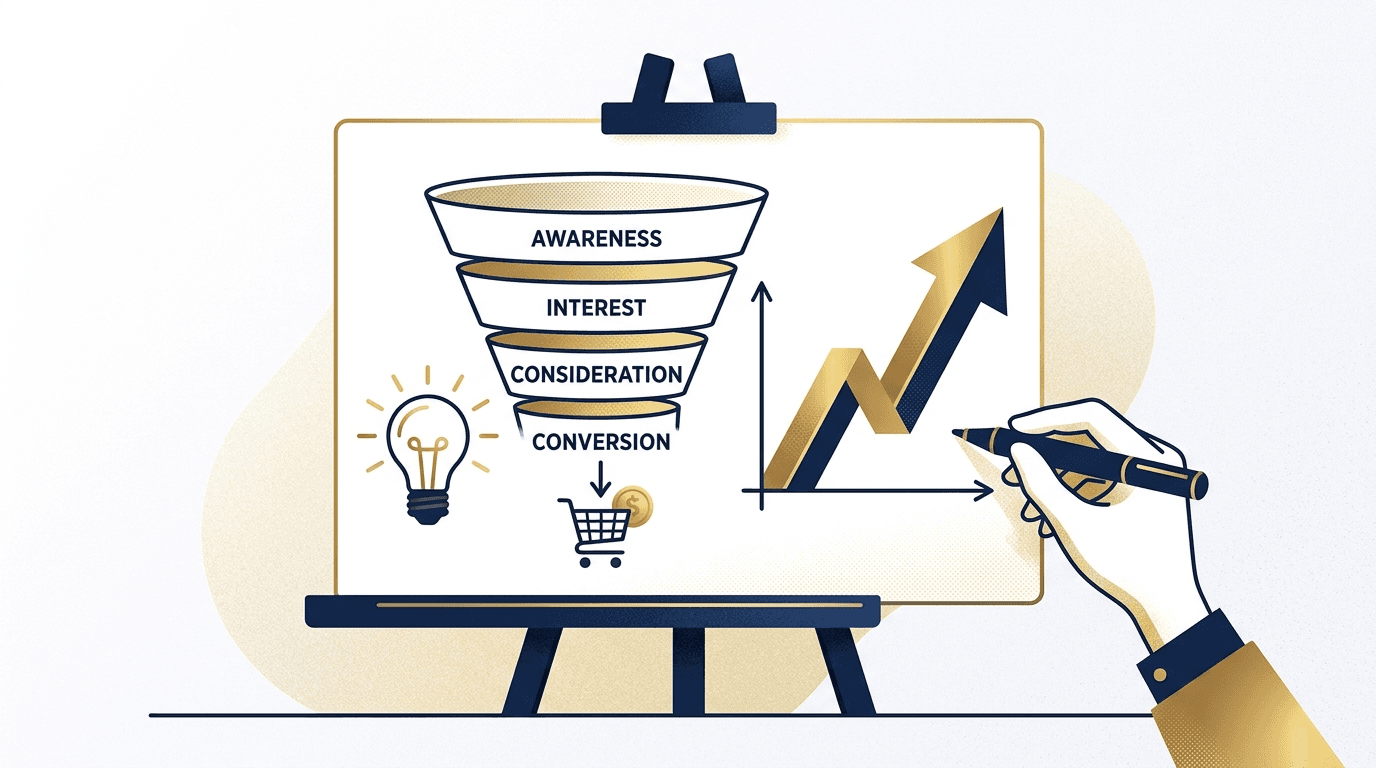
SEO content writing service page
An SEO content writing service page should explain the service, match buyer intent, demonstrate credible expertise and make the next step clear. Strong pages connect keyword targeting with positioning, proof, conversion paths and measurement. They are built to attract qualified buyers, not vanity traffic, and should be reported against leads and revenue.
An effective page does more than describe writing services. It helps prospective buyers decide whether your organisation understands their market, can solve their commercial problem and has a credible process for doing so.
This guide explains how to plan, write, optimise and measure an SEO content writing service page for the Australian market. It also covers the questions buyers should ask when comparing providers.
Key takeaways
Start with buyer, market and positioning research before selecting keywords.
Match the page to commercial search intent, not broad informational traffic.
Explain deliverables, responsibilities and review processes without hiding behind vague marketing language.
Use specific, verifiable proof and avoid unsupported performance promises.
Connect rankings and traffic to enquiries, qualified leads, sales and revenue.
Treat the page as a measured sales asset that requires ongoing refinement.
Summary table
Page element | Purpose | What strong execution looks like |
Positioning | Establish relevance | Names the buyer, problem and competitive difference clearly |
Search targeting | Match demand | Focuses on commercial intent and closely related buyer questions |
Service scope | Set expectations | Defines research, writing, optimisation, review and reporting |
Process | Reduce uncertainty | Shows how strategy moves from customer intelligence to accountable execution |
Proof | Build trust | Uses attributable outcomes, examples and transparent caveats |
Conversion path | Generate action | Offers a logical next step with minimal friction |
Measurement | Prove commercial value | Connects organic visibility with leads, sales and revenue |
What is an SEO content writing service page?
An SEO content writing service page is a commercial landing page for an organisation that researches, writes and optimises search-focused content. Its job is to rank for relevant service demand while helping qualified prospects understand the offer, assess credibility and take a measurable next step such as submitting an enquiry or booking a consultation.
This is different from a blog post about SEO writing. A blog post usually serves informational intent. A service page targets visitors who may be comparing providers, defining project requirements or preparing to buy.
The page therefore needs to satisfy two audiences at once:
Search engines need a clear subject, useful supporting detail and an accessible structure.
Prospective buyers need relevance, confidence, commercial clarity and a low-friction path forward.
Many pages satisfy neither. They repeat phrases such as "high-quality content" and "experienced writers" without explaining what the provider actually does. Others become long keyword essays that attract visits but fail to qualify or convert buyers.
Google's guidance on helpful, reliable, people-first content says content should primarily serve people rather than exist to manipulate search rankings. That principle is especially important on a service page. Every section should help a buyer understand the service or make a decision.
What should an SEO content writing service page include?
A strong SEO content writing service page should include a direct value proposition, defined audience, service scope, delivery process, evidence, commercial outcomes, relevant questions and a clear call to action. These elements should form one decision path rather than a collection of disconnected sections written mainly to accommodate keywords.
A specific value proposition
The opening should answer several practical questions immediately:
What service is being offered?
Who is it for?
What commercial problem does it address?
Why is this provider meaningfully different?
What should the visitor do next?
"We create engaging content that gets results" answers none of these properly. Almost any provider can make the same claim.
A stronger proposition might explain that the service develops search-led pages for Australian SMEs that need qualified enquiries, with strategy, writing, on-page optimisation and conversion tracking managed as one engagement. That wording defines the buyer, scope and outcome without promising a ranking that cannot be guaranteed.
A clearly defined service scope
Buyers should not have to guess what "SEO content writing" includes. State whether the engagement covers:
Customer and competitor research
Search intent and keyword analysis
Content briefs
Subject matter expert interviews
Writing and editing
Metadata and internal linking recommendations
Content upload or implementation
Measurement and ongoing refinement
The scope should also explain what the client supplies. Access to internal experts, analytics, customer objections and sales insights can materially improve the work. Good SEO writing is not produced in a vacuum.
A process buyers can understand
A service process reduces perceived risk. It shows that the outcome does not depend on a writer receiving a keyword and improvising.
At 3P Digital, our work follows Profile, Plan, Perform:
Profile: Understand the business, its best customers, search behaviour and the advantage hiding in plain sight.
Plan: Define positioning, page purpose, search intent, information architecture, proof and conversion paths.
Perform: Produce, optimise, publish, measure and refine the page against commercial outcomes.
This is not process theatre. Each stage prevents a predictable failure. Profile stops the page targeting the wrong buyer. Plan stops disconnected content. Perform makes execution accountable.
Verifiable proof
Proof should be relevant to the claim beside it. A general client logo does not prove content performance. Better evidence includes account data, search visibility, qualified enquiries, cost per lead or revenue connected to organic sessions.
According to 3P Digital's own account data, a Queensland mortgage broker moved from page three to position one for its primary keyword within six months. Organic traffic increased by 312%, and organic search produced more than 40 qualified leads per month. The important result was not the ranking alone. It was the shift from outbound lead chasing to recurring inbound enquiries.
The Australian Competition and Consumer Commission warns that claims can mislead through words, images or an overall impression. Service-page proof should therefore be attributable, accurately framed and qualified where necessary. Past performance should not be presented as a guaranteed future result.
How should keyword and search intent research work?
Keyword research for a service page should identify the language used by commercially relevant buyers, then distinguish purchase intent from general learning. Search volume alone is not a strategy. The primary term, supporting topics and page format must align with the service being sold and the decision the visitor is trying to make.
Separate buyers from information seekers
A person searching for "what is SEO content writing" may be learning. Someone searching for an "SEO content writing service" is more likely to be evaluating an external provider. Both questions can appear on the same page, but the commercial purpose should remain dominant.
Intent can be assessed by reviewing:
The types of pages currently ranking
The language used in titles and snippets
Whether results emphasise guides, agencies, freelancers or software
Related searches and recurring buyer questions
Search Console queries from existing service and content pages
Terms used in sales calls, proposals and enquiry forms
The search results are evidence of what Google currently considers relevant, not a template to copy. Competitor headings often reveal baseline expectations. They rarely reveal the strongest positioning available to your business.
Build a focused topic set
A service page can naturally discuss strategy, briefs, writing, editing, on-page SEO, expertise, pricing factors, timelines, reporting and provider selection. That does not mean every related keyword requires a separate section.
Group terms by the question they answer. Remove phrases that would force irrelevant copy. Assign deeper informational subjects to supporting articles where appropriate. The service page should stay focused on evaluation and action.
Use first-party evidence
Search tools estimate market demand. Your own data reveals how actual prospects find and assess the business.
Useful sources include:
Google Search Console query and page data
Analytics landing-page and conversion data
Paid search terms
Recorded sales objections
Customer support questions
CRM lead quality and sales outcomes
This is where generic competitor research becomes commercially useful. It connects search behaviour with genuine customer language and downstream results.
How do you structure the page for rankings and conversions?
Structure the page around the buyer's decision sequence: relevance, problem, solution, process, proof, scope, objections and action. Use one clear primary heading, descriptive subheadings, concise paragraphs and contextual calls to action. Search optimisation should support this sequence rather than interrupt it with repetitive phrasing or unnecessary sections.
Open with the answer
The introductory section should state what the service is and why it matters. Do not begin with a broad lecture about the importance of digital marketing.
Visitors arriving from search have already expressed a need. Confirm that they are in the right place, show your difference and provide a next step.
Build decision depth
Different buyers need different levels of assurance. A business owner may focus on outcomes and cost. A marketing manager may need delivery details, approval workflows and reporting. A subject matter expert may care about factual review.
A well-structured page lets each reader find the required detail without forcing everyone through the same block of copy. Useful techniques include:
Descriptive headings that answer genuine questions
Short paragraphs for mobile readability
Lists for deliverables and decision criteria
Tables for comparing scope or responsibilities
Examples placed beside the claim they support
Calls to action after meaningful decision points
Google's SEO Starter Guide recommends logical organisation and descriptive headings that help users navigate content. These fundamentals also improve internal review because writers, designers and stakeholders can see the purpose of each section.
Keep calls to action specific
"Learn more" is usually weaker than a call to action that explains what happens next. A service page might invite the visitor to request an SEO content assessment, discuss a priority service page or review current organic lead tracking.
The form should request only information needed for the next conversation. If qualification requires more detail, explain why. Friction is not always bad. Unexplained friction is.
What makes SEO service-page copy credible?
Credible copy uses specific language, demonstrates subject knowledge and distinguishes evidence from opinion. It names the audience, explains decisions, sets realistic expectations and attributes performance claims. It avoids guaranteed rankings, artificial urgency and vague superlatives. Trust grows when prospects can see how the provider thinks, works and measures success.
Expertise must be visible in the reasoning
Saying "our experts understand SEO" is a claim. Explaining how search intent, information architecture, subject matter input and conversion tracking shape a page demonstrates expertise.
Strong copy reveals practical judgement. For example, an experienced provider should explain when a service page is the wrong format for a query. It should also explain why publishing more pages can weaken a site when those pages overlap, lack differentiation or target no meaningful demand.
Proof must connect to the service
Testimonials can support trust, but they are most useful when they describe the problem, intervention and commercial outcome. Screenshots and case studies should include enough context to prevent misleading conclusions.
In another 3P Digital engagement, a national recruitment firm depended heavily on job boards for candidate and client leads. We used an integrated SEO and content strategy built around recurring recruitment search demand. According to our account data, the work generated 574 leads at a 63.5% lower cost per lead.
That example is useful because it connects content with an operating cost the business wanted to reduce. It is stronger than reporting impressions without lead quality or acquisition cost.
Accuracy needs an owner
SEO copy often crosses legal, technical or regulated subject matter. The workflow should identify who approves claims and how updates are handled.
Writers should not invent authority. The provider brings search and communication expertise. The client or nominated expert validates facts that require professional or organisational knowledge.
How should an SEO content writing service be delivered?
A reliable SEO content writing service should combine discovery, research, briefing, drafting, expert review, on-page optimisation, publication checks and performance analysis. Responsibilities should be agreed before production begins. Quality depends on informed inputs and a controlled review process, not simply assigning more words to a writer.
Discovery and profiling
Discovery should capture commercial priorities, margins, customer segments, geographic coverage, objections, sales language and competitive differences. This stage defines what a qualified lead means.
Without that definition, a page can rank and still fail. It may attract students, job seekers, low-value enquiries or buyers outside the service area.
Planning and briefing
A useful brief gives the writer direction without dictating weak copy. It should cover:
Page objective and intended action
Primary buyer and stage of awareness
Search intent and topic scope
Core positioning and differentiators
Required evidence and sources
Structural recommendations
Brand and compliance constraints
Conversion and tracking requirements
The brief should explain why sections exist. A heading list scraped from ranking pages does not provide enough strategic context.
Drafting and expert review
The first draft should prioritise completeness, accuracy and decision flow. Editing can then tighten language, remove duplication and improve hierarchy.
Subject matter review should test factual accuracy. SEO review should test intent alignment, page focus, metadata and contextual relevance. Commercial review should test whether the page reflects what sales teams can actually deliver.
Publication and quality assurance
Publishing can introduce errors that were absent from the draft. Check heading order, metadata, links, mobile layout, form behaviour, indexability, canonical settings and analytics events.
A page is not finished when the copy document receives approval. It is finished when the live experience works and measurement is verified.
How should performance be measured?
Measure an SEO content writing service page from visibility through to commercial outcome. Rankings and clicks diagnose reach, while engaged visits, enquiries, qualified leads, sales and revenue show business value. Reporting should expose where the journey breaks, so the team can refine targeting, copy, offers, forms or follow-up.
Use a measurement chain
A practical measurement chain connects:
Search visibility to organic clicks, landing-page behaviour, conversion actions, lead qualification and closed revenue.
Each stage answers a different question. Low impressions may indicate limited relevance or authority. Strong traffic with weak enquiries may indicate poor offer alignment. Enquiries without qualified opportunities may indicate the wrong audience. Qualified opportunities without sales may expose pricing, follow-up or delivery issues.
Define conversions properly
A form submission is not automatically a qualified lead. Agree on the fields and CRM stages that separate genuine opportunities from spam, suppliers, job applicants and unsuitable enquiries.
Where sales cycles allow, connect source and landing-page information to the CRM. Revenue attribution will not always be perfect, especially across devices and long buying journeys. Imperfect but documented tracking is better than pretending every conversion has equal value.
Review the page after publishing
Use Search Console to see which queries generate impressions and clicks. Compare those terms with the intended audience. Review analytics for engagement and conversion behaviour. Speak with sales teams about lead quality.
Changes should follow evidence. A lower-than-expected click rate may call for better titles and snippets. Strong traffic with low conversion may require clearer proof, offer positioning or calls to action. Do not rewrite a page merely because a reporting calendar says it is due.
Why we profile the buyer before opening a keyword tool
The strongest service-page opportunity usually comes from customer and positioning intelligence, not a larger keyword list. My view is direct: agencies that start with a standard channel package create activity before understanding the commercial problem. We start with Profile, Plan, Perform because execution should follow the buyer and competitive advantage.
Keyword tools show how people search. They cannot decide which customers the business should prioritise, what work is profitable or why a buyer should choose one provider over another.
This distinction matters. Two businesses can target the same phrase but require very different pages. One may compete on specialist expertise. Another may offer speed, integration or geographic coverage. Generic optimisation erases those differences precisely when the buyer needs them.
There is also a useful lesson in catalogue-scale work. A medical equipment retailer had a 325-product catalogue that did not reflect how clinicians, aged-care procurement teams and home-care buyers searched. We used its Search Console and analytics data to rewrite titles, metadata, descriptions and image alt text at scale. According to 3P Digital's account data, the team optimised 324 product pages in one day. Subsequently, 192 pages ranked in Google's top 10, 497 terms reached the top 10 and monthly organic traffic rose 21%, from 1,590 to 1,928 visits.
The scale was useful, but scale was not the core advantage. The work succeeded because existing buyer data informed the language. Automation without that profile would simply have produced incorrect copy faster.
That is the principle I apply to an SEO content writing service page: find the advantage hiding in plain sight, express it in the buyer's language and measure whether the page produces results, not activity reports.
What mistakes weaken an SEO content writing service page?
The most damaging mistakes are targeting broad traffic, copying competitor structures without strategy, hiding the service scope, making unsupported claims and measuring only rankings. These errors usually stem from treating the page as a writing task. It is better treated as a combined positioning, search, sales and measurement asset.
Writing for a word count
Longer is not automatically better. A page should be as detailed as the buying decision requires. Repetition added to reach an arbitrary length can obscure the offer and weaken trust.
Repeating the primary keyword
Use the main phrase where it helps clarity, including the title, opening and relevant metadata. Do not force exact wording into every heading. Natural variations and related concepts should emerge from complete coverage.
Google's spam policies identify keyword stuffing as a practice that can violate its policies. It also makes copy unpleasant to read.
Copying the ranking pages
Competitor research is useful for identifying expected topics. It becomes harmful when every heading, claim and example follows the same pattern.
Search results already contain those pages. Your opportunity is to add stronger evidence, clearer positioning, better decision support or original expertise.
Promising rankings
No provider controls Google's results. Guaranteed rankings ignore competition, technical conditions, site authority, algorithm changes and the quality of implementation.
A credible provider can commit to a process, transparent deliverables and accountable reporting. It should not guarantee an outcome outside its control.
Stopping at publication
A published page needs indexing checks, conversion testing and performance review. Without those steps, the organisation cannot tell whether weak results come from visibility, relevance, persuasion or tracking.
How should you choose an SEO content writing provider?
Choose a provider that can explain your buyers, commercial objective, research method, review process and measurement model before discussing content volume. Ask how it handles subject matter expertise, search intent, proof, implementation and lead attribution. Avoid no cookie-cutter package that prioritises output while leaving business outcomes undefined.
Useful evaluation questions include:
How will you identify our highest-value audience?
What evidence do you need from our team?
How do you decide whether a service page or article fits the query?
Who writes, edits and approves the content?
How are factual and regulated claims checked?
Does the scope include implementation and quality assurance?
How will enquiries be tracked and qualified?
What happens when the initial data contradicts the plan?
Also inspect the provider's own service pages. They should demonstrate the clarity, proof and decision support being offered to clients.
Pricing should be assessed against scope and commercial value rather than a rate per word. Research, expert interviews, strategic planning, conversion work and tracking require effort that a word count cannot represent.
Build a service page around commercial outcomes
An effective page starts with customer intelligence, defines a focused position and turns that strategy into accountable execution. If your current service page attracts the wrong traffic, produces unqualified enquiries or cannot be connected to revenue, the first step is diagnosis rather than publishing more content.
3P Digital helps Australian SMEs and mid-market organisations connect SEO content with qualified demand, conversion paths and reliable tracking. We report against leads and revenue, not just clicks.
To discuss an SEO content writing service page, visit the 3P Digital contact page at /contact. We will assess the audience, offer, search opportunity and measurement requirements before recommending execution.
Frequently asked questions
These questions cover the practical issues buyers commonly raise when evaluating an SEO content writing service page or engaging a provider. The right answer depends on competition, website condition, internal expertise and commercial goals, but the principles of intent alignment, evidence, implementation and measurement remain consistent.
What is the difference between SEO content writing and copywriting?
SEO content writing aligns a page with search demand, topic relevance and organic discovery. Copywriting focuses on persuasion and action. A strong service page needs both. It must be discoverable, useful and convincing without sacrificing accuracy or readability for keyword repetition.
How long should an SEO service page be?
It should be long enough to answer the buyer's material questions and support an informed decision. There is no universal word count. Scope, competition, buyer risk and subject complexity determine the required depth. Remove repetition even when competitors publish longer pages.
Can an SEO content writer guarantee rankings?
No. A writer or agency can control research, content quality, optimisation and implementation recommendations. It cannot control competitors, Google's systems or every technical condition affecting the site. Guaranteed ranking claims should be treated cautiously.
How quickly will an SEO content service page produce results?
Timing varies with the site's current visibility, technical condition, authority, competition, implementation and search demand. Early indexing or query movement does not necessarily mean qualified leads will follow immediately. Establish baseline data and review visibility, engagement and conversions together.
Should every service have its own SEO page?
Only when the service has distinct buyer intent, enough substance and a clear role in the website structure. Creating overlapping pages for minor keyword variations can cause duplication and internal competition. Closely related services may be stronger on one comprehensive page.
What should I provide to an SEO content writing agency?
Provide customer profiles, sales insights, service details, proof, brand guidance, compliance constraints and access to relevant analytics. Nominate subject matter experts and decision-makers early. Better inputs allow the agency to produce accurate positioning rather than generic copy based only on public competitor pages.
References
These sources support the search, content quality, structured data and advertising principles used in this guide. They are primary guidance from Google and the ACCC rather than anonymous benchmarks. Performance examples elsewhere in the article are explicitly identified as 3P Digital's own account data.
Google Search Central, SEO Starter Guide
Google Search Central, Creating helpful, reliable, people-first content
Google Search Central, Google Search Essentials
Google Search Central, Spam policies for Google web search
Australian Competition and Consumer Commission, False or misleading claims
FAQ_SCHEMA_JSON