Why Your Agency Partner Needs an A/B Testing Services Page, Not Just Monthly Reports
Most Australian businesses are paying digital marketing agencies for activity, not results. They receive glossy monthly reports packed with charts showing rising traffic, climbing keyword rankings, and mounting ad impressions. However, these vanity metrics mean absolutely nothing if they are not generating qualified, paying customers. The digital marketing industry relies heavily on locking clients into 12-month contracts so agencies can bill for busywork without being held accountable for actual revenue. At 3P Digital, we operate differently. We are a pay-for-performance digital agency that ties every marketing activity directly to pipeline growth.
Traffic is merely a vanity metric unless it consists of qualified buyers and is reported against revenue. Anyone can buy cheap clicks or optimise a page for an irrelevant keyword to make a traffic chart point upwards. The real work of marketing begins when those users land on your website. This is why we treat conversion rate optimisation (CRO) as the central pillar of our strategy, rather than an afterthought. When a marketing partner offers an A/B testing services page, it demonstrates a commitment to turning existing traffic into measurable sales. If you cannot tie a specific marketing channel to a closed deal, you are simply burning cash on an unpredictable cost centre.
The most critical metric for any business is return on investment. Through deep structural testing, we have achieved a 46:1 return on SEO investment for an automotive dealership group within 12 months. We did not achieve this by blindly publishing content or buying links. We achieved it by continually refining the user journey to ensure we captured high-intent buyers. If your current agency only reports on traffic and ignores what happens after the click, you need a new approach. This article breaks down exactly how rigorous A/B testing changes user behaviour, the framework required to map tests to revenue, and why your agency must operate without lock-in contracts.
Key Takeaways
Traffic without conversions is a vanity metric. High website visit numbers are irrelevant unless the traffic consists of qualified buyers and is reported against revenue.
Look for an explicit A/B testing services page. Agencies serious about your growth will highlight their testing capabilities rather than just focusing on top-of-funnel acquisition.
Structural testing beats superficial changes. Moving beyond simple button colour adjustments to test page layouts, value propositions, and user flows fundamentally alters user behaviour.
The 3P Framework aligns marketing with pipeline. Following the Profile, Plan, Perform methodology ensures every test is mapped directly to business growth.
Lock-in contracts encourage complacency. Agencies should operate month-to-month and prove their value through accountable execution, which is why we maintain a 98% client retention rate.
Summary Table: Standard Agencies vs Performance Partners
Feature | Typical Digital Marketing Agency | Performance-Focused Partner (3P Digital) |
Primary Deliverable | Monthly activity and traffic reports | Revenue, qualified leads, and ROI |
Contract Structure | 12-month lock-in agreements | Month-to-month, no lock-in contracts |
View on Traffic | The ultimate success metric | Useless unless made of qualified buyers |
Testing Methodology | Occasional, superficial changes | Rigorous, structural A/B testing programme |
Data Focus | Rankings, impressions, clicks | Cost per acquisition, lead volume, closed revenue |
Client Retention | Retained through legal contracts | Retained through performance (98% retention) |
The Vanity Metric Trap: Why High Traffic Is Useless
Most marketing conversations start and end with traffic. Business owners ask their agency how many people visited the site this month. The agency points to a rising line on a graph. Everyone nods and assumes the business is growing. This is the vanity metric trap, and it is the exact reason most marketing budgets are wasted.
Traffic is simply a measure of how many people looked at your digital storefront. It does not tell you if they had the intent to buy, if they matched your target audience, or if they were actually ready to make an enquiry. Attracting generic visitors who do not convert simply wastes ad spend and server resources. Success comes from identifying the hidden market advantage and pointing every dollar of spend at high-intent buyers.
The Australian Competition and Consumer Commission (ACCC) and the Australian Bureau of Statistics (ABS) consistently highlight the importance of digital capability for local SMEs. However, having a digital presence is only step one. If you generate 10,000 visitors a month but none of them pick up the mobile to call your office, your website is failing as a sales asset.
The Dangers of Reporting on Activity
Standard agencies love reporting on activity because activity is easy to generate. Running a generic Google Ads campaign, publishing generic blog posts, and pushing social media updates all create the illusion of work. However, marketing is not about staying busy. It is about accountable execution that results in revenue.
Consider a campaign we took over for a national recruitment firm. They were over-reliant on expensive job board spend and were frustrated by their rising cost per acquisition. The previous agency had driven massive amounts of traffic to their portal by optimising for broad, generic career queries. The traffic looked impressive on the dashboard, but the candidates were unqualified, and the recruitment firm was bleeding money.
We intervened by replacing the costly job board advertising with an SEO and content strategy focused exclusively on capturing specific candidate and client leads directly. Rather than chasing high search volumes, we targeted high-intent queries. The outcome was a shift from empty clicks to real pipeline opportunities. We generated 574 leads at a 63.5% lower cost per lead. We did not improve their traffic numbers across the board, but we radically improved their marketing ROI.
Shifting the Focus to Revenue
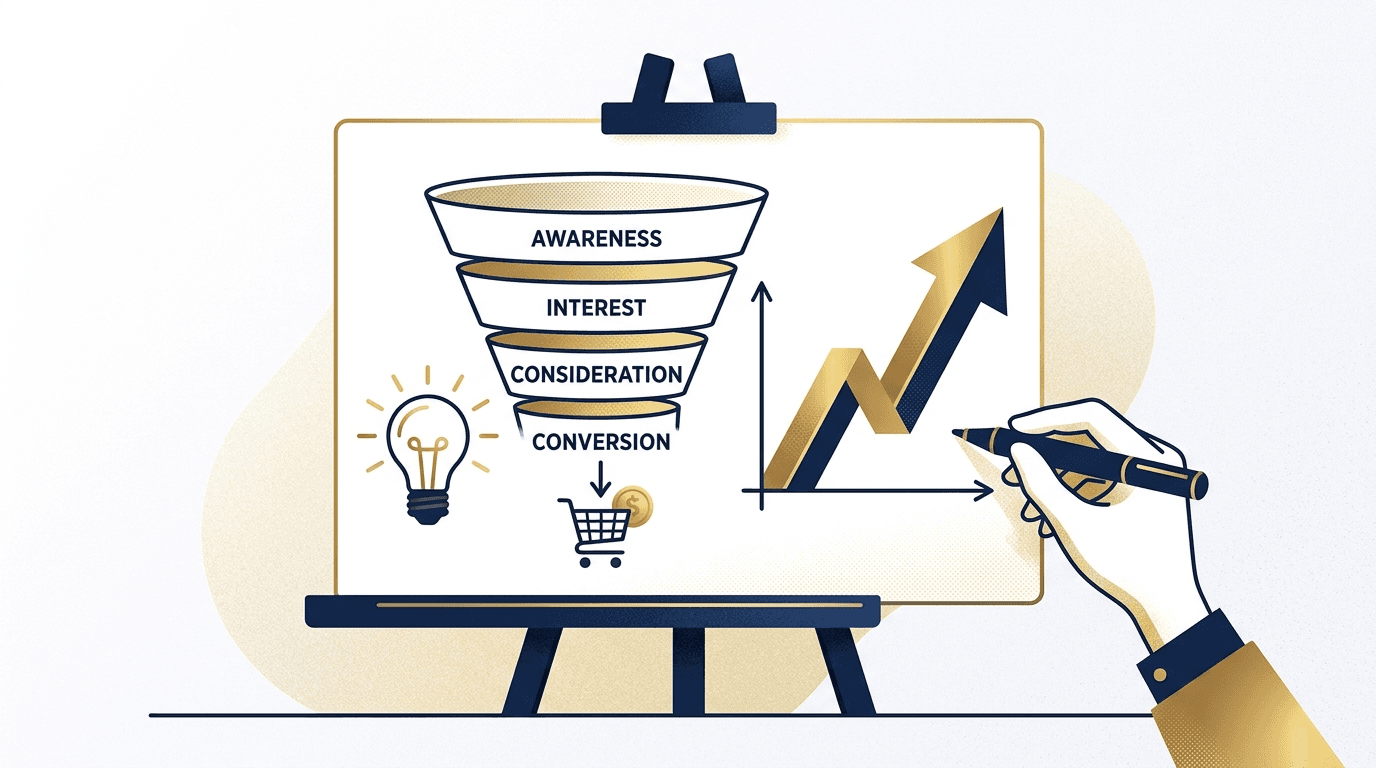
The only way to escape the vanity metric trap is to demand that every metric is reported against revenue. Click-through rates, bounce rates, and time on page are diagnostic metrics. They tell you what is happening on your website, but they do not tell you if your business is making money. A conversion rate optimisation agency shifts the focus from the top of the funnel to the bottom. We obsess over the point where attention turns into transactions.
What Rigorous A/B Testing Actually Looks Like
When business owners think about A/B testing, they usually think of trivial experiments. They imagine testing a red button against a blue button. The truth is, superficial tests yield superficial results. Rigorous A/B testing is a structural approach to user psychology, value proposition, and friction reduction.
An effective A/B testing services page outlines how an agency uses controlled experiments to isolate variables and measure their impact on user behaviour. It is the scientific method applied to your digital sales funnel. When done correctly, it removes guesswork from your website design and replaces it with hard data.
Beyond Button Colours
To generate real changes in conversion rates, you have to test structural elements. This requires moving past colours and fonts to test the fundamental architecture of your pages.
1. Value Proposition Testing Your headline and subheadline carry 80% of your page weight. We run tests comparing rational value propositions against emotional triggers. For example, in mortgage broking, we test headlines focusing purely on interest rates against headlines focusing on the peace of mind that comes with fast loan approval. The winning variation is almost never the one the client initially preferred, which proves the necessity of testing.
2. Page Layout and Cognitive Load How information is structured dictates how easily a user can make a decision. We frequently test long, detailed pages against short, punchy versions. We also test the placement of trust signals. Moving customer testimonials from the bottom of a page to sit immediately next to a lead capture form often yields significant lifts in form submissions because it answers the user trust objection at the exact moment they are deciding to act.
3. Lead Capture vs Content Gating We test the friction involved in making an enquiry. Removing optional phone number fields, changing the microcopy on the submit button, or testing a multi-step form against a single-step form can change conversion rates by double-digit percentages. A multi-step form breaks the psychological barrier of filling out a long questionnaire by making the process feel bite-sized.
How A/B Testing Changes User Behaviour
Every visitor to your website is asking a series of silent questions. Does this company understand my problem? Can I trust them? How much will this cost? Structural testing helps you answer these questions more effectively.
Consider a fitness client offering a 6-week challenge. We ran a test where Variation A highlighted the physical workouts and programme details. Variation B highlighted a supportive community and accountability coaching. Variation B won by a landslide. The data proved that users were not looking for more exercise routines, they were looking for motivation and support. By aligning the page copy with the actual user psychology, we increased sign-ups dramatically. This is how structural testing transforms user behaviour and turns traffic into revenue.
The Groundwork: The 3P Framework for CRO
At 3P Digital, we do not touch a single ad or write a piece of content until we have done the groundwork. The difference between good and bad marketing lies in this preparation. We find the advantage your competitors missed, build a strategy around it, and point every dollar of spend at actual buyers.
Our entire approach is governed by the 3P Framework: Profile, Plan, Perform. We use this proprietary framework to overhaul how Australian businesses attract customers and to ensure our testing is directly mapped to pipeline growth.
Phase 1: Profile
The Profile stage is about deep discovery. We do not make assumptions about your market. We analyse the data to understand who your actual buyers are, what triggers their search behaviour, and where the friction exists in your current sales process.
During this phase, we look at your historical analytics, talk to your sales team, and audit your competitors. We define your Ideal Customer Profile (ICP) and identify the specific intent behind their search queries. If you are a professional services firm, we need to know if your clients are searching for immediate crisis management or long-term strategic planning. These two intents require completely different landing page experiences.
We also identify your hidden market advantage. This might be a specific service level agreement, a unique piece of intellectual property, or a geographic dominance that you have not effectively communicated online. We use this advantage as the foundation for all our testing hypotheses.
Phase 2: Plan
Once we know who we are targeting and what our unique advantage is, we build the plan. The Plan phase is where we map our tests directly to pipeline growth. We do not test randomly. Every A/B test is designed with a specific business objective in mind.
We prioritise tests based on the ICE framework: Impact, Confidence, and Ease. A test that could lift form submissions by 20% (High Impact), has worked in similar industries (High Confidence), and requires minimal development time (High Ease) is scheduled first. We create a testing roadmap that outlines exactly what structural elements we will experiment with over the coming months.
This phase also involves establishing the baseline metrics. We must know your current conversion rate, your average lead value, and your closing rate before we can accurately measure the impact of our CRO efforts. We ensure your analytics are configured correctly so that every test result is reported against revenue.
Phase 3: Perform
The Perform phase is accountable execution. This is where we build, run, and analyse the A/B tests. We deploy the structural variations to your website and monitor the statistical significance of the results. We do not call a test a winner until we have 95% statistical confidence.
When a test concludes, we implement the winning variation permanently and document the psychological insight behind the win. Then, we use that insight to generate the next hypothesis. This creates a compounding effect. Every successful test builds on the last, continually improving your conversion rates and lowering your cost per acquisition.
The Perform phase is continuous. Digital markets shift, competitors update their offers, and consumer behaviour changes. A rigid website will lose relevance. A website backed by continuous A/B testing will continue to generate qualified leads year after year.
No Lock-In Contracts: The Contrarian Agency Model
Most digital marketing agencies sell activity, reports and vanity metrics, then lock you into 12-month contracts to ensure they get paid regardless of their performance. We believe this model is fundamentally flawed and inherently biased against the client.
Agencies should operate on a month-to-month basis with no lock-in contracts. Lock-in clauses encourage complacency. They focus the agency on delivering the bare minimum required to avoid cancellation rather than driving towards maximum possible return. When an agency knows a client can leave at any time, the agency is forced to continuously prove its value and deliver measurable results every single month to retain the client.
This is the core philosophy of a pay-for-performance digital agency. We do not need a legal contract to hold our clients hostage. We rely on our performance to earn their trust and their ongoing business.
Proof in Performance
Our model works because our methodology works. By removing the safety net of a lock-in contract, we have maintained an average client retention rate of 98% across over 250 clients served. Clients stay because we generate measurable ROI.
Consider our work with a Queensland mortgage broker. They were stuck on page 3 of search results and were struggling to generate consistent inbound leads. Their previous agency had them locked into a generic SEO retainer that produced no qualified leads.
We implemented a targeted SEO and content strategy designed to capture high-intent search traffic for primary industry keywords, combined with structural landing page A/B testing to convert that traffic. Within 6 months, we generated 40+ qualified leads per month and achieved a 312% increase in organic traffic. More importantly, we delivered a 46:1 return on SEO investment within 12 months for a similar engagement with an automotive dealership group.
These outcomes were not achieved by accident. They were the result of rigorous profiling, strategic planning, and relentless testing. We turned their marketing from an unpredictable cost centre into a measurable growth engine. This is why our clients stay with us without the threat of a contract.
Why A/B Testing Drives True Accountability
A/B testing is the ultimate tool for accountability. It strips away subjective opinions. A marketing director cannot argue that a design looks better if the test data proves it converts worse. A business owner does not have to guess if a new headline is working because the data will show the exact lift in form submissions.
When an agency commits to rigorous A/B testing, they are committing to a transparent feedback loop. Every month, you see exactly what was tested, how it performed, and how it impacted your bottom line. This is the antithesis of the vanity metric trap. You are no longer paying for activity. You are paying for validated improvements to your sales process.
How to Evaluate a Conversion Optimisation Agency
If you are looking for a marketing partner, you need to evaluate their approach to CRO. Do not simply look for an agency that mentions A/B testing in their proposal. Look for an agency that has built its entire methodology around it.
Start by checking if they have a dedicated A/B testing services page. This indicates that testing is a core product, not a bolt-on service used to upsell web design. Read their case studies. Do they report on vanity metrics like time on page, or do they report on cost per lead, qualified enquiries, and return on ad spend?
Look closely at the Performance Marketing and Agency Alternatives available in the Australian market. The landscape is shifting away from monolithic retainers towards specialised, accountable engagements. Australian business owners are demanding better ROI from their digital spend. With the rising cost of paid media across platforms like Google and Meta, simply buying more traffic is economically unviable for most SMEs. The only sustainable way to improve marketing ROI is to maximise the value of your existing traffic.
A true conversion optimisation agency will start by auditing your analytics to ensure they can track revenue. They will then map out the user journey to identify drop-off points. They will propose a testing roadmap that targets structural elements of your page. Finally, they will execute these tests transparently and report the results in the context of your overall business growth.
The Danger of In-House Testing
Many businesses attempt to run A/B tests in-house using free tools. While the tools are accessible, the strategic oversight is usually missing. In-house teams often fall into the trap of testing trivial elements like button colours because they lack the framework to identify high-impact structural changes. They may also call tests too early before reaching statistical significance, leading to false positives and wasted development time.
Effective CRO requires a blend of data analytics, behavioural psychology, and technical execution. It requires a framework like Profile, Plan, Perform to ensure that every test moves the needle on revenue. By partnering with an agency that specialises in CRO, you gain access to cross-industry insights and a dedicated testing infrastructure that scales.
Stop Paying for Activity and Start Investing in Revenue
Marketing must be tied directly to revenue. If a strategy does not generate qualified leads and measurable ROI, it is simply an expense. For too long, Australian SMEs have accepted glossy reports and rising traffic charts as a substitute for actual business growth. It is time to demand more.
At 3P Digital, we do not believe in cookie-cutter packages or hiding behind 12-month lock-in contracts. We believe in finding the advantage your competitors missed and using rigorous A/B testing to turn your website into a high-performing sales asset. Whether you are in mortgage broking, recruitment, fitness, or professional services, our 3P Framework will ensure your marketing is reported against revenue.
If you are tired of paying for empty clicks and vanity metrics, it is time for a change. Stop paying for activity and start investing in revenue. Contact 3P Digital today to discover how our conversion optimisation strategies will generate qualified leads, not just empty clicks.
Frequently Asked Questions
What is an A/B testing services page?
An A/B testing services page is a dedicated section on an agency website that outlines their methodology, tools, and approach to conversion rate optimisation. It details how the agency structures tests, what metrics they track, and how they apply the results to improve a client return on investment.
How does A/B testing improve marketing ROI?
A/B testing improves marketing ROI by increasing the percentage of website visitors who take a desired action, such as submitting a lead form or making a purchase. By improving conversion rates, you generate more revenue from the same amount of traffic, effectively lowering your cost per acquisition and maximising your existing ad spend.
Why is traffic considered a vanity metric?
Traffic is a vanity metric because it only measures top-of-funnel activity. Having 50,000 visitors means nothing if none of them fit your target audience or have the intent to buy. Unless traffic is made up of qualified buyers and is reported against revenue, it simply inflates server costs without contributing to business growth.
Do I need a 12-month contract for effective CRO?
No. In fact, 12-month contracts often lead to complacency. A reputable performance marketing agency should operate on a month-to-month basis. This model forces the agency to continuously prove its value through accountable execution, ensuring that your marketing budget is always working hard to generate measurable results.
How long does it take to see results from A/B testing?
The time it takes to see results depends on your current website traffic volume and the magnitude of the changes being tested. High-traffic websites can reach statistical significance in a matter of days. Lower-traffic websites may take several weeks per test. However, structural changes often yield noticeable improvements in conversion rates shortly after implementation.
What is the 3P Framework?
The 3P Framework stands for Profile, Plan, Perform. It is our proprietary methodology. We start by profiling your ideal customer and finding your hidden market advantage. We then plan a testing roadmap mapped directly to pipeline growth. Finally, we perform rigorous A/B tests to validate our hypotheses and implement winning variations to drive revenue.
Can you run A/B tests on a mobile device?
Yes. In fact, testing mobile experiences is critical for the Australian market. Mobile user behaviour differs significantly from desktop behaviour. We run specific tests targeting mobile layouts, form fields, and navigation structures to ensure users on smartphones and tablets have a frictionless path to conversion.
References
Australian Competition and Consumer Commission (ACCC): Guidelines on digital marketing practices and consumer protection.
Australian Bureau of Statistics (ABS): Data on digital activity and technology adoption among Australian SMEs.
WiderFunnel: Established principles on the ICE framework for test prioritisation.
Optimizely: Foundational documentation on achieving statistical significance in A/B testing.