Best SEO in Sydney: How to Choose an SEO Agency That Delivers Leads, Not Just Rankings in 2026
Most business owners searching for the "best SEO in Sydney" want a ranked list. Agency A, Agency B, Agency C, ordered by star rating or awards shelf. I understand why. It feels efficient. But here is the problem: that search is asking the wrong question, and it will lead you to the wrong answer.
The right question is not which agency ranks highest on a list. It is which agency will make your phone ring, fill your pipeline, and give you a measurable return on every dollar you spend. Those are two very different briefs. An agency can be celebrated, award-winning, and technically proficient while consistently failing to connect their work to the only outcome that matters to you: qualified leads that convert into revenue.
I have built 3P Digital on the belief that most digital marketing fails not because of bad tactics, but because agencies optimise for activity instead of outcomes. Reporting on sessions, impressions, and keyword counts is easy. Reporting on qualified leads, pipeline growth, and return on investment requires accountability that most agencies quietly avoid. This guide is for Sydney-based business owners and marketing managers who are done with activity reports and ready to demand results. I will show you exactly what good SEO looks like in 2026, how to vet any agency you are considering, and why the 3P Framework (Profile, Plan, Perform) consistently delivers outcomes rather than optics.
Key Takeaways
Traffic without conversion is a cost, not an asset. The only SEO metric that matters to your business is qualified leads, pipeline, and measurable ROI.
Good SEO in Sydney requires technical foundations, local search optimisation, content built around qualified-lead intent, and compounding owned channels, not rented platforms.
Across our client base, we have achieved an average organic traffic increase of 312% and a best-documented ROI of 46:1 on SEO investment.
Rented platforms (job boards, paid directories) inflate cost per lead over time. Owned organic channels compound and get cheaper per lead as they mature.
Before signing any Sydney SEO agency, ask specific questions about accountability, reporting, and how they define success. The answers will separate the outcome-focused from the activity-focused.
The 3P Framework (Profile, Plan, Perform) is built to solve the right problems for your specific business, not to fill reports with numbers that look good but mean nothing.
Summary Table: Activity-Focused SEO vs. Outcome-Focused SEO
Factor | Activity-Focused Agency | Outcome-Focused Agency (3P Digital) |
Primary KPIs | Sessions, impressions, keyword rankings | Qualified leads, cost per conversion, pipeline ROI |
Reporting style | Monthly traffic dashboards | Lead volume, revenue attribution, conversion data |
Content strategy | Volume-driven blog posts | High-intent service page optimisation targeting buyer intent |
Local SEO | Basic Google Business Profile setup | Full local authority building, citation management, review strategy |
Technical SEO | Periodic audits | Ongoing technical health as a core foundation |
Accountability model | Retainer regardless of results | Pay-per-performance model tied to client outcomes |
Platform dependency | Often recommends paid directories | Builds owned organic channels that compound over time |
Client retention | Varies | 98% across 250+ clients served |
Typical outcome | Traffic growth, unclear lead impact | 312% average organic traffic increase with qualified lead growth |
Why "Best SEO in Sydney" Is the Wrong Search
Let me be direct. When someone types "best SEO in Sydney" into Google, they are usually looking for social proof: a top-ten list, a badge, a clutch.co ranking. What they rarely stop to examine is whether the agencies on those lists have a trackable record of growing their clients' businesses, not just their clients' traffic.
This is the activity-vs-outcomes gap, and it is the single biggest source of wasted marketing budget in Australian SMEs. Here is what it looks like in practice.
An agency onboards your business, sets up tracking, runs a technical audit, publishes a content calendar, and builds some backlinks. Three months later they send you a report showing that organic sessions are up 45% and you are now ranking on page one for seven keywords. It looks good. But your enquiry inbox has not moved. Your sales team is not fielding more calls. Your pipeline is the same as it was when you signed the contract.
The agency calls this a win. You are not so sure.
This happens because most agencies optimise for the metrics they can most easily influence: traffic volume, keyword position counts, domain authority scores. These are real signals, but they are upstream signals. They tell you something is moving, but they do not tell you whether the right people are finding you or whether those people are doing anything useful once they land on your site.
The businesses that get genuine ROI from SEO are the ones that reframe the brief entirely. They stop asking "can you get me to the top of Google?" and start asking "can you get me 30 qualified leads per month from organic search, at a lower cost per conversion than my current paid spend?" That second question forces accountability. It makes the agency prove business value, not just report activity.
That is the standard 3P Digital holds itself to. We only succeed when you succeed. If your lead volume is not moving, neither is the relationship. This is what a pay-per-performance model means in practice: we are commercially motivated to solve the right problems, not to look busy.
The Cost of Choosing on Reputation Alone
Reputation matters. I am not dismissing it. But reputation in the SEO industry is often built on awards judged by peers, case studies that cherry-pick favourable metrics, and testimonials that never mention cost per lead. None of those things tell you whether an agency will move the needle on your specific business.
The Sydney digital marketing market is large and competitive. There are dozens of capable agencies. There are also dozens of agencies that will charge you $2,000-$5,000 per month, send you detailed reports full of green arrows, and leave you no closer to a predictable lead pipeline at the end of 12 months. The differentiator is not capability. It is accountability.
Before you evaluate any agency, you need to redefine your own success criteria. Write it down: how many qualified leads per month would make this investment worthwhile? What is your current cost per acquisition? What would a 46:1 ROI on SEO spend look like for your business? When you have those numbers, every agency conversation becomes far more productive, and the ones who cannot engage with those questions reveal themselves immediately.
What Genuinely Good SEO Looks Like in Sydney in 2026
Good SEO is not one thing. It is a system of interconnected components, each of which must be functional for the whole to work. I see agencies focus exclusively on content, or exclusively on backlinks, or exclusively on technical fixes, while ignoring the rest. The result is always partial. Here is what the full system looks like when it is built properly.
Technical Foundations: The Floor Everything Else Sits On
You cannot build rankings on a broken site. Technical SEO is not glamorous, but it is the foundation that determines whether Google can crawl, index, and understand your content at all. In 2026, the technical requirements have expanded. Core Web Vitals are a confirmed ranking signal, and Google's AI-driven crawling is more sensitive to site architecture, internal linking, and structured data than ever before.
For a Sydney SME, the technical checklist includes:
Page speed and Core Web Vitals. Largest Contentful Paint (LCP) under 2.5 seconds, Cumulative Layout Shift (CLS) under 0.1, Interaction to Next Paint (INP) under 200 milliseconds. Failing these is a direct ranking penalty and a conversion killer. Mobile users in Sydney expect fast-loading pages, and they bounce immediately if they do not get them.
Crawlability and indexation. Your robots.txt, XML sitemap, and canonical tags need to be configured correctly. Duplicate content, orphaned pages, and misconfigured canonicals silently suppress rankings for months before anyone notices.
Site architecture and internal linking. Google distributes page authority through internal links. A flat, logical site architecture with deliberate internal linking from high-authority pages to target pages accelerates ranking timelines significantly.
Structured data markup. Schema markup for local business, reviews, FAQs, and service pages tells Google exactly what your content is about and increases your chances of appearing in rich results. For lead generation, LocalBusiness and Service schema are non-negotiable.
HTTPS and security signals. This should be a given in 2026, but I still encounter SME sites running on HTTP or with mixed-content warnings. Fix it immediately.
The reason technical SEO matters so much for Sydney businesses is competitive density. Sydney is the largest city in Australia by business count. You are competing against well-resourced competitors, many of whom have been investing in SEO for years. A technically clean site is table stakes for entering that competition.
Local Search: Winning the Sydney Suburbs That Matter to Your Business
For most Sydney SMEs, local SEO is where the ROI is concentrated. The mechanics of local search have changed significantly over the past three years. Google's local pack (the map results that appear at the top of local searches) now accounts for a disproportionate share of clicks for service-based queries, and the signals that drive local pack rankings are distinct from those that drive organic blue-link rankings.
Local SEO in Sydney requires:
Google Business Profile (GBP) optimisation. This is not a one-and-done setup. GBP is a living asset that requires regular updates: accurate category selection, service descriptions written around search intent, photo uploads, Q&A management, and weekly Google Posts. The businesses that dominate local packs in Sydney are the ones treating their GBP as a content channel, not a directory listing.
NAP consistency. Name, address, and phone number must be identical across every citation: your website, GBP, Yelp, Yellow Pages, True Local, and any industry-specific directories. Inconsistency confuses Google and suppresses local rankings.
Review acquisition and management. Google Reviews are a direct local ranking signal and a conversion driver. Businesses in Sydney's competitive verticals (legal, financial services, health, trades) need a systematic process for requesting, monitoring, and responding to reviews. A 4.8-star average with 200 reviews outranks a 5-star average with 12 reviews almost every time.
Local content targeting suburb-level intent. Service pages targeting "mortgage broker Parramatta" or "building inspection Sutherland Shire" outperform generic city-level pages for high-intent local searches. Sydney's geographic spread means suburb-level targeting is both practical and necessary.
Local link authority. Links from Sydney-based business associations, local news outlets, industry bodies, and suburb-specific directories carry localisation signals that generic backlinks cannot replicate.
When I worked with a Queensland mortgage broker who was stuck on page three for their primary keyword, the local SEO components were just as important as the content and technical work. Moving them to position one within six months required all three elements working together: technical cleanup, local authority building, and content targeting high-intent search terms. The result was 312% organic traffic growth and 40-plus qualified leads per month from organic search alone. The traffic number matters, but the 40-plus qualified leads per month is the number that changed the business.
Content Built Around Qualified-Lead Intent, Not Traffic Volume
Content strategy is where I see the biggest gap between agencies that understand lead generation and agencies that do not. The default approach is to target high-volume keywords and publish blog content designed to attract traffic. More traffic, more leads. Simple maths.
Except it is not. Volume-driven content attracts everyone, including the 90% of searchers who will never become your customers. A Sydney mortgage broker does not need 10,000 visits from people Googling "what is a fixed rate mortgage." They need 200 visits from people Googling "best mortgage broker Sydney" or "refinance home loan $800,000 Sydney."
High-intent service page optimisation is the discipline of building content around queries that signal purchasing readiness, not just curiosity. This means:
Service pages targeting specific problems and outcomes. Not "SEO services" but "SEO for mortgage brokers in Sydney" or "lead generation SEO for recruitment agencies." Specific pages for specific audiences convert at dramatically higher rates.
Comparison and evaluation content. Searchers in the consideration phase ("top SEO agencies Sydney," "SEO vs Google Ads for lead generation") are close to making a decision. Content that answers these questions directly, with genuine specificity, attracts buyers, not browsers.
FAQ and "how it works" content. Bottom-of-funnel content that anticipates objections and explains process converts organic traffic into enquiries. Structured data markup on FAQs increases visibility in Google's AI Overviews and featured snippets.
Location-specific landing pages. For multi-location businesses, individual pages for each service area in Sydney (Parramatta, North Sydney, the CBD, the Inner West, the Hills District) target local intent more precisely than a single city-level page.
Content built for traffic inflates your session count. Content built for qualified-lead intent fills your pipeline. The two strategies can look similar on the surface. The results are very different.
Owned Channel Compounding vs. Rented Platforms
This is one of the positions I hold most firmly, and I will be direct about it: building your lead pipeline on rented platforms is a strategic risk that most business owners underestimate until it hurts them.
Rented platforms include job boards (Seek, Indeed), paid directories (Oneflare, HiPages), lead marketplaces, and social media ad platforms. They are not inherently bad. But they share a structural problem: the moment you stop paying, the leads stop. You are renting access to an audience you do not own, at prices that are set by someone else and almost always increase over time.
I worked with a national recruitment firm that had built its entire candidate and client acquisition strategy around job board spend. When job board prices rose and lead volume became unpredictable, the business was exposed. There was no owned channel to fall back on. By replacing that job board dependency with an integrated SEO and content marketing strategy, we generated 574 leads at 63.5% lower cost per lead compared to previous job board spend. The owned organic channel kept producing after the initial investment. The job board spend disappeared the moment the contract ended.
This is the compounding advantage of owned SEO. A well-built organic search presence does not deteriorate when you pause your ad spend. The content, the backlinks, the technical authority, the Google Business Profile signals, all continue working. Month over month, the cost per lead from organic search falls as the asset appreciates. Rented platforms trend in the opposite direction.
For Sydney businesses in high-cost verticals (financial services, legal, recruitment, property), the long-term economics of owned channels are not just better. They are transformative for unit economics in a way that rented platforms never can be.
The Metrics That Actually Matter for Sydney SEO in 2026
I want to be specific about this because there is a lot of noise in the industry around metrics. Every agency has a dashboard. Every dashboard has a lot of numbers. Here is the short version of which ones matter and which ones are noise.
Metrics That Matter
Qualified leads from organic search. Not all leads are equal. A qualified lead for a Sydney mortgage broker is someone who has a property purchase in mind, a realistic budget, and is actively looking for a broker. A traffic spike from an informational blog post about interest rates is not the same thing. Your CRM should be tagging lead source, and you should be reviewing organic lead quality, not just organic lead volume, every month.
Cost per conversion from organic search. This is the number that makes SEO defensible in a board meeting or a budget conversation. Take your total SEO spend (agency fees, content production, tools) and divide it by the number of qualified conversions generated from organic search. Track this monthly and quarterly. It should be trending downward over time as your organic authority compounds.
Pipeline revenue attributed to organic search. If your CRM and your analytics are connected properly (they should be), you can attribute closed revenue to organic search as the acquisition channel. This is the number that turns SEO from a cost line into an investment. Our automotive dealership client achieved a 46:1 return on SEO investment within 12 months by tracking exactly this: how much revenue closed directly from opportunities that originated via organic search.
Organic visibility for high-intent keywords. Not keyword count (how many keywords you rank for), but the specific rankings for the keywords that your ideal customers actually use when they are ready to buy. A business ranking on page one for "mortgage broker Sydney" and "refinance home loan Sydney" is in a categorically different position to a business ranking for 200 informational queries.
Conversion rate on organic landing pages. If your organic traffic is growing but your conversion rate on service pages is flat, you have a conversion problem, not an SEO problem. The two need to be optimised together. Driving qualified traffic to a page that does not convert is like filling a bucket with a hole in the bottom.
Metrics That Are Largely Noise
Total organic sessions. Useful as a directional signal. Not useful as a primary success metric. Sessions can grow 200% while qualified leads stay flat if the traffic quality is wrong.
Keyword ranking counts. "You now rank for 847 keywords" is not a business result. Where are those keywords in the funnel? Are any of them driving enquiries?
Domain Authority (DA) or Domain Rating (DR). These are third-party metrics from Moz and Ahrefs. They are useful for competitive benchmarking but are not Google ranking signals. An agency that leads with DA improvements as a primary deliverable is optimising for a metric Google does not use.
Impressions. Impressions tell you that Google is showing your result. They tell you nothing about whether anyone is clicking, and nothing about whether the people who do click are the right people.
The reason I am emphatic about this is that activity-focused agencies build their reports around the metrics in the first column because those numbers are easier to move and harder to connect to business outcomes. When you hold your agency accountable to qualified leads, pipeline, and cost per conversion, the quality of the conversation changes immediately.
Questions to Ask Before You Sign a Sydney SEO Agency
Vetting an SEO agency is not difficult if you know what to look for. Here is the checklist I would run through if I were a business owner evaluating options in Sydney right now.
How Do You Define Success for This Engagement?
Listen carefully. If the answer centres on traffic growth, keyword rankings, or DA improvements, that is an activity-focused agency. If the answer centres on qualified leads, cost per conversion, and pipeline contribution, you are talking to an outcome-focused agency. The answer to this one question eliminates most of the field.
Can You Show Me a Specific Client Result That Maps to My Industry or Problem?
Case studies should be specific. Not "we grew traffic for a financial services client" but "we generated 40-plus qualified mortgage enquiries per month within six months for a broker who was previously stuck on page three." Specificity is evidence of genuine experience. Vagueness is a sign the agency is generalising from limited data.
How Do You Report, and What Does the Monthly Report Include?
A good agency report includes: organic lead volume, conversion rate on key landing pages, cost per organic conversion, ranking movement for high-intent target keywords, and any technical issues actioned. A bad agency report includes: a traffic graph with an upward arrow, a list of keywords you rank for, and a section on backlinks built. If you cannot see lead data in the report, you are being given an activity report, not a results report.
What Does Your Engagement Model Look Like, and How Are You Incentivised?
Pure retainer models, where the agency charges the same fee regardless of results, create misaligned incentives. The agency is financially motivated to retain the engagement, not necessarily to deliver outcomes that would make you want to renew anyway. Ask whether any component of their pricing is tied to performance. At 3P Digital, our pay-per-performance model means we are commercially motivated to solve your problem, not to maintain a comfortable retainer.
What Happens in the First 90 Days?
SEO takes time. Anyone who tells you otherwise is either oversimplifying or being dishonest. But 90 days is enough time to complete a technical audit and implement fixes, set up accurate tracking and attribution, build a keyword strategy around your highest-value conversion targets, and publish the first round of high-intent content. If an agency's 90-day plan is mostly research and strategy decks, they are delaying the work, not preparing for it.
How Do You Handle Transparency Around What You Are Actually Doing?
SEO has a transparency problem. Many agencies treat their methods as a black box, citing proprietary process or competitive sensitivity as reasons not to explain what they are doing. A good agency explains its reasoning in plain language. You do not need to understand every technical detail, but you should understand what is being done, why, and how it connects to your business outcomes.
Do You Have a 98% Client Retention Rate? What Does Your Client Retention Look Like?
Our 98% client retention across 250-plus clients served is not something I mention to brag. It is evidence that the work produces outcomes that clients value enough to continue paying for. Ask any agency you are considering what their retention rate is. If they do not track it, that tells you something. If they track it but it is significantly lower, ask why.
What Are the Realistic Timelines and Expected Outcomes for My Specific Business?
Anyone who guarantees page-one rankings within 30 days is either working with obscure keywords or using tactics that will eventually hurt your site. Realistic SEO in a competitive Sydney market takes three to six months to show meaningful traction, and six to twelve months to show material lead volume impact. An agency that is honest about timelines is more likely to be honest about everything else.
The 3P Framework: Profile, Plan, Perform
Every engagement at 3P Digital runs through the same framework. It is not a gimmick. It exists because I have seen too many SEO campaigns fail not because the tactics were wrong but because no one stopped to define the right problem before starting the work.
Profile: Know Exactly Who You Are Talking To
The Profile phase is where most agencies skip straight to keywords and backlinks. We do not. Before we write a single piece of content or touch a single technical setting, we need to understand who your ideal client actually is, what they search for when they are ready to buy, and why they choose you over your competitors.
This means building a genuine Ideal Customer Profile (ICP), not a demographic description but a behavioural and intentional portrait: what problem are they trying to solve, what words do they use to describe it, what objections do they have before they enquire, and what does their search journey look like from awareness to conversion.
For a Sydney mortgage broker, this means understanding that their highest-value clients are not searching "what is a home loan." They are searching "mortgage broker Parramatta refinance" or "best broker for investment property loan Sydney." Those two keyword profiles require completely different content, completely different local SEO configurations, and completely different conversion journeys.
The Profile phase also includes competitive analysis: who is currently ranking for the terms your ideal clients use, what are they doing right, and where are the gaps we can exploit. In Sydney's competitive verticals, there are almost always structural gaps in the market that an informed content strategy can fill quickly.
Plan: Build a Strategy That Solves the Right Problem
With a clear Profile, the Plan phase builds a roadmap that connects SEO activity directly to business outcomes. This is not a keyword list and a content calendar. It is a document that says: here are the 12 highest-value keywords for your business, here is the current competitive position for each, here is the content and technical work required to rank for each, here is the timeline and the expected lead impact at each stage.
The Plan phase includes:
Technical audit and prioritised fix list. Not everything in a technical audit matters equally. We prioritise the fixes that will have the most direct impact on rankings and conversions for your specific site.
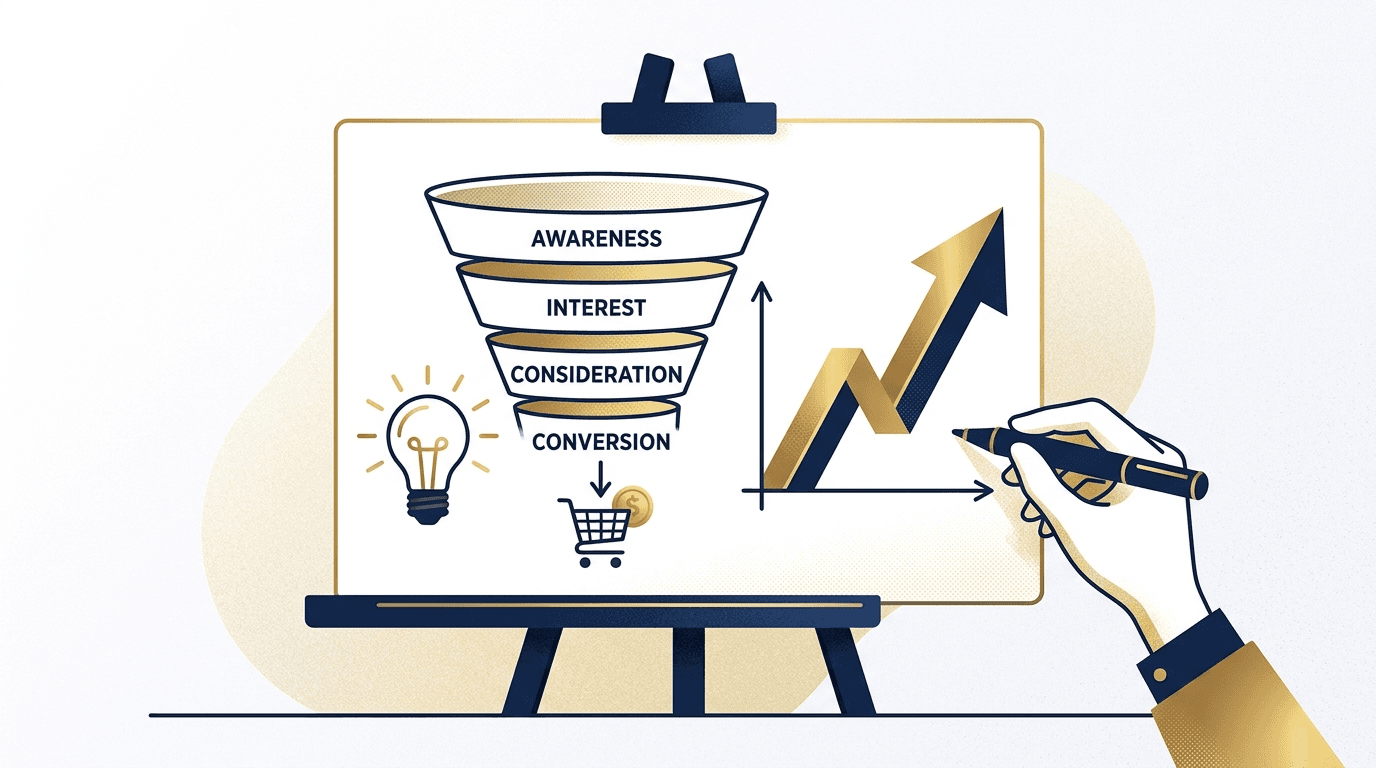
Keyword strategy mapped to funnel stage. Awareness keywords, consideration keywords, and decision-stage keywords are treated differently. The decision-stage keywords get the most resource because they drive the most valuable traffic.
Content architecture. Which pages need to be created, which need to be rewritten, and which need to be consolidated. Thin pages and duplicate content suppress rankings; a clean content architecture accelerates them.
Local SEO configuration. GBP setup and optimisation plan, citation audit, review acquisition process, and local link targets.
Link acquisition strategy. Not volume-based link building but targeted outreach to high-authority, locally relevant sources that will carry genuine ranking weight.
Perform: Execute, Measure, and Improve
Strategy without execution is guesswork, so the Perform phase is where the plan becomes real. It is also where accountability lives. Every month, we review performance against the business outcomes defined in the Profile phase, not against a set of activity metrics.
The Perform phase includes ongoing technical monitoring, content publication and optimisation, link building, GBP management, and conversion rate optimisation on organic landing pages. It also includes transparent reporting: you see what was done, what moved, and what is being adjusted.
Importantly, Perform is iterative. SEO in 2026 is not a set-and-forget exercise. Google's algorithm changes frequently, competitor behaviour changes, and your own business priorities change. The best-performing SEO campaigns are the ones that adapt continuously, guided by data, not by habit.
This is why "Profile, Plan, Perform" is not just a branding device. It is the operating rhythm that keeps every engagement oriented toward the right outcomes. When the data shows that a keyword strategy is not driving qualified leads, we revise it. When a technical issue is suppressing a high-value page, we fix it. When a competitor starts ranking above you for a critical term, we analyse why and respond.
Proof: Real SEO Results for Sydney and Australian Businesses
I want to be specific here, because vague claims about results are one of the things I criticise in other agencies. Here is what outcome-focused SEO actually produces.
312% Organic Traffic Growth for a Mortgage Broker, With 40+ Qualified Leads Per Month
A Queensland mortgage broker came to us stuck on page three for their primary keyword and generating almost no inbound enquiries. Their business ran almost entirely on referrals, which limited growth and made revenue unpredictable. The brief was not "get us to page one." The brief was "generate consistent inbound leads from people who are ready to apply."
We implemented a full 3P Framework engagement: technical site optimisation to fix crawlability and speed issues, content development around high-intent search terms (including suburb-level landing pages for their target service areas), and local authority building targeting the directories and associations relevant to their market.
Within six months, the broker moved to position one for their primary keyword. Organic traffic increased 312%. More importantly, they were generating 40-plus qualified leads per month from organic search alone, which reduced their dependence on referrals and gave them a predictable, scalable inbound pipeline for the first time. That is the shift from chasing leads to having them come to you.
46:1 ROI on SEO Investment for an Automotive Dealership Group
An automotive dealership group came to us frustrated that they could not connect their digital marketing spend to revenue outcomes. They had been investing in SEO for months without a clear picture of whether it was working.
We deployed a local SEO strategy combined with high-intent service page optimisation, targeting buyers actively searching for specific automotive services in the dealership's geographic markets. Critically, we also rebuilt their attribution model so that organic search-initiated enquiries could be tracked through to closed sales.
Within 12 months, the group achieved a 46:1 return on their SEO investment. That is the highest documented ROI across our client portfolio, and it was achievable because we built the measurement infrastructure alongside the SEO work. If you cannot measure the ROI, you cannot prove it. And if you cannot prove it, you cannot make the case for continued or increased investment.
63.5% Reduction in Cost Per Conversion for a Building and Pest Operator
A building and pest inspection operator was running Google Ads campaigns with high cost per conversion and significant wasted spend on leads outside their serviceable area. The operator was at capacity, managing demand manually, and needed better-qualified leads, not just more of them.
Our work included overhauling the Google Ads account (removing non-serviceable area targeting, improving ad relevance and Quality Scores, optimising bidding), which reduced cost per click by an average of $12.56. The result was 574 additional leads generated and a cost per conversion reduction of $37.93, representing a 63.5% reduction in what they were previously paying per conversion. The business subsequently hired additional staff to manage increased demand. That is not an activity metric. That is a business outcome.
Replacing Job Board Dependency With Owned Organic Channels
A national recruitment firm was spending heavily on job boards to attract candidates and clients. Costs were rising, lead volume was unpredictable, and the business had no fallback if job board pricing increased further (which it did).
By replacing job board dependency with an integrated SEO and content marketing strategy targeting both candidate and client search intent, we built an owned organic lead channel. The result was consistent, lower-cost pipeline: 574 leads at 63.5% lower cost per lead compared to the previous job board spend. The organic channel compounds. The job board spend would have stopped delivering the moment they paused it.
This is the core argument for owned channels: the economics improve over time, whereas rented platform costs almost always trend upward.
How to Get Started: Turning Sydney Search Traffic Into Qualified Leads
If you have read this far, you are probably not looking for a ranked list of agencies. You are looking for an SEO partner that will be accountable to outcomes, not activity.
Here is how I would approach the next 30 days if I were in your position.
Step 1: Define your success criteria before you talk to anyone. How many qualified leads per month would justify your SEO investment? What is your current cost per acquisition from your most expensive lead channel? What would a 46:1 ROI on SEO look like for your business? Write these numbers down. They will guide every agency conversation you have.
Step 2: Audit your current organic position. You do not need a paid tool for this. Run your top five highest-value keywords through Google and note where you rank. Check your Google Search Console data for which queries are generating impressions and clicks. Look at your Google Business Profile for completeness and recent reviews. This gives you a baseline.
Step 3: Identify your highest-cost lead channel and question whether it is sustainable. If you are spending $5,000 per month on job boards, paid directories, or lead marketplaces, calculate your cost per qualified lead from each. Then ask what it would take to replace 30% of that spend with owned organic channels within 12 months.
Step 4: Talk to 3P Digital. Book a strategy session and we will show you what a Profile-led SEO plan looks like for your specific business. We will review your current organic position, identify the highest-value keywords for your ICP, and give you a realistic picture of what qualified lead growth from organic search looks like in your market and timeline. No activity reports. Qualified leads, not activity reports. Real results, real growth.
Every dollar works harder when it is pointed at the right problem. The question is not which agency has the most impressive brochure. The question is which agency will be sitting across from you in 12 months, showing you the leads, the cost per conversion, and the pipeline that came from your SEO investment.
That is the standard we hold ourselves to at 3P Digital. It is the only standard that matters.
Frequently Asked Questions About SEO in Sydney
How long does SEO take to generate leads in Sydney?
For most Sydney businesses in competitive verticals, meaningful lead generation from organic search takes three to six months, with more substantial pipeline impact typically visible at the six to twelve month mark. Timelines depend on your current domain authority, the competitiveness of your target keywords, the quality of your existing content, and how quickly technical issues are resolved. Local SEO for suburb-level keywords can show results faster, often within eight to twelve weeks, because the competition density is lower than for city-wide terms. Anyone who promises page-one rankings within 30 days is either targeting low-value keywords or using tactics that carry long-term risk.
What does SEO cost for a Sydney small business?
Quality SEO for a Sydney SME typically ranges from $1,500 to $5,000 per month, depending on the competitiveness of the target keywords, the scope of technical work required, the volume of content needed, and whether local or national rankings are the target. The more useful question than "what does it cost" is "what is the cost per qualified lead from SEO compared to my current channels?" An SEO investment of $3,000 per month that generates 30 qualified leads is a $100 cost per lead. If you are currently paying $250 per lead from paid search or directories, the economics are clear. Always evaluate SEO as an investment with an expected return, not as a cost line.
Is SEO better than Google Ads for Sydney lead generation?
SEO and Google Ads serve different purposes and work best together, but the long-term economics favour SEO for most Sydney businesses. Google Ads delivers immediate visibility and can generate leads within days of launch, but the cost per lead is ongoing and often increases as competition in Sydney's key verticals drives up CPCs. SEO takes longer to produce results, but once rankings are established, the cost per lead falls over time as the organic asset appreciates. For businesses with an immediate lead gap, Google Ads fills it while SEO builds. For businesses thinking 12-24 months ahead, SEO is the higher-returning investment.
What is local SEO and do Sydney businesses need it?
Local SEO is the practice of optimising a business to appear prominently in Google's local search results, including the map pack (the three business listings that appear above organic results for location-based queries). For most Sydney service businesses, the map pack drives more qualified clicks than organic blue-link results because it signals proximity and relevance to searchers with immediate buying intent. Yes, Sydney businesses need local SEO. The Sydney market is geographically large and commercially dense, meaning that suburb-level targeting (for example, "accountant Chatswood" or "conveyancer Surry Hills") delivers higher conversion rates than generic city-level rankings. Google Business Profile optimisation, citation consistency, and review management are the three highest-leverage local SEO activities for most Sydney SMEs.
How do I know if my current SEO agency is actually delivering results?
The clearest sign that your current SEO agency is not delivering results is that you receive traffic reports without lead data. If your monthly report shows organic sessions and keyword rankings but does not show how many qualified leads came from organic search, how those leads compare to last month, and what your cost per organic conversion is, you are receiving an activity report, not a results report. Other warning signs include: rankings improving but enquiry volume flat, content being published that does not target buying-intent keywords, and a lack of transparency about what specific work was done and why. Request a reporting change. If the agency cannot or will not add lead and conversion data to their reporting, consider whether they are the right partner.
What industries does 3P Digital serve in Sydney?
3P Digital works with Sydney-based businesses across professional services, financial services (including mortgage broking), recruitment, fitness and wellness, trades and home services, automotive, and B2B services. The common thread is not industry but situation: business owners and marketing managers who want consistent, qualified leads and provable ROI, who have often been burned by agencies that reported activity without delivering outcomes. Our 3P Framework (Profile, Plan, Perform) adapts to different industries because the foundation is always a deep understanding of the specific ideal client and the specific search behaviour that signals buying readiness.
Can SEO work for B2B businesses in Sydney?
Yes, and often very effectively. B2B SEO in Sydney differs from B2C in that the keyword volumes are lower but the lead values are higher, which changes the economics substantially. A B2B professional services firm does not need 10,000 organic visitors per month. They need 50 highly qualified visitors per month, each of whom could represent tens or hundreds of thousands of dollars in contract value. We achieved a 247% increase in qualified enquiries for a B2B professional services client through an integrated SEO, paid media, and conversion optimisation approach. B2B SEO success requires precise ICP definition (which is why the Profile phase is critical), content that addresses the specific concerns of commercial buyers, and conversion architecture that gives decision-makers clear next steps.
What makes 3P Digital different from other Sydney SEO agencies?
The core difference is accountability. Our pay-per-performance model means we are commercially motivated to deliver outcomes, not to maintain retainers regardless of results. Our 98% client retention rate across 250-plus clients is evidence that this model works: clients renew because they see results, not because they are locked into long contracts. Practically, the difference shows up in how we define success (qualified leads and pipeline ROI, not traffic and rankings), how we report (lead data and cost per conversion, not sessions and keyword counts), and how we structure engagements (Profile-led, so we are always solving the right problem for the right audience, not running a generic SEO playbook).
References
Google Search Central, Core Web Vitals Documentation (2026). Google's official technical guidance on Core Web Vitals metrics (LCP, CLS, INP) as ranking signals, including threshold values and measurement tools. Google Search Central, developers.google.com/search.
Australian Bureau of Statistics (ABS), Business Counts by Industry and Region, 2026. ABS data on business registrations by industry and geographic area across Australian states and territories, used for contextualising competitive density in Sydney's SME market. abs.gov.au.
Google Business Profile Help Centre, Optimise Your Business Profile (2026). Google's official guidance on GBP ranking factors for local search, including category selection, review management, and post frequency as signals for local pack visibility. support.google.com/business.
ACCC, Digital Platforms Inquiry and Digital Advertising Services Inquiry Reports. Australian Competition and Consumer Commission reports examining platform dependency, digital advertising market dynamics, and the structural risks of reliance on dominant platforms for lead generation. accc.gov.au.
Ahrefs, Global SEO Industry Study (2026). Ahrefs' large-scale analysis of organic search click-through rates, SERP feature distribution, and the relationship between ranking position and traffic volume, used for informing keyword strategy prioritisation. ahrefs.com/blog.
BrightLocal, Local Consumer Review Survey (2026). Annual survey data on Australian and global consumer behaviour regarding Google Reviews: how review volume, recency, and rating affect both local pack rankings and conversion rates for service businesses. brightlocal.com.