How to Build a Content Marketing Funnel That Actually Generates Leads: A Practical Guide for Australian Businesses
Most Australian businesses are producing content without a funnel. They publish blog posts, share them on LinkedIn, get a handful of clicks, and then wonder why their content budget never seems to translate into enquiries. The problem is not the content itself. The problem is architecture. Without a funnel, content is just expensive noise.
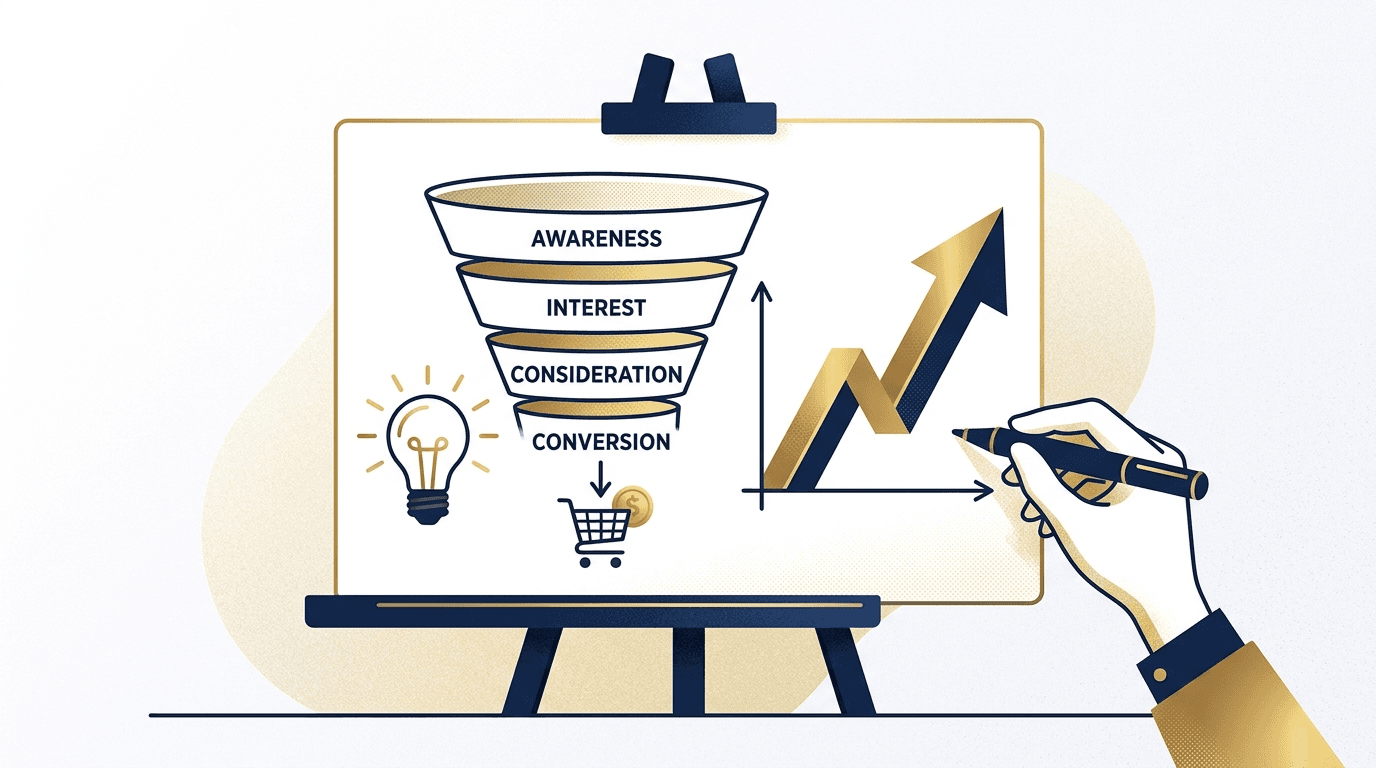
A content marketing funnel is the strategic framework that takes a complete stranger and moves them through awareness, consideration, and decision stages until they raise their hand and ask to work with you. When it is built correctly, it compounds over time. Content you publish today continues generating leads six, twelve, even twenty-four months from now. That is the fundamental difference between content that costs money and content that makes money.
In this guide, I am going to walk you through exactly how we build content marketing funnels for Australian businesses at 3P Digital. You will get the full architecture, the specific content formats for each stage, the KPIs that actually matter, and two real case studies showing what this looks like when it works. If you are serious about turning your content into a lead generation engine rather than a vanity exercise, this is the guide you need.
Key Takeaways
Content without funnel mapping is expensive noise. Most Australian businesses publish content at the awareness stage only and never convert readers into leads.
Every funnel stage requires different content formats, different CTAs, and different success metrics. A blog post and a case study serve completely different purposes.
A well-built content funnel takes six to twelve months to compound meaningfully, but early signals like email opt-ins and time-on-page appear within weeks.
Lead magnets, email nurture sequences, and retargeting audiences are the connective tissue between your top-of-funnel traffic and bottom-of-funnel conversions.
Measurement matters from day one. GA4 event tracking and multi-touch attribution are non-negotiable if you want to prove content ROI to stakeholders.
The businesses that win with content in Australia are not those publishing the most. They are those publishing the most strategically.
Summary Table: Content Marketing Funnel at a Glance
Funnel Stage | Content Types | Primary KPI | Australian Example |
Top of Funnel (TOFU) | Blog posts, SEO guides, short-form video, podcasts, social content | Organic traffic, impressions, new users | A mortgage broker publishing "How much can I borrow on a $120k salary in Australia?" |
Middle of Funnel (MOFU) | Lead magnets, email sequences, webinars, comparison guides, case study teasers | Email opt-in rate, lead magnet downloads, email open rate | A recruitment agency offering a free "2026 Salary Guide for Tech Roles in Australia" |
Bottom of Funnel (BOFU) | Full case studies, ROI calculators, consultation landing pages, testimonial pages, comparison pages | Conversion rate, cost per lead, booked calls | A fitness franchise publishing "How [Client Name] Added 47 Members in 90 Days" with a free trial CTA |
Why Most Content Marketing Fails: No Funnel Architecture
Let me be direct about something. The reason most Australian businesses fail at content marketing is not lack of effort. It is lack of strategy. Specifically, it is the absence of funnel architecture.
Here is what typically happens. A business owner reads that content marketing is important. They hire a copywriter or an SEO agency and start publishing blog posts. The posts are reasonably well-written. Some of them rank. Traffic ticks up. And then... nothing. No leads. No enquiries. No ROI.
The Content Marketing Institute's 2026 research consistently shows that businesses with a documented content strategy outperform those without one by a factor of three to one in terms of lead generation effectiveness. Yet a significant proportion of Australian SMEs still operate without a documented content plan, let alone a funnel strategy.
The core issue is that awareness-stage content and conversion-stage content are completely different animals. A blog post titled "What is mortgage lenders mortgage insurance?" serves someone at the very beginning of their homebuying research. It is never going to convert that reader into a booking on its own. But if that post captures them into an email sequence and retargeting audience, and that sequence eventually serves them a comparison guide, and that guide leads them to a case study, and that case study leads them to a free consultation page, you have a funnel. You have a system that nurtures a stranger into a lead.
Without that connective tissue, every piece of content you publish is essentially a dead end.
The Compounding Effect Australian Businesses Are Missing
One of the most powerful arguments for building a proper content funnel is the compounding return. Paid advertising stops the moment you stop paying. Content compounds. A well-optimised article published today will generate traffic and leads in 2028 with zero additional spend. HubSpot's State of Marketing data consistently shows that inbound leads generated through content have a significantly lower cost per acquisition over a twelve-month period compared to paid channels alone.
For Australian businesses operating with tighter marketing budgets than their US counterparts, this compounding effect is particularly valuable. The catch is that it only compounds when the funnel is properly built. Traffic without conversion architecture is just a vanity metric.
Anatomy of a Content Marketing Funnel: TOFU, MOFU, and BOFU Explained
Before we get into tactics, let us establish a shared vocabulary. A content marketing funnel has three stages, and each one serves a distinct purpose in the buyer journey.
Top of Funnel (TOFU): Creating Awareness
TOFU content targets people who have a problem or question but may not yet know your business exists. They are searching Google, watching YouTube, or scrolling LinkedIn. They are not ready to buy. They are researching.
The goal of TOFU content is not to sell. It is to attract qualified strangers, build brand recognition, and capture them into your ecosystem, whether that is through an email opt-in, a retargeting pixel, or a social follow.
In the Australian context, TOFU content often performs best when it speaks to specifically local concerns. A Sydney-based professional services firm writing about "how to choose an accountant in Australia" rather than generic accounting advice will attract a far more qualified audience than one writing for a global readership.
Middle of Funnel (MOFU): Building Consideration
MOFU content targets people who are aware of their problem and actively evaluating solutions. They know they need help, but they have not yet decided who to trust or which solution is right for them.
This is where most content strategies fall apart. Businesses invest heavily in TOFU blog content and then jump straight to "contact us" CTAs. There is a massive gap in between that MOFU content fills. Lead magnets, email sequences, comparison guides, and educational webinars all live in this stage.
The conversion mechanism here is critical. A MOFU piece should always have a clear next step that moves the reader deeper into your ecosystem. That might be downloading a guide, registering for a webinar, or joining an email list.
Bottom of Funnel (BOFU): Driving Decisions
BOFU content targets people who are ready to make a decision. They just need the final proof point that you are the right choice. This is where case studies, ROI calculators, testimonial pages, and consultation landing pages do their heaviest lifting.
BOFU content is often the most neglected in Australian SME content strategies. Businesses spend time and budget on blog posts that attract strangers but forget to build the proof-based content that actually converts warm prospects into paying clients.
Mapping Content Types to Each Funnel Stage
Understanding the theory is one thing. Knowing exactly which content format to use at each stage is where strategy becomes execution.
TOFU Content Formats
SEO Blog Posts: Long-form, keyword-optimised articles targeting informational search queries. These are the workhorses of any TOFU strategy. The key is intent mapping: you need to match your content to what your ideal client is actually searching for, not what you think they should care about. Our SEO intent mapping guide covers this process in detail.
Short-Form Video: LinkedIn video, Instagram Reels, and YouTube Shorts are increasingly powerful TOFU distribution channels in Australia. A thirty-second video answering a common industry question can reach thousands of people in your target market without a single dollar of paid spend.
Podcast Episodes: For professional services businesses in Australia, podcasting has become a meaningful TOFU channel. It builds authority and trust in a way that written content alone cannot replicate.
Organic Social Content: Not every piece of TOFU content needs to be a 2,000-word article. A punchy LinkedIn post that identifies a common problem your audience has can attract shares, followers, and website visits.
MOFU Content Formats
Lead Magnets: The lead magnet is the cornerstone of any MOFU strategy. It is a high-value piece of content offered in exchange for an email address. Effective lead magnets in the Australian market include salary guides, industry benchmark reports, checklists, templates, and mini-courses. The key is specificity: a "2026 Digital Marketing Benchmark Report for Australian Professional Services Firms" will outperform a generic "Marketing Tips PDF" every single time.
Email Nurture Sequences: Once you have captured an email address, the nurture sequence is how you move that prospect toward a decision. A well-built sequence delivers value over five to ten emails, builds trust, addresses objections, and eventually presents a clear CTA. Most Australian businesses either do not have nurture sequences or they have one generic email that says "thanks for downloading."
Comparison Guides: Content that helps a prospect understand the difference between options, whether that is DIY versus agency, one software versus another, or different service tiers, is highly effective at the MOFU stage because it meets the reader exactly where they are in their research.
Webinars and Live Events: For B2B businesses especially, a well-run webinar is one of the highest-converting MOFU assets you can build. It combines education with a live interaction opportunity, and it filters for highly engaged prospects.
BOFU Content Formats
Case Studies: A properly structured case study is the single most powerful piece of BOFU content you can produce. It needs to include a specific client situation, a measurable problem, the solution implemented, and the quantified outcome. Vague testimonials are not case studies. Real metrics matter.
ROI Calculators: Interactive tools that help a prospect calculate the potential return from working with you are highly effective BOFU assets because they make abstract value concrete. If a mortgage broker's calculator shows a prospect they could save $47,000 over the life of their loan by refinancing, that is a powerful conversion mechanism.
Consultation Landing Pages: Your "book a call" or "get a free strategy session" page is BOFU content. It needs to be treated with the same care as any other piece of content: clear headline, specific value proposition, social proof, and a friction-reduced CTA.
Testimonial and Review Pages: Aggregated social proof in a structured format gives hesitant buyers the final reassurance they need.
For a deeper look at how content assets connect to conversion, our conversion optimisation services page explains how we approach CRO as an extension of content strategy.
How to Build Your TOFU Engine: SEO, Intent Mapping, and Topic Clusters
Building a TOFU engine that consistently drives qualified traffic requires three interlocking components: keyword intent mapping, topic cluster architecture, and distribution.
Keyword Intent Mapping for Australian Audiences
Not all keywords are created equal. The most important distinction for TOFU content is between informational, navigational, commercial, and transactional intent. TOFU content should target informational and, to a lesser extent, commercial investigation queries.
For Australian audiences, this also means localising your keyword research. "Mortgage broker fees" and "mortgage broker fees Australia" are different keywords with different competition profiles. "How to register a business" and "how to register a business in Queensland" serve different audiences. Specificity wins in local SEO.
We use a four-quadrant intent mapping framework at 3P Digital that plots keywords by search volume and buyer readiness. High-volume, low-readiness keywords get TOFU treatment. Lower-volume, high-readiness keywords get BOFU treatment. This prevents the common mistake of optimising a high-converting BOFU page for an informational keyword and vice versa.
Topic Cluster Architecture
Google's current ranking algorithms reward topical authority, not just individual page optimisation. A topic cluster approach means you build one comprehensive "pillar" page on a broad topic and then create a constellation of supporting "cluster" content around it, each targeting a specific subtopic and linking back to the pillar.
For example, a pillar page on "content marketing for Australian businesses" might be supported by cluster articles on "content marketing for mortgage brokers," "content marketing for professional services Australia," "how to measure content marketing ROI," and so on. Each cluster article ranks for its own specific query and funnels authority and internal link equity back to the pillar.
This architecture also mirrors the buyer journey. Someone who reads three or four cluster articles is significantly more engaged and more likely to convert than someone who reads one article and leaves.
Distribution: Amplifying Your TOFU Content
Creating content without a distribution plan is like opening a restaurant and not telling anyone about it. Every piece of TOFU content needs a distribution checklist:
Social sharing across relevant platforms (LinkedIn is priority for B2B, Instagram for consumer-facing)
Email broadcast to existing subscribers
Repurposing into video or audio for additional reach
Outreach to relevant publications or aggregators for backlinks and traffic
Paid amplification on social for high-priority pieces
The Australian digital marketing landscape in 2026 is competitive, particularly in high-value niches like professional services and finance. Organic reach alone is rarely sufficient. A modest paid amplification budget behind your best TOFU content dramatically accelerates the compounding effect.
MOFU: Converting Readers Into Leads
Getting traffic is the easy part. Converting that traffic into trackable leads is where most content strategies stall. The MOFU stage is your conversion engine, and it requires deliberate architecture.
Building Lead Magnets That Actually Get Downloaded
The most common reason lead magnets fail is that they are not specific enough. A generic eBook titled "10 Marketing Tips" competes with thousands of similar assets and offers no compelling reason to exchange an email address.
A high-converting lead magnet in the Australian market has four characteristics: it is specific to a defined audience, it solves an immediate problem, it promises a tangible outcome, and it is credible. "The 2026 Salary Guide for Marketing Professionals in Australian Mid-Market Companies" hits all four. "Marketing Guide" hits none.
The format matters less than the specificity and perceived value. PDF guides, templates, checklists, video courses, and tool kits all convert well when the content is genuinely valuable.
Email Nurture: The Engine Behind the Funnel
Once someone downloads your lead magnet, the nurture sequence begins. A well-structured sequence does not pitch immediately. It delivers value first, builds trust, and creates a relationship before it asks for anything.
A basic five-email nurture sequence for a B2B professional services business might look like this:
Email 1 (Immediate): Deliver the lead magnet, introduce yourself briefly, set expectations for what is coming.
Email 2 (Day 2): Teach something genuinely useful related to the prospect's problem. No pitch.
Email 3 (Day 4): Share a relevant case study or client outcome. Let social proof do the work.
Email 4 (Day 7): Address the most common objection your prospects have. Be honest about it.
Email 5 (Day 10): Present a clear, low-friction CTA. Free consultation, free audit, free strategy call.
This sequence architecture can be extended and refined, but even five emails significantly outperforms businesses who send one thank-you email and then go silent.
Retargeting: Staying in Front of MOFU Audiences
Retargeting is the bridge between TOFU and MOFU for prospects who did not convert on their first visit. A prospect who read your blog post but did not opt in is not a lost cause. With a properly configured Meta or Google retargeting audience, you can serve them your lead magnet offer for days or weeks after their visit.
In the Australian market, retargeting CPMs are generally lower than comparable US campaigns, making this a cost-effective way to keep your brand in front of warm prospects during their consideration phase. Budget as little as $10 to $20 per day on retargeting can meaningfully improve MOFU conversion rates.
BOFU: Closing With Content
BOFU content exists to give a warm prospect the final confidence they need to act. At this stage, they know their problem, they understand the solutions available, and they are evaluating providers. Your BOFU content needs to answer one question: why you, specifically?
Writing Case Studies That Actually Convert
A case study is the most powerful BOFU asset in most content funnels. But most Australian business case studies are too vague to convert. They say things like "we helped a client improve their digital presence" without any specifics. That is not a case study. That is a vague testimonial.
A converting case study has five sections:
Client context: Who is the client, what is their industry, and what was their situation before working with you?
The problem: What specific, measurable challenge were they facing? Be honest and concrete.
The solution: What did you do, specifically? What strategy, tools, and processes were involved?
The outcome: Quantified results with timeframes. Not "significant improvement" but "47% increase in qualified enquiries over 90 days."
The CTA: A direct invitation for similar businesses to get the same outcome.
Case Study 1: Mortgage Broking Firm, Melbourne
A Melbourne-based mortgage broking firm came to 3P Digital in early 2026 with a common problem: they were generating website traffic from paid Google Ads but their cost per lead had climbed to over $280 per enquiry and the quality was inconsistent. We built a content funnel targeting informational keywords in the homebuyer journey, including "how much deposit do I need in Victoria," "first home buyer grants 2026," and "how to compare home loan rates." These TOFU articles fed into a lead magnet: a "First Home Buyer Checklist for Victorian Buyers" which captured email addresses. A seven-email nurture sequence followed, ending with a free 30-minute "loan strategy call" CTA. Within six months, organic traffic to the site increased by 214%. Email list grew to 1,840 subscribers. Cost per qualified lead from content channels came in at $43, compared to $280 from paid search. The firm now generates approximately 35 to 40 content-attributed enquiries per month.
Case Study 2: Recruitment Agency, Sydney
A specialist technology recruitment agency in Sydney had strong industry knowledge but zero content presence. Competitors were ranking for searches like "technology recruitment agency Sydney" and "how to hire a software developer in Australia" and capturing leads the firm could not access. We built a topic cluster strategy anchored by a pillar page on tech recruitment in Australia, supported by fourteen cluster articles covering salary guides, hiring process timelines, and remote hiring frameworks. A "2026 Australian Tech Salary Report" lead magnet captured 620 new email subscribers in the first ninety days. MOFU webinars on "How to Hire Your First Senior Engineer" converted at 18% from registration to booked consultation. Within nine months, the firm ranked on page one for eleven of its target keywords, organic-attributed revenue grew by $340,000 in annualised new client billings, and content overtook LinkedIn outreach as the firm's primary lead source.
ROI Calculators and Interactive BOFU Tools
If your service has a measurable financial outcome, an ROI calculator is one of the highest-leverage BOFU tools you can build. It makes your value proposition tangible and personal to each prospect. A recruitment agency might build a "cost of a bad hire calculator." A digital marketing agency might build a "content marketing ROI estimator." These tools convert because they create an "aha" moment: the prospect can see exactly what the problem is costing them and what the solution is worth.
Client Testimonial: "Before working with 3P Digital, we were publishing blog posts regularly but had no idea if any of it was working. They rebuilt our entire content approach around a proper funnel strategy. Within eight months we were generating more qualified leads from our content than from our paid ads, at a fraction of the cost. The structure they brought changed everything." — Marketing Manager, Technology Recruitment Agency, Sydney
Measuring Funnel Performance: GA4 Setup, Attribution, and Benchmarks
A content funnel you cannot measure is a funnel you cannot improve. Measurement is not optional, and in 2026 with GA4 as the standard analytics platform, there is no excuse for flying blind.
GA4 Configuration for Content Funnels
The default GA4 setup is insufficient for content funnel measurement. You need to configure custom events that track the specific micro-conversions in your funnel:
Lead magnet download (form submission event with lead magnet name as a parameter)
Email opt-in confirmation
Blog scroll depth (tracking users who read 75% or more of an article)
Video engagement (plays and completions)
CTA click events (differentiated by funnel stage)
Booked call or consultation form submission
With these events configured, you can build GA4 exploration reports that show exactly where in the funnel prospects are dropping off and which content assets are generating the highest conversion rates. Our analytics services team sets up these custom event frameworks as part of every content funnel engagement.
Attribution: Understanding Which Content Converts
Attribution is where content marketing ROI gets complicated. A prospect might read four blog posts, download a lead magnet, receive a nurture sequence, click a retargeting ad, and then book a call. Which touchpoint gets credit?
Data-driven attribution in GA4, combined with UTM parameters on all your distribution activities, gives you a multi-touch view of the content journey. This is critical for making intelligent decisions about where to invest your content budget. First-click attribution will tell you blog posts are driving everything. Last-click attribution will tell you your consultation page is driving everything. Neither is the full picture.
Australian Content Marketing Benchmarks for 2026
Based on aggregated data from Australian digital marketing benchmarks and our own client portfolio, here are realistic performance benchmarks for a well-built content funnel:
TOFU blog post CTR from organic search: 2% to 5% (position 1 to 3)
Lead magnet opt-in rate from dedicated landing page: 25% to 45%
Email nurture sequence open rate: 35% to 50% (Australian B2B, permission-based list)
Consultation booking rate from bottom of funnel CTA: 8% to 15%
Time to meaningful traffic from new content: Three to six months
Time to consistent lead flow from content: Six to twelve months
These benchmarks exist to calibrate expectations, not to guarantee outcomes. Your actual performance will depend on your industry, competition level, content quality, and how well your funnel is integrated.
How 3P Digital Builds Content Funnels Using the 3P Framework
Every content funnel we build at 3P Digital runs through our proprietary 3P Framework: Profile, Plan, Perform. It is not a generic process. It is a structured methodology that ensures content strategy is grounded in real audience insight before a single word is written.
Profile: We start by building a detailed Ideal Client Profile (ICP) for your business. This includes psychographic and behavioural mapping, not just demographics. We identify the specific questions your ideal clients are asking at each stage of their buying journey, the objections they have, and the proof points they need. Without this foundation, content strategy is guesswork.
Plan: We map a full-funnel content architecture based on the Profile findings. This includes keyword intent mapping for TOFU, lead magnet design for MOFU, and case study and conversion page strategy for BOFU. We also define the distribution plan, email sequence structure, and analytics configuration before any content is produced.
Perform: We execute, measure, and iterate. Content is published, tracked, and refined based on real performance data. No set-and-forget. A funnel that is not being actively optimised is a funnel that is slowly dying.
This approach is what separates a content strategy that compounds from one that flat-lines after three months. If you want to explore what a full-funnel content strategy looks like for your business specifically, our content marketing services page outlines the engagement models we offer, and you can book a strategy session here.
For a broader overview of how content marketing fits within the Australian digital landscape, our content marketing services Australia guide is a useful companion resource to this article.
Frequently Asked Questions
How long does it take to see results from a content marketing funnel?
You should expect early signals, such as improving organic impressions, email list growth, and increased time-on-page, within the first six to twelve weeks. Meaningful lead flow from organic content typically begins at the three-to-six month mark, with consistent, compounding results appearing from six to twelve months onwards. This assumes a properly structured funnel with regular content publication and active distribution. Businesses that expect overnight results from content will be disappointed. Those who commit to the system for twelve months are generally very pleased with what they see.
How much budget do I need to build a content marketing funnel?
For an Australian SME, a functional content funnel can be built on a monthly investment of between $3,000 and $8,000, depending on your industry competitiveness, content volume, and whether you are doing any paid amplification. This covers content production, technical SEO, email automation setup, and basic analytics configuration. Mid-market businesses with higher competition or faster growth targets typically invest $8,000 to $20,000 per month. The key point is that content investment should be evaluated on a twelve-month horizon, not a monthly cost-per-lead basis, because the compounding return changes the economics significantly over time.
Should I build my content funnel in-house or use an agency?
The honest answer is that it depends on your internal capability and capacity. A content funnel requires skills across SEO, copywriting, email marketing, analytics, and conversion optimisation. If you have strong in-house capabilities across all of these, building in-house is viable. Most Australian SMEs and mid-market companies have one or two of these skills internally but not all of them. An agency like 3P Digital brings the full stack and the strategic coordination that keeps the funnel performing as a unified system rather than a collection of disconnected tactics. A hybrid model, where the agency builds and manages the strategy and an internal team handles some execution, is often the most cost-effective approach for mid-market businesses.
How do I measure content marketing ROI?
Content marketing ROI is calculated by comparing the revenue attributed to content-driven leads against the total investment in producing and distributing that content. The formula is: (Revenue from Content Leads minus Content Investment) divided by Content Investment, multiplied by 100. The challenge is attribution. You need GA4 configured with custom events and multi-touch attribution modelling to accurately track which content assets are contributing to conversions. Without this infrastructure, you are estimating rather than measuring. Our analytics services team configures this tracking framework as a standard part of any content engagement.
What is the best CMS for building a content marketing funnel?
For most Australian businesses, WordPress remains the most flexible and SEO-friendly CMS for content-driven websites, particularly when combined with a solid technical SEO setup. HubSpot CMS is an excellent option for businesses that want native CRM and email marketing integration. Webflow is increasingly popular for design-forward businesses. The CMS choice matters less than the technical configuration: page speed, clean URL structures, proper schema markup, and mobile optimisation are more important than which platform you build on. What you want to avoid is a locked-down website builder that limits your ability to add structured data, customise meta tags, or integrate your email and analytics tools properly.
What are the most common mistakes Australian businesses make with content funnels?
The five most common mistakes we see are: publishing only TOFU content with no MOFU or BOFU strategy; using generic lead magnets that do not convert; having no email nurture sequence after a lead magnet download; measuring content success by traffic alone rather than lead quality; and failing to build internal links between content pieces. The last one is surprisingly impactful. Internal linking is the plumbing of a content funnel. Without it, a reader who finishes your blog post has nowhere to go, and you lose the opportunity to move them deeper into the funnel.
Can content marketing work for niche Australian industries like mortgage broking or recruitment?
Absolutely, and in some ways it works better in niche industries because the competition for specific long-tail keywords is lower and the audience is more defined. The mortgage broking and recruitment sectors in Australia are both high-trust, high-consideration purchase categories. Buyers in these markets research extensively before committing to a provider. A well-built content funnel that answers their specific questions and builds trust over time is perfectly suited to this buying behaviour. Both of our case studies in this article are from exactly these sectors, and the results speak for themselves.
How often should I publish content to keep my funnel active?
Quality and consistency both matter. For most Australian SMEs, publishing two to four well-researched, properly optimised blog posts per month is more effective than publishing ten thin pieces. The frequency should match your capacity to produce genuinely valuable content, not an arbitrary posting schedule. At the TOFU stage, consistency builds topical authority over time. At the MOFU and BOFU stages, the assets you build, such as lead magnets, case studies, and email sequences, do not require the same publishing cadence. They need to be built once and then maintained. Focus your content calendar on TOFU volume and MOFU/BOFU quality.
References
Content Marketing Institute, 2026 B2B Content Marketing Report - Annual benchmark study tracking content marketing adoption, strategy documentation, and performance outcomes across B2B organisations globally. Regularly cited as the most comprehensive dataset on content marketing effectiveness.
HubSpot State of Marketing Report, 2026 - HubSpot's annual survey of marketing professionals covering channel performance, budget allocation, lead generation tactics, and ROI benchmarks. Provides strong comparative data on inbound versus outbound lead costs.
Demand Gen Report, Content Preferences Survey - Research into B2B buyer content consumption habits, including which content types influence purchase decisions at each stage of the buying journey. Particularly useful for MOFU and BOFU content strategy.
Australian Digital Marketing Benchmarks Report, 2026 - Published by industry bodies and aggregated from Australian agency and brand data, this report provides locally relevant benchmarks for email open rates, CPL by channel, and content engagement metrics specific to the Australian market.
Google Search Central Documentation on Helpful Content - Google's official guidance on quality content standards, E-E-A-T principles, and how the helpful content system evaluates pages. Essential reference for any SEO-informed content strategy.
Salesforce State of the Connected Customer, 2026 - Research into buyer behaviour and digital expectations, including data on how many touchpoints buyers require before making a purchase decision. Highly relevant to understanding why multi-stage funnel content is necessary.