LinkedIn Ads for B2B Lead Generation in Australia: How to Build Campaigns That Actually Convert in 2026
Most Australian B2B advertisers waste more than 60% of their LinkedIn budget. Not because the platform doesn't work, but because they approach it the same way they approach Google Ads: bid on intent, send to a landing page, wait for conversions. That model fails on LinkedIn almost every time.
LinkedIn is not a search platform. Your audience isn't actively looking for you right now. They're scrolling a professional feed between meetings, passively consuming content, and building opinions about vendors before they ever raise their hand. If your campaign structure doesn't account for that buyer psychology, you'll burn through budget fast and walk away convinced LinkedIn doesn't work for your industry. It does. You just need to build it differently.
This guide covers the specific mechanics of profitable LinkedIn B2B lead generation campaigns for the Australian market in 2026. I'll walk you through campaign architecture, audience layering, ad format selection, realistic cost-per-lead benchmarks, retargeting sequences, and attribution setup. Whether you're allocating your first $3,000 or optimising a $30,000 per month account, the principles here will help you stop wasting spend and start generating leads that actually close.
Key Takeaways
LinkedIn Lead Gen Forms consistently outperform landing pages for top-of-funnel B2B lead capture, but landing pages win at the bottom of the funnel where intent is higher.
Australian B2B advertisers should expect a CPL range of $50 to $150 depending on industry, seniority level, and offer type — much higher than Google Ads but with significantly better lead quality in most cases.
Audience layering using job title plus company size plus industry is the minimum viable targeting setup. Relying on job titles alone inflates your audience with unqualified contacts.
Campaign structure matters more than creative. Most underperforming accounts have the wrong objective selected, not the wrong ad design.
Retargeting sequences that move leads from awareness to consideration to conversion over 30 to 60 days consistently outperform single-stage campaigns.
LinkedIn is not the right channel for every B2B business. If your ACV (average contract value) is under $5,000, the economics rarely work without a very tight funnel.
Summary Table: LinkedIn Ad Formats by Objective, Cost, and Conversion Rate
Ad Format | Best Objective | Avg. CPM (AU) | Avg. CTR | Conversion Rate | Best Use Case |
Single Image Ad | Awareness, Lead Gen | $25–$45 | 0.4%–0.8% | 2%–5% (LGF) | Brand awareness, ebook downloads, webinar sign-ups |
Carousel Ad | Consideration | $25–$40 | 0.5%–1.0% | 1.5%–4% | Multi-feature product, case study storytelling |
Video Ad | Awareness, Retargeting | $20–$35 | 0.2%–0.5% | 1%–3% | Brand intro, explainer, testimonials |
Document Ad | Engagement, Lead Gen | $20–$38 | 1.0%–2.5% | 3%–7% (LGF) | Whitepapers, frameworks, industry reports |
Conversation Ad | Lead Gen, Nurture | $0.30–$0.80/send | 35%–60% open rate | 5%–12% | High-intent outreach, event invites, demo requests |
Thought Leader Ad | Awareness, Trust | $22–$40 | 0.6%–1.2% | 2%–5% | Executive-led content, founder posts |
Message Ad | Direct Response | $0.25–$0.70/send | 25%–45% open rate | 3%–8% | Targeted offers, event follow-up |
CPM and CTR estimates based on Australian B2B campaign benchmarks as of 2026. Actual results vary by industry, audience size, and offer quality.
Why LinkedIn Ads Are Different From Every Other Paid Channel
If you've ever heard someone say "we tried LinkedIn and it didn't work," I can almost guarantee they made one of two mistakes. Either they sent cold traffic to a generic landing page with a contact form, or they ran a campaign for three weeks, got frustrated with the CPL, and turned it off before the algorithm had time to learn.
LinkedIn operates on fundamentally different logic than Google or Meta.
Google Ads captures existing demand. Someone types "HR software for small business Australia" and you show up. The intent is explicit. The purchase window is short.
Meta Ads works on interest and behavioural data. You can reach people who look like your customers, but you're fishing in a consumer-dominated pool where B2B signals are weak.
LinkedIn is the only platform where professional identity is the core data layer. Job title, seniority, company size, industry, skills, years of experience, and group membership are all first-party, user-verified data. That's enormously valuable for B2B targeting. But it comes with a trade-off: LinkedIn users are not in buying mode when they're on the platform. They're in professional development mode. That changes everything about how you need to structure your campaigns.
The implication is that LinkedIn campaigns need longer runway, more sequenced touchpoints, and offers calibrated to the stage of awareness rather than pushing straight for a demo or a quote. When you build it that way, the channel becomes one of the most powerful B2B lead generation tools available to Australian marketers.
The LinkedIn Audience Advantage in the Australian Market
As of 2026, LinkedIn has more than 6 million Australian members, with strong penetration in financial services, technology, professional services, construction, and healthcare. For B2B advertisers targeting mid-market and enterprise decision-makers in Australia, this concentration is significant.
Australia is a relationship-driven market. Decision-makers here often need more trust signals before engaging with an unknown vendor compared to, say, US buyers who are more transactional. That makes LinkedIn's ability to deliver authority content (thought leadership, case studies, frameworks) at scale particularly well-suited to how Australian B2B buying decisions actually work.
If you want to understand how we build the strategic foundation before launching any paid campaign, our 3P Framework covers the Profile, Plan, and Perform methodology we use across all client engagements.
Campaign Structure That Works for Australian B2B
Before you touch ad creative or targeting, you need to get your campaign architecture right. This is where most accounts go wrong first.
LinkedIn Campaign Manager organises activity into three levels: Campaign Groups, Campaigns, and Ads. The mistake most advertisers make is dumping everything into one campaign and hoping for the best. A well-structured account separates campaigns by funnel stage, not just by ad format.
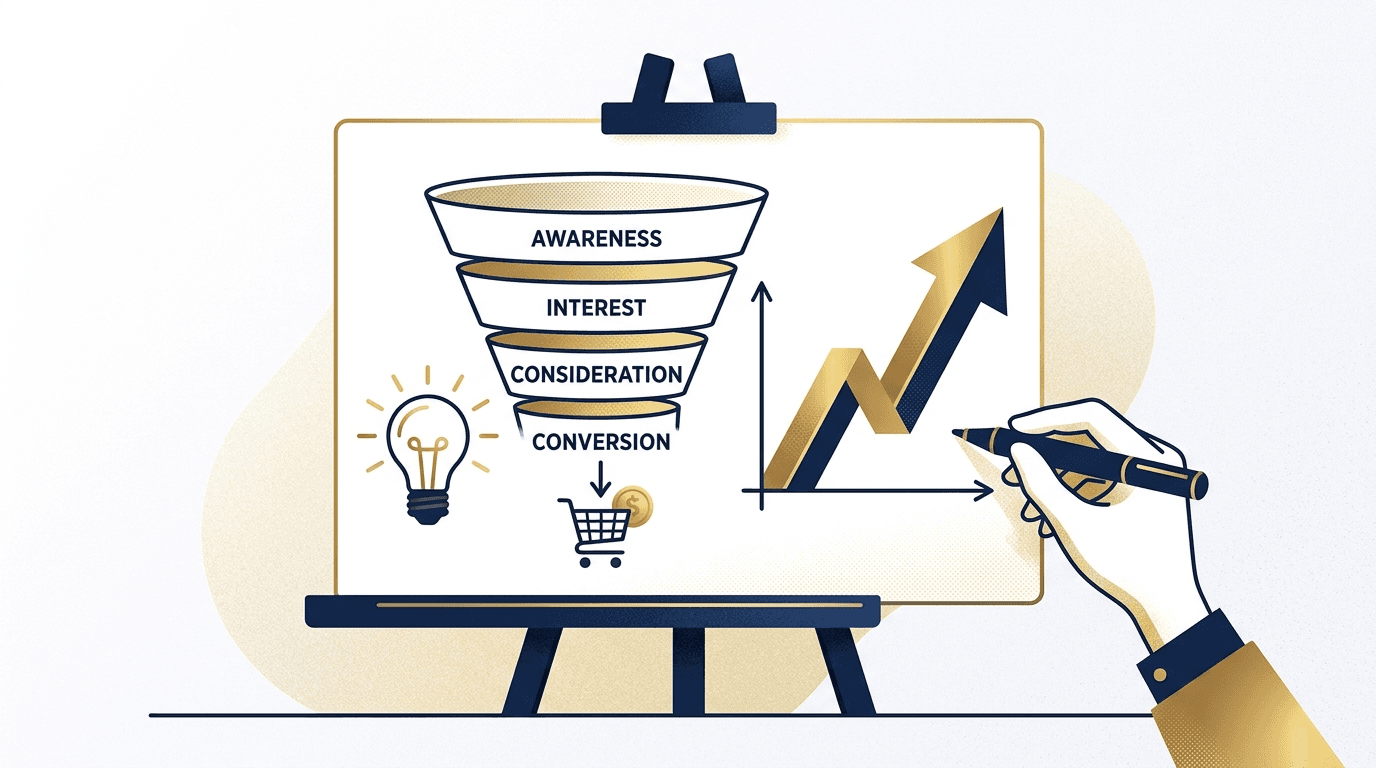
The Three-Stage Campaign Architecture
Stage 1: Awareness (TOFU) Objective: Brand Awareness or Video Views Audience: Broad but qualified (job title + industry + company size) Content: Thought leadership articles, short-form video, industry data, founder perspective posts Budget: 30%–40% of total spend
Stage 2: Consideration (MOFU) Objective: Engagement or Lead Generation Audience: Engaged with TOFU content (website visitors, video viewers, company page engagers) Content: Case studies, whitepapers, document ads, webinar invitations Budget: 40%–50% of total spend
Stage 3: Conversion (BOFU) Objective: Lead Generation or Website Conversions Audience: Retargeted from MOFU engagement, CRM list uploads Content: Demo requests, free audits, discovery call invitations, ROI calculators Budget: 20%–30% of total spend
This structure ensures you're building a warm audience before asking for conversion, which is the single biggest structural improvement most accounts need.
Naming Conventions and Organisation
Use consistent naming conventions so you can read performance at a glance. A format like [Stage]_[Audience]_[Format]_[Date] keeps Campaign Manager readable as your account grows. For example: TOFU_FinanceManagers_DocAd_Jan26. This saves hours when you're reviewing performance across multiple campaigns and becomes essential when you have a media agency or internal team sharing access.
Audience Targeting: Beyond Job Titles
Job title targeting is the starting point, not the finish line. LinkedIn's job title data is messy. The same role might be listed as "Head of Finance," "CFO," "Finance Director," or "Chief Financial Officer" depending on how that person chose to describe themselves. If you only target "CFO" you'll miss a significant chunk of your actual audience.
Layered Targeting Strategy
The most effective audience targeting on LinkedIn combines at least three dimensions:
Layer 1: Job Function or Job Title (broad) Start with Job Function (e.g., Finance, Operations, IT) rather than specific titles. This casts a wider net that captures title variations.
Layer 2: Seniority Level Narrow to the decision-making tier: Senior, Manager, Director, VP, C-Suite, Owner. This prevents your ads from reaching junior staff who have no procurement authority.
Layer 3: Company Size and/or Industry This is where you qualify for fit. If your product is designed for companies with 50 to 500 employees, add that filter. If you serve specific industries (e.g., professional services, recruitment, healthcare), add that too.
This three-layer approach typically produces audience sizes of 20,000 to 80,000 in the Australian market, which is large enough for LinkedIn's algorithm to optimise but small enough to remain highly qualified.
Audience Expansion: When to Use It (and When Not To)
LinkedIn's Audience Expansion feature will automatically broaden your targeting to reach similar profiles. Turn it off. For B2B lead generation with a specific ICP (Ideal Customer Profile), audience expansion dilutes targeting quality and inflates your CPL. The algorithm will take the path of least resistance, which is usually the cheapest impression rather than the most qualified one.
Account-Based Marketing (ABM) Targeting
For clients with a defined target account list, LinkedIn's Matched Audiences feature allows you to upload a company list and serve ads specifically to employees at those organisations. This is ABM at scale and works particularly well when combined with a sales outreach sequence. We've used this approach for professional services clients targeting 200 to 500 named accounts in Australia with strong results. Combined with our paid media strategy services, ABM on LinkedIn becomes a highly efficient pipeline-building tool.
Ad Format Selection Guide
Choosing the right format is about matching the content type to the stage of awareness and the behaviour you want to trigger. Here's how each format performs in practice.
Single Image Ads
The workhorse of LinkedIn advertising. Best for lead generation campaigns using Lead Gen Forms, awareness campaigns with strong visual assets, and retargeting. Keep headlines under 150 characters, use a direct value proposition in the first line of body copy (LinkedIn truncates after roughly 150 characters on desktop), and test dark-background images against light ones. In our experience, images featuring people consistently outperform product shots for Australian B2B audiences.
Document Ads
Document Ads are one of the most underused formats in the Australian market and consistently deliver the best CPL for content-led campaigns. Users can scroll through a PDF preview in their feed, which builds perceived value before they even submit their details. We've seen CPLs 20% to 40% lower with Document Ads compared to Single Image Ads for the same offer when targeting similar audiences. Use them for frameworks, industry reports, benchmarking guides, or playbooks.
Conversation Ads
Conversation Ads land directly in LinkedIn's messaging inbox. They can feel intrusive if done poorly, but with a genuinely relevant offer and a conversational (not salesy) tone, they achieve high open and click rates. They work best for event invitations, exclusive content offers, or following up with people who have already engaged with your brand. Important note: Conversation Ads are not available to reach EU users under GDPR, but they work fine for Australian audiences.
Thought Leader Ads
This is LinkedIn's newer format that allows you to boost individual employee or founder posts as paid ads. Because the content appears to come from a person rather than a brand page, engagement rates are significantly higher. For founder-led B2B businesses, this is often the highest-ROI format available. The format aligns perfectly with how trust is built in the Australian professional services market.
Video Ads
Video works well for brand awareness and retargeting audiences who've already engaged with you. For cold audiences, keep videos under 90 seconds with captions (most LinkedIn users scroll with sound off). Don't use video as your primary lead generation format; use it to warm up audiences before hitting them with a direct offer.
Lead Gen Forms vs Landing Pages: A Data-Backed Comparison
This is one of the most common questions I get from Australian B2B marketers: should I use LinkedIn's native Lead Gen Forms or send traffic to my website?
The honest answer is: it depends on funnel stage, but Lead Gen Forms win more often than most people expect.
Why Lead Gen Forms Work So Well at the Top of the Funnel
LinkedIn Lead Gen Forms pre-populate with the user's profile data (name, email, job title, company, phone if provided). The friction is almost zero. On mobile especially, this is a massive advantage over asking someone to type out their details on a landing page.
Across Australian B2B campaigns we've run at 3P Digital, Lead Gen Forms consistently achieve conversion rates of 8% to 15% on the form itself for content offers (whitepapers, checklists, guides). The same offer sent to a landing page typically converts at 3% to 6%. The gap is significant.
However, Lead Gen Form leads are often softer. The friction reduction that makes them convert well also means some users fill in the form without strong intent. You'll get more leads but need a stronger qualification and nurture sequence to sort the sales-ready from the just-curious.
When Landing Pages Win
For bottom-of-funnel offers (demo requests, discovery calls, free audits), landing pages tend to perform better because the higher friction self-selects for higher intent. Someone who takes the time to navigate to your website, read your value proposition, and fill in a form is typically more serious than someone who tapped a button in their LinkedIn feed.
The practical recommendation: use Lead Gen Forms for TOFU and MOFU content offers. Use landing pages for BOFU conversion offers. This hybrid approach gets you volume at the top and quality at the bottom.
Lead Quality Nurture After LGF Capture
When you capture leads via Lead Gen Forms, the nurture sequence that follows is critical. Connect your LinkedIn Campaign Manager to your CRM (HubSpot, Salesforce, and Zoho all have native integrations) so leads flow in automatically. Then trigger a 5 to 7 email nurture sequence over 14 days that delivers the promised content, establishes credibility, and progressively invites the prospect to a higher-commitment action.
Without this nurture infrastructure, many LGF leads simply go cold. The platform did its job. The follow-up is your responsibility.
Budget Allocation and Realistic CPL Expectations
One of the most common complaints about LinkedIn Ads is the cost. Yes, LinkedIn is expensive relative to other platforms. But CPL on its own is a misleading metric if you're not factoring in lead quality and downstream close rate.
Australian LinkedIn CPL Benchmarks by Industry (2026)
Based on campaign data across Australian B2B clients at 3P Digital and broader market benchmarks:
Professional Services (consulting, legal, accounting): $80–$140 per lead
Technology and SaaS: $70–$130 per lead
Recruitment and Staffing: $50–$100 per lead
Financial Services (B2B): $90–$160 per lead
Manufacturing and Industrial: $60–$120 per lead
Healthcare (B2B): $80–$150 per lead
These figures assume a well-structured campaign with a relevant offer. Poorly structured campaigns can push CPL above $200 in the same industries.
Minimum Viable Budget for Australian LinkedIn Ads
LinkedIn's minimum daily budget is $10 AUD per campaign, but in practice, you need meaningful spend to generate enough data for optimisation. For Australian B2B campaigns, I recommend a minimum of $3,000 per month to run a single campaign with enough impressions to test and learn. $5,000 to $10,000 per month is where you can run a proper three-stage funnel with meaningful data at each stage.
Below $3,000 per month, the algorithm doesn't have enough budget to exit the learning phase efficiently, and you'll struggle to get statistically significant results from A/B tests.
The CPL vs. Pipeline Economics Argument
Here's how I explain this to clients who are comparing LinkedIn CPL to Google CPL:
A Google Ads lead for an accounting software company might cost $35. A LinkedIn Ads lead for the same company might cost $110. At first glance, Google wins. But if the Google lead closes at 8% and the LinkedIn lead closes at 22%, the cost per closed deal from LinkedIn is actually lower. The job title, company size, and industry targeting on LinkedIn means you're reaching the right people, not just the people who happened to search a relevant keyword.
For the economics to work, your ACV needs to justify the CPL. If you're selling a $500 product, LinkedIn is almost certainly the wrong channel. If you're selling a $15,000 to $200,000 service contract, the CPL-to-pipeline maths generally works in your favour.
Case Study 1: Recruitment Firm Reduces CPL by 47%
A national recruitment agency came to 3P Digital running LinkedIn campaigns with a single objective (Lead Generation) and a generic "get in touch" CTA sent directly to a contact form. Their CPL was sitting at $210. Most leads were consultants or junior staff rather than hiring managers.
We restructured the account into a three-stage funnel:
TOFU: Thought Leader Ads featuring the firm's Managing Director sharing market insights (no CTA, pure content)
MOFU: Document Ad with an "Australian Hiring Trends 2026" report using a Lead Gen Form
BOFU: Conversation Ad to MOFU converters, inviting them to a 20-minute hiring strategy call
Audience targeting was tightened to Operations Directors, HR Directors, and C-Suite at companies with 50 to 500 employees across specific industries aligned to the firm's specialisation.
After 60 days, CPL dropped to $112. More importantly, the quality of leads improved significantly: 78% were senior hiring decision-makers versus 41% in the previous structure. You can see more about how we approach recruitment industry campaigns on our recruitment industry page.
Case Study 2: B2B SaaS Company Generates Pipeline from Cold Audience
A B2B SaaS platform targeting operations managers at mid-market manufacturers had no brand recognition in the Australian market and a limited ad budget of $6,000 per month. They needed to build awareness and generate qualified demo requests.
We built a content-led entry point using Document Ads featuring an operations efficiency benchmark report. This generated 87 leads in the first 30 days at a CPL of $69. From those 87 leads, a CRM-integrated nurture sequence ran for 21 days.
At day 22, we retargeted lead form submitters and email openers with a short testimonial video followed by a Conversation Ad offering a no-cost operations audit. Of the 87 initial leads, 14 booked a call. Of those 14, 3 converted to paid contracts within 90 days. Total pipeline value: $186,000 against $6,000 in ad spend.
The lesson: the CPL of $69 looked reasonable on paper, but the real number that mattered was $2,000 spend per closed contract. That's where LinkedIn's B2B targeting advantage becomes concrete and measurable.
Client Testimonial
"Before 3P Digital restructured our LinkedIn campaigns, we were spending $8,000 a month and couldn't tell you what we were getting for it. Within 90 days of the new structure, we had a clear pipeline report showing exactly which campaigns were generating our best clients. The quality of inbound has completely changed." — Marketing Manager, Professional Services Firm, Sydney
Retargeting and Nurture Sequences
Retargeting on LinkedIn is where most of the conversion value lives, and it's consistently the most underinvested part of Australian B2B LinkedIn strategies.
Building Retargeting Audiences
LinkedIn allows you to build retargeting audiences from:
Website visitors (requires LinkedIn Insight Tag installed)
Video viewers (by percentage watched: 25%, 50%, 75%, 97%)
Lead Gen Form openers and submitters
Company page visitors and engagers
Event attendees
CRM contact list uploads (matched by email)
For a retargeting audience to be usable, it needs a minimum of 300 matched members. In the Australian market, this means retargeting audiences can take 2 to 4 weeks to build to usable size if you're starting from scratch, which is another reason minimum budget thresholds matter.
30-Day Retargeting Sequence Structure
Days 1–7: Serve a different content piece to anyone who engaged with your TOFU content. If they watched your video, show them a relevant case study document ad. If they clicked an article, serve a carousel with a client outcome story.
Days 8–21: Move to a higher-commitment offer. A webinar registration, a free assessment, or a live demo invitation. This audience has already seen your brand multiple times and is primed for a conversion offer.
Days 22–30: If they still haven't converted, serve a direct Conversation Ad from a named person at your company (e.g., the account manager or the CEO) with a specific, time-limited offer or a question that invites a response.
This sequence consistently outperforms single-stage campaigns and reflects how B2B buying decisions actually happen: slowly, with multiple touchpoints, and requiring trust before commitment.
Measurement and Attribution Setup
You cannot optimise what you cannot measure. LinkedIn attribution is imperfect by default, but with the right setup, you can get a clear enough picture to make confident budget decisions.
LinkedIn Insight Tag
Install the LinkedIn Insight Tag on every page of your website. This JavaScript tag enables website conversion tracking, retargeting audience building, and LinkedIn's reporting on website demographics (which companies, job titles, and industries are visiting your site). It's free, takes 15 minutes to install, and is non-negotiable for any serious LinkedIn advertiser.
Verify the tag is firing correctly using LinkedIn's Insight Tag helper Chrome extension before spending a dollar.
Conversion Event Setup
Define conversion events in LinkedIn Campaign Manager that align with your business objectives:
Lead Gen Form submission
Thank you page view (for landing page conversions)
Calendar booking (Calendly or equivalent page load)
Phone call (if using call tracking)
Map each conversion event to a monetary value so LinkedIn's reporting can calculate ROAS automatically. Even an estimated value (e.g., average lead value of $500 based on historical close rate and ACV) is better than leaving it blank.
GA4 Integration
UTM parameters are essential for tracking LinkedIn traffic in GA4. Use a consistent UTM structure:
utm_source=linkedin
utm_medium=paid
utm_campaign=[campaign name]
utm_content=[ad name or format]
Note that Lead Gen Form submissions don't redirect to your website, so they won't appear in GA4 natively. You need to export LGF lead data from LinkedIn Campaign Manager or your CRM integration and analyse it separately. This is a common gap in LinkedIn attribution reporting.
For clients who need deeper analytics infrastructure, our analytics services cover the full attribution stack from LinkedIn through to CRM and revenue reporting.
LinkedIn vs GA4 Attribution Discrepancy
Expect LinkedIn to report more conversions than GA4. LinkedIn uses a 28-day click and 7-day view attribution window by default. GA4 uses last-click attribution unless you configure data-driven attribution. Both are incomplete pictures. The most reliable approach is to use CRM-based revenue attribution as your primary source of truth and use LinkedIn and GA4 data as directional signals for optimisation decisions.
When LinkedIn Ads Are NOT the Right Channel
I want to be straight with you here because too many agencies will sell LinkedIn Ads to clients for whom it's genuinely not the best fit.
LinkedIn is likely the wrong channel if:
Your average contract value is under $5,000. The CPL economics rarely work unless your funnel is exceptionally efficient.
You're selling to micro-businesses or sole traders. LinkedIn's professional targeting works best for company-level decisions, not individual freelancers.
You need leads within the next 30 days. LinkedIn requires runway. If you're in a cash-flow emergency and need leads fast, Google Ads search campaigns are a better short-term bet.
Your business has no differentiated value proposition or proof points. LinkedIn puts your brand in front of qualified prospects, but if your messaging doesn't resonate, high-quality targeting just means high-quality rejection.
Your target audience isn't active on LinkedIn. Trades, hospitality, retail, and many B2C industries have poor LinkedIn penetration. Don't force the channel.
If you're unsure whether LinkedIn is right for your B2B strategy, a good starting point is working through your ICP and channel fit before committing budget. Our B2B digital marketing strategy service covers this diagnostic process, and our professional services industry page shows how we've applied this thinking in practice.
For context on how LinkedIn Ads fits within a broader paid media strategy, it's worth reading our paid media services overview to understand where LinkedIn sits relative to Google, Meta, and programmatic channels.
If you're ready to build a LinkedIn campaign that actually converts, get in touch with the 3P Digital team and we'll walk you through what a well-structured campaign would look like for your specific market and budget.
FAQs
How much do LinkedIn Ads cost in Australia?
LinkedIn Ads in Australia typically have a CPM (cost per thousand impressions) of $25 to $45 for B2B audiences, depending on targeting specificity and industry. Cost per click generally ranges from $8 to $18 AUD. Cost per lead via Lead Gen Forms for Australian B2B campaigns sits between $50 and $160 depending on industry, audience seniority, and offer quality. LinkedIn is more expensive on a per-click basis than Google or Meta, but for B2B campaigns targeting specific professional roles and company sizes, the lead quality is typically higher, which often makes the cost-per-acquisition competitive when you factor in close rates.
What is the minimum budget for LinkedIn Ads in Australia?
LinkedIn's minimum daily budget is $10 AUD per campaign, but that's not a practical working minimum. To generate enough data for meaningful optimisation and exit the algorithm's learning phase, you need at least $3,000 per month for a single-campaign approach. For a proper three-stage funnel (awareness, consideration, conversion), $5,000 to $10,000 per month gives you the budget depth to learn fast and scale what's working. Anything under $3,000 per month produces data too slowly to make confident decisions and often results in advertisers giving up before the campaign has had a fair chance to perform.
Which industries get the best results from LinkedIn Ads in Australia?
Industries that consistently see strong LinkedIn Ads performance in Australia include professional services (consulting, legal, accounting), technology and SaaS, financial services targeting business decision-makers, recruitment and staffing, and B2B healthcare. The common thread is a high average contract value (generally $10,000 or more per year), a complex buying decision involving multiple stakeholders, and a target audience of professionals who are active on LinkedIn. Industries with lower ACV, consumer-facing products, or audiences not well-represented on LinkedIn (trades, hospitality, retail) tend to see poor ROI from the platform.
How long does it take to see results from LinkedIn Ads?
Expect a 60 to 90 day runway before you have reliable performance data from LinkedIn Ads. The first 30 days are typically the learning phase where the algorithm is gathering data, audiences are building, and creative is being tested. Meaningful lead volume and CPL trends usually emerge between days 30 and 60. By day 90, you should have enough data to identify what's working, cut what isn't, and begin scaling. Advertisers who judge LinkedIn performance at the 2 to 3 week mark are almost always making premature decisions. This is a channel that rewards patience and systematic optimisation, not reactive changes.
Should I use LinkedIn Lead Gen Forms or send traffic to my website?
For top-of-funnel and mid-funnel offers (content downloads, guide requests, webinar registrations), LinkedIn Lead Gen Forms almost always outperform landing pages. They pre-populate with profile data, eliminate friction, and typically convert at 8% to 15% versus 3% to 6% for equivalent landing pages. For bottom-of-funnel, high-intent offers like demo requests, discovery calls, or free audits, landing pages can outperform Lead Gen Forms because the additional friction self-selects for more serious prospects. The practical answer for most Australian B2B advertisers is to use Lead Gen Forms for content offers and landing pages for sales-stage conversions, then nurture LGF leads through a CRM sequence.
How do I track ROI from LinkedIn Ads?
A complete LinkedIn Ads measurement setup includes four components: the LinkedIn Insight Tag installed on your website, conversion events configured in LinkedIn Campaign Manager (including estimated values), UTM parameters on all ads for GA4 tracking, and CRM integration to connect lead source data to closed revenue. LinkedIn's native reporting will show you CPL, lead volume, and conversion rates. GA4 will show you website behaviour post-click. Your CRM is where you close the loop between ad spend and actual revenue. Plan for discrepancies between LinkedIn and GA4 data due to different attribution windows. Use your CRM's revenue attribution as the primary source of truth for ROI calculations.
LinkedIn Ads vs Google Ads: which is better for B2B lead generation?
Neither is universally better. The right answer depends on your buying cycle, ACV, and audience. Google Ads captures existing demand: people actively searching for what you sell right now. It produces faster results for high-intent searches and works well when your product category has established search volume. LinkedIn Ads creates demand: it reaches professional decision-makers before they start searching, builds brand familiarity, and positions you as the credible choice when the buying process begins. For B2B companies with long sales cycles, high ACV, and specific professional audiences, LinkedIn often delivers better lead quality even though the CPL is higher. For B2B companies with shorter sales cycles or audiences that search actively (e.g., "accounting software for SMEs"), Google Ads often delivers better cost efficiency. The most effective B2B paid media strategies typically use both channels together, with LinkedIn building the pipeline and Google capturing the demand it generates.
References
LinkedIn Marketing Solutions Blog — LinkedIn's official resource for advertising benchmarks, product updates, and B2B marketing research. Covers ad format performance, campaign manager features, and targeting capabilities. Particularly relevant for understanding Lead Gen Form conversion benchmarks and audience reach data for the Australian market.
HubSpot State of Marketing Report 2026 — Annual global marketing benchmarks report covering B2B lead generation, content marketing performance, and paid social ROI. Provides comparative data on LinkedIn Ads performance relative to other paid channels, including conversion rates and CPL benchmarks across industries.
Hootsuite Digital 2026 Global Overview Report — Comprehensive annual report covering social media usage statistics, advertising spend trends, and platform-specific performance data. Includes Australian market data on LinkedIn penetration, professional audience demographics, and B2B social advertising trends.
Content Marketing Institute B2B Content Marketing Report 2026 — Annual research report on B2B content marketing practices and effectiveness. Includes data on LinkedIn's role in B2B content distribution, content format preferences among Australian B2B buyers, and the relationship between content marketing and lead generation outcomes.
Australian B2B Marketing Association Research Report 2026 — Local market research covering B2B marketing budget allocation, channel effectiveness rankings, and buyer behaviour patterns specific to the Australian professional market. Provides context on relationship-driven purchasing dynamics and trust signals relevant to LinkedIn advertising strategy in Australia.