LinkedIn Advertising for B2B Lead Generation in Australia: Campaign Types, Costs, and What Actually Works in 2026
Most Australian B2B advertisers waste more than 60% of their LinkedIn budget on awareness campaigns that never convert, then blame the platform. I see it constantly. A business owner or marketing manager runs a few Sponsored Content posts, spends $3,000 in a month, gets 14 clicks and zero leads, and walks away convinced LinkedIn advertising does not work for their industry. That conclusion is almost always wrong. The problem is not LinkedIn. The problem is campaign architecture.
LinkedIn is the only paid advertising platform in Australia where you can reach a Chief Financial Officer at a 200-person professional services firm in Melbourne by job title, seniority level, company size, and industry simultaneously. Google Ads can target someone searching for your solution, but LinkedIn can target the specific person in a specific organisation who has the authority to buy it. That distinction matters enormously in B2B, where the average deal involves five to seven stakeholders and sales cycles stretch from three to twelve months.
In this guide I am going to break down exactly how LinkedIn advertising works for B2B lead generation in Australia in 2026: the campaign types that actually drive pipeline, realistic cost benchmarks for the Australian market, targeting strategies that reduce wasted spend, and the full-funnel sequencing that separates a $250 cost per lead from a $3,000 cost per lead. I will back everything with real examples from campaigns we have run at 3P Digital.
Key Takeaways
LinkedIn is the highest-converting paid B2B channel in Australia when campaigns are structured correctly across a full funnel
Average cost per lead on LinkedIn in Australia ranges from $75 to $250 depending on industry, targeting precision, and offer quality
LinkedIn Lead Gen Forms outperform landing pages by 2 to 3 times on mobile because they eliminate friction
Retargeting sequences matter more than initial targeting precision for driving qualified pipeline
Job function plus seniority targeting typically outperforms job title targeting in reducing CPL
Small businesses with budgets as low as $1,500 per month can run profitable LinkedIn campaigns if the offer and funnel are correctly structured
Summary Table: LinkedIn Ad Format Comparison
Format | Average AU CPL | Best Use Case | Expected Conv. Rate | Key Limitation |
Sponsored Content (Single Image) | $120 - $250 | Top-of-funnel awareness, retargeting | 0.4% - 0.8% CTR | Requires strong creative and copywriting |
Lead Gen Forms | $75 - $180 | Direct lead capture, webinar sign-ups | 8% - 13% form completion | Limited customisation, lower lead quality signal |
Message Ads (InMail) | $90 - $200 per lead | High-intent offers to warm audiences | 3% - 7% open-to-click | Frequency caps limit scale; feels intrusive if cold |
Document Ads | $100 - $220 | Content downloads, thought leadership | 5% - 10% download rate | Works best mid-funnel with retargeting follow-up |
Conversation Ads | $80 - $190 | Event invites, multi-step nurture paths | 4% - 9% engagement | Increasingly filtered into spam on mobile app |
Sponsored Content (Video) | $110 - $230 | Brand story, product demos, retargeting | 15% - 30% view-through rate | Higher production cost; audio-off viewing is common |
Article Body
Why LinkedIn Ads for B2B in Australia?
Australia has approximately 6.5 million LinkedIn members as of 2026, with the platform reporting strong growth among senior decision-makers in professional services, technology, finance, construction, and healthcare. More importantly for advertisers, LinkedIn's self-reported data shows that roughly 4 in 5 members drive business decisions at their organisations. That is not the case on any other social platform.
For Australian B2B businesses, this matters for a simple reason. The typical buyer journey in B2B does not start with a Google search. According to Demand Gen Report research, 67% of B2B buyers engage with three to seven pieces of content before contacting a sales representative. Those buyers are reading industry content, comparing vendors, and forming opinions well before they type a keyword into a search engine. LinkedIn is where that pre-intent activity happens at scale.
The Australian B2B paid media landscape in 2026 is increasingly competitive. More agencies and in-house teams have shifted budget toward LinkedIn following years of declining organic reach on Facebook and rising CPCs on Google. This has pushed LinkedIn CPMs higher, which makes campaign architecture even more critical. Throwing money at awareness without a clear conversion pathway will drain your budget quickly.
When we build LinkedIn campaigns for Australian clients at 3P Digital through our paid media service, the starting point is never ad creative. It is the offer. What are you asking your audience to do, and why would a senior professional take time out of their day to do it? A vague "learn more" CTA attached to a product feature post will not move a CFO or Head of Operations. A specific, high-value offer, such as a benchmark report, a free audit, or an invitation to a private webinar, will.
Campaign Types Explained
Understanding the mechanics of each LinkedIn campaign format is essential before you allocate a single dollar of budget. Each format serves a different role in the funnel.
Sponsored Content (Single Image and Carousel)
Sponsored Content is the standard feed ad that appears natively in the LinkedIn feed between organic posts. It is the most versatile format and the right starting point for most Australian B2B advertisers.
Single image ads work best for direct response campaigns where the creative can communicate the entire offer in one image plus a short body copy block. The best-performing single image ads I have seen in the Australian market are not polished corporate graphics. They are screenshot-style posts that look like organic LinkedIn content, text-heavy with a clear insight or provocation in the opening line.
Carousel ads work well for step-by-step guides, case study breakdowns, and product comparisons where you need multiple frames to tell the story. They tend to have higher engagement rates than single image ads but lower direct conversion rates because they invite browsing rather than action.
Setup note: Always use the Website Conversions objective rather than Brand Awareness or Engagement when your goal is lead generation. This tells LinkedIn's algorithm to optimise delivery toward users more likely to take action on your page or form.
Lead Gen Forms
Lead Gen Forms are LinkedIn's native form format, and for mobile-heavy audiences they are transformative. When a user clicks your ad, instead of being taken to an external landing page, a pre-populated form appears with their LinkedIn profile data already filled in. Name, email, job title, company, phone number. All they do is confirm and submit.
The friction elimination is significant. Our testing across multiple Australian B2B accounts consistently shows Lead Gen Forms converting at 8% to 13%, compared to 2% to 5% for the same offer sent to a landing page. On mobile, where more than 60% of LinkedIn traffic originates, the difference is even more pronounced because users avoid leaving the app.
The trade-off is lead quality. Because the form is so easy to complete, you will capture some low-intent submissions. People who filled it in impulsively without genuine interest. The solution is to design qualifying questions into your form. LinkedIn allows up to three custom questions in addition to the auto-populated profile fields. Asking "What is your current marketing budget?" or "How many employees does your business have?" filters out poor-fit leads before they enter your CRM.
Message Ads and Conversation Ads
Message Ads deliver a direct message to a user's LinkedIn inbox from a sponsored sender. They are powerful for high-intent offers delivered to warm audiences who have already engaged with your brand, such as website visitors or previous lead form submitters.
Cold Message Ads to people who have never heard of you are generally a mistake. The open rates drop significantly and the response quality suffers. I recommend using Message Ads as a retargeting tool in the middle or bottom of your funnel, not as a cold outreach mechanism.
Conversation Ads are an evolution of Message Ads that present multiple CTA buttons within the message, allowing users to self-select their path. For example: "Yes, I want the guide" or "Tell me more about the service." They work well for event invitations and multi-step nurture sequences. Be aware that LinkedIn's mobile app increasingly filters these into a promotional message category, which affects visibility.
Document Ads
Document Ads allow users to scroll through a PDF document directly in the feed without leaving LinkedIn. For thought leadership content, whitepapers, benchmark reports, and how-to guides, they are excellent mid-funnel assets. The user can read several pages before deciding whether to download the full document, which creates a natural qualification moment.
Pair Document Ads with a Lead Gen Form gate on the download, and you have a mid-funnel asset that captures contact details from people who have already demonstrated interest in the specific topic. This is a much warmer lead than someone who clicked an awareness ad.
Targeting Strategy: Job Title vs Job Function vs Matched Audiences
Targeting is where Australian B2B LinkedIn campaigns either win or bleed budget. The platform gives you more targeting levers than most advertisers use, and using the right combination is non-negotiable.
The Problem with Job Title Targeting
Job title targeting sounds logical: you want to reach CFOs, so you target the job title "Chief Financial Officer." The problem is that job titles on LinkedIn are self-reported and wildly inconsistent. One person calls themselves "CFO," another calls themselves "Chief Financial Officer," another says "Finance Director," another says "Head of Finance." If you only target one exact title, you miss the majority of the audience.
Furthermore, job title targeting has some of the highest CPMs on LinkedIn because it is the most obvious targeting method and therefore the most contested by advertisers. Competition inflates costs.
Job Function Plus Seniority: A Smarter Approach
Job function targeting groups members by the broad department they work in, such as Finance, Operations, Marketing, or Business Development. Combined with seniority targeting (Director, VP, C-Suite, Owner), this approach reaches the same decision-maker profiles as job title targeting but with a larger, less contested audience pool. In our Australian campaigns, this combination typically reduces CPM by 15% to 25% compared to strict job title targeting.
For example, if you are targeting procurement decision-makers in Melbourne-based manufacturing companies, you might set: Job Function = Purchasing and Operations, Seniority = Manager, Director, VP, C-Suite, Industry = Manufacturing, Company Size = 51 to 500 employees, Location = Greater Melbourne Area. This produces a tightly qualified audience without the CPM premium of job title targeting.
Matched Audiences: Your Most Powerful Weapon
Matched Audiences allow you to upload a list of target companies or contacts from your CRM, target users who have visited your website, or build lookalike audiences from existing customer profiles. For Australian B2B advertisers with a defined ideal customer profile, this is where LinkedIn's targeting becomes genuinely formidable.
Account-Based Marketing (ABM) campaigns built on Matched Audiences consistently deliver our lowest CPLs at 3P Digital. By uploading a list of 300 to 500 target accounts sourced from your CRM or a tool like ZoomInfo, you are running hyper-targeted ads to the exact companies on your prospect list. The CPMs are higher because the audience is small, but the lead quality and conversion-to-opportunity rate are significantly better.
Website retargeting audiences built from your LinkedIn Insight Tag are equally powerful. Anyone who visited your pricing page, services page, or contact page is already further along the buying journey. Serving them a specific offer, such as a free consultation or a case study from their industry, is far more efficient than running cold awareness campaigns.
If you want a full breakdown of how we build targeted B2B audiences as part of a broader strategy, read our guide on B2B digital marketing strategy.
Budget and Cost Benchmarks for Australian B2B
LinkedIn advertising is more expensive than most other digital channels. There is no way to soften that reality. Minimum bids start around $2 AUD CPM, but competitive B2B audiences in Australia typically run between $18 and $55 AUD CPM depending on targeting specificity and industry.
Here is what you need to know about costs in the Australian market in 2026:
Minimum viable budget: $1,500 to $2,000 AUD per month to generate meaningful data. Below this threshold, the algorithm does not have enough spend to optimise delivery, and your results will be statistically unreliable.
Sweet spot for SMEs: $3,000 to $6,000 AUD per month. This budget allows you to run one to two campaigns simultaneously, test creative variations, and build retargeting audiences over 30 to 60 days.
Mid-market and enterprise budgets: $10,000 to $30,000 AUD per month, enabling full-funnel campaigns with segmented messaging across multiple audience types, industries, and stages of the buyer journey.
Industry-specific CPL benchmarks (Australian market, 2026):
Professional services (consulting, accounting, legal): $120 to $200 per lead
Recruitment and HR technology: $85 to $165 per lead
SaaS and technology: $100 to $220 per lead
Financial services and mortgage broking: $110 to $190 per lead
Construction and engineering: $90 to $175 per lead
These numbers assume a competent campaign structure. Poorly built campaigns can easily hit $400 to $600 CPL in the same industries.
Lead Gen Forms vs Landing Pages: When to Use Each
This is one of the most common questions I get from Australian marketers setting up their first LinkedIn campaigns. The answer depends on your offer and where the lead sits in the funnel.
Use Lead Gen Forms when:
Your offer is simple and self-explanatory (content download, webinar registration, newsletter sign-up)
Your audience is primarily mobile
You want to maximise volume of leads at lower CPL
Your follow-up process is fast and your CRM integration is solid
Use landing pages when:
Your offer requires explanation and context before someone will commit
You want to pre-qualify leads more aggressively through the landing page copy
You have a high-ticket offer where lead quality matters more than volume
You want to track micro-conversions (time on page, scroll depth) to understand audience behaviour
Your offer involves a product demo or free trial that benefits from visual demonstration on the page
A hybrid approach often works best. Run Lead Gen Forms for top-of-funnel content offers to build your retargeting audiences. Then serve those warm audiences landing page campaigns for higher-commitment offers like demo requests or consultations. This mirrors the natural buying journey and matches friction level to intent level.
For more on converting leads once they enter your funnel, see our lead nurturing strategies guide.
Building a Full-Funnel LinkedIn Sequence
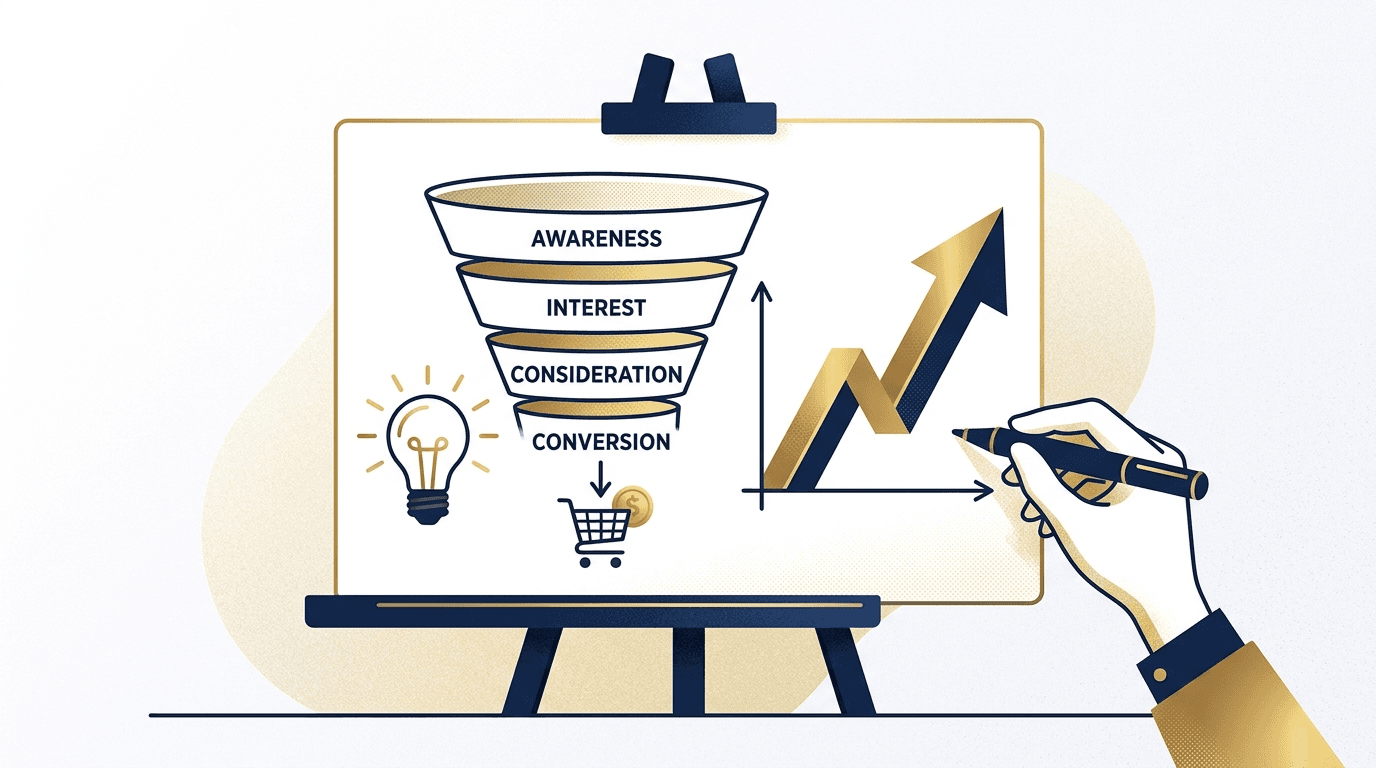
The biggest mistake Australian B2B advertisers make is running a single campaign and expecting it to carry prospects from first awareness to booked meeting. LinkedIn advertising works best as a sequenced experience across three stages.
Stage 1: Awareness (Top of Funnel) Objective: Get your brand and point of view in front of your target audience. Format: Single image or video Sponsored Content. Offer: Educational insight, provocative question, industry statistic, or short article excerpt. Budget allocation: 20 to 30% of total LinkedIn budget. Success metric: Reach, CPM, website visits, video views (if using video).
Stage 2: Consideration (Middle of Funnel) Objective: Capture contact details from people who engaged with Stage 1 content. Audience: Retargeting audience from Stage 1 (video viewers, ad engagers, website visitors). Format: Lead Gen Form or Document Ad. Offer: High-value content (benchmark report, checklist, recorded webinar). Budget allocation: 40 to 50% of total LinkedIn budget. Success metric: Cost per lead, lead form completion rate.
Stage 3: Decision (Bottom of Funnel) Objective: Convert qualified leads into sales conversations. Audience: Lead Gen Form submitters, high-intent website visitors (pricing page, contact page). Format: Message Ad or Sponsored Content. Offer: Free consultation, audit, demo, or case study from their specific industry. Budget allocation: 25 to 35% of total LinkedIn budget. Success metric: Cost per opportunity, booked meetings.
This architecture is not complicated, but very few Australian B2B advertisers actually implement it fully. Most spend 90% of their budget at Stage 1 and wonder why they have no leads.
Real Case Studies from Australian B2B Campaigns
Case Study 1: Recruitment Technology Company, Sydney
A Sydney-based recruitment software provider came to 3P Digital running LinkedIn campaigns that were spending $8,500 AUD per month with an average CPL of $380. They were running a single Sponsored Content campaign targeting HR Directors and Talent Acquisition Managers by job title across Australia, sending all clicks to their homepage.
We restructured the campaign into a three-stage funnel. Stage 1 ran a video ad featuring a 60-second explainer of a core product feature. Stage 2 retargeted 50%+ video viewers with a Document Ad showcasing a "State of Talent Acquisition in Australia" report, gated behind a Lead Gen Form. Stage 3 retargeted form submitters with a Message Ad offering a 30-minute product walkthrough.
After 90 days, CPL dropped from $380 to $142. Monthly lead volume increased from 22 to 61 leads at the same budget. Qualified opportunities (leads that progressed to a sales call) increased by 220%.
Case Study 2: Accounting Firm, Brisbane
A mid-size Brisbane accounting firm specialising in SME clients wanted to grow their advisory services revenue. Their LinkedIn budget was $2,500 per month. Their previous agency had been running brand awareness campaigns with no conversion objective.
We implemented a simple two-stage approach given the smaller budget. Stage 1 used a single image Sponsored Content ad targeting business owners and directors at Queensland companies with 10 to 50 employees, running a provocative post about the three tax planning mistakes most SME owners make. Stage 2 retargeted ad engagers and website visitors with a Lead Gen Form offering a free 30-minute tax strategy session.
Within 60 days, the firm was generating 18 to 24 qualified leads per month at an average CPL of $104. Six of those leads converted to ongoing advisory clients in the first quarter, representing more than $85,000 AUD in annualised revenue from a $5,000 total ad spend.
Client Testimonial:
"We had tried LinkedIn ads twice before and written them off entirely. 3P Digital completely changed our view. The difference was the funnel structure, not just the creative. We are now generating 20-plus qualified leads per month from LinkedIn and our sales team actually wants to take these calls. The lead quality is completely different to what we were used to." — Marketing Manager, Australian SaaS company, 2026.
LinkedIn Ads vs Google Ads for B2B: Which One Should You Use?
This question comes up in almost every new client conversation. The honest answer is that the best Australian B2B advertising strategies use both, but for different purposes.
Google Ads captures existing demand. When someone types "accounting software for small business Australia" into Google, they are already in buying mode. Google Search captures that intent at the moment it exists. If your product or service has strong search volume from qualified buyers, Google Ads should be your first investment.
LinkedIn Ads creates demand. Most B2B products and services have limited or ambiguous search intent. Nobody searches for "strategic consulting firm to help us improve procurement processes." But you can reach the operations director at a 200-person manufacturer in Perth through LinkedIn and educate them on why their procurement process is costing them 15% in preventable overhead. That conversation starts on LinkedIn, not Google.
For our detailed breakdown of building the full B2B lead generation ecosystem, see our B2B lead generation strategies guide.
Measuring LinkedIn Ad ROI: Attribution Challenges and Solutions
LinkedIn's native reporting in Campaign Manager shows you impressions, clicks, leads, and cost per lead. This is useful but incomplete. The attribution challenge in B2B is that LinkedIn-influenced pipeline often does not show up as a direct conversion because the sales cycle is long and multi-touch.
A prospect might see your LinkedIn ad in January, visit your website in February after a colleague mentions your brand, attend a webinar in March, and book a discovery call in April. LinkedIn gets zero credit in last-click attribution, but it initiated the entire journey.
Solutions that work in practice:
First, install the LinkedIn Insight Tag on your website. This enables website retargeting, conversion tracking, and demographic reporting on your organic and paid traffic. It is free and takes 15 minutes to implement.
Second, use UTM parameters on all LinkedIn ad destination URLs. This allows you to see LinkedIn traffic and conversions in Google Analytics 4 broken down by campaign, ad set, and creative. Connect this to your CRM to track lead source through the full sales cycle.
Third, ask leads directly. In your Lead Gen Form or on your landing page thank-you step, include a question: "How did you hear about us?" The self-reported data will not be perfectly accurate, but it adds a qualitative layer to your attribution picture.
Fourth, implement a CRM attribution model that tracks first-touch, last-touch, and linear attribution simultaneously. This gives your sales and marketing teams a multi-dimensional view of which channels are influencing pipeline, not just which channel got the final click.
For deeper support on tracking and analytics, our analytics services team builds attribution models specifically for Australian B2B clients with complex sales cycles.
Common Mistakes Australian B2B Advertisers Make on LinkedIn
After running LinkedIn campaigns for Australian businesses across professional services, technology, recruitment, and finance, I see the same mistakes appear repeatedly.
Mistake 1: Sending traffic to the homepage. The homepage is designed for everyone. Your ad audience is a specific segment. Always send LinkedIn traffic to a dedicated landing page or Lead Gen Form that matches the exact offer in the ad. Mismatched messaging between ad and destination is the single biggest conversion killer.
Mistake 2: Too broad an audience. LinkedIn's algorithm encourages you to expand your audience for "better reach." Resist this. A 50,000-person highly targeted audience will outperform a 500,000-person broad audience for B2B lead generation every time. Quality over quantity is not a cliche here. It is math.
Mistake 3: Stopping campaigns too early. LinkedIn campaigns need three to four weeks minimum to exit the learning phase and optimise delivery. Stopping a campaign after one week because CPL looks high is a common and costly mistake. Give campaigns at least 30 days and 50 conversions before drawing conclusions.
Mistake 4: No retargeting strategy. Running cold awareness campaigns indefinitely without building and targeting warm retargeting audiences is the primary reason LinkedIn budgets underperform. Retargeting should represent at least 30% of your LinkedIn spend.
Mistake 5: Generic creative and copy. LinkedIn audiences are professional and discerning. Corporate stock photos, vague headlines, and generic CTAs are ignored. The highest-performing LinkedIn ads look like genuine professional content, not advertisements. Real insights, real data, real opinions, real faces.
Mistake 6: Not using the LinkedIn Insight Tag. Failing to install the Insight Tag means you cannot retarget website visitors, track conversions accurately, or build lookalike audiences. It is a foundational setup step and its absence limits every other tactic.
If you want to understand how these tactics fit into a broader marketing system, our 3P Framework walks through how we build LinkedIn and paid media into a full Profile, Plan, and Perform engagement.
FAQs
How much does LinkedIn advertising cost in Australia?
LinkedIn advertising costs in Australia vary by industry, targeting, and campaign objective. As a benchmark, expect to pay between $18 and $55 AUD CPM (cost per thousand impressions) for competitive B2B audiences. Cost per lead typically ranges from $75 to $250 AUD for well-structured campaigns, with professional services and SaaS trending toward the higher end. The minimum daily budget LinkedIn allows is approximately $15 AUD, but meaningful campaign performance requires at least $1,500 to $2,000 AUD per month.
What is the minimum budget needed to run LinkedIn ads effectively in Australia?
The practical minimum for generating reliable data and results is $1,500 to $2,000 AUD per month. Below this threshold, LinkedIn's algorithm struggles to exit the learning phase, your retargeting audiences build too slowly, and any results you do see will not be statistically meaningful enough to optimise against. For businesses with smaller budgets, we recommend starting with a single highly targeted campaign focused on one specific audience and one clear offer, then scaling once that campaign proves its return.
How does LinkedIn advertising compare to Google Ads for B2B lead generation?
Google Ads excels at capturing existing demand from buyers already searching for a solution. LinkedIn Ads excels at creating demand by reaching decision-makers before they start searching. For B2B businesses where search volume is low or ambiguous, LinkedIn is often the more powerful channel for building pipeline. The two platforms work best together: LinkedIn builds awareness and captures leads from cold audiences, while Google Ads converts high-intent searchers. Budget-constrained businesses should prioritise Google Search first if search volume exists, then layer in LinkedIn as budget grows.
How long does it take to see results from LinkedIn advertising?
Expect a four to six week period before drawing any strong conclusions about campaign performance. The first two to three weeks are often spent in LinkedIn's learning phase, where the algorithm tests delivery across your audience. Weeks three through eight typically show performance stabilise and improve as the algorithm optimises toward conversions. For full-funnel campaigns with a three-stage retargeting sequence, allow 90 days to see the complete picture, because retargeting audiences need time to build and the sales cycle in B2B means some leads will not convert to opportunities until 60 to 90 days after first contact.
Can small businesses use LinkedIn ads effectively, or is it only for large companies?
Small businesses can absolutely generate strong ROI from LinkedIn ads, but they need to be more disciplined about targeting and offer design than larger companies with bigger budgets. The key is specificity: a tight audience of 20,000 to 50,000 highly relevant professionals will outperform a broad audience of 500,000. A clear, high-value offer (free consultation, industry report, audit) will outperform a generic brand awareness campaign every time. We have run profitable LinkedIn campaigns for Australian businesses spending as little as $1,800 per month, generating 12 to 20 qualified leads monthly at CPLs under $150.
How do I track LinkedIn ad leads through to revenue?
Tracking LinkedIn leads through to closed revenue requires three integrated systems. First, install the LinkedIn Insight Tag on your website to enable conversion tracking and retargeting. Second, use UTM parameters on all ad destination URLs and connect them to Google Analytics 4 so you can see LinkedIn-sourced traffic and on-site behaviour. Third, ensure your CRM records lead source on every contact record and tracks the lead through each pipeline stage to closed-won. Using a multi-touch attribution model rather than last-click attribution is critical in B2B, because LinkedIn often influences the beginning of a journey that closes months later through a different channel.
Which LinkedIn ad format works best for B2B lead generation?
Lead Gen Forms consistently deliver the best cost per lead for direct response B2B campaigns, particularly on mobile where they eliminate the friction of an external landing page. For top-of-funnel awareness, Single Image Sponsored Content is the most versatile and scalable format. Document Ads work well for mid-funnel content downloads. Message Ads perform best for high-intent, bottom-of-funnel offers delivered to warm retargeting audiences. The best LinkedIn strategy uses multiple formats across different stages of the funnel rather than relying on one format for all objectives.
Should I use LinkedIn Campaign Manager directly or work with an agency?
LinkedIn Campaign Manager is accessible and any business can set up campaigns directly. The platform is reasonably intuitive. However, the difference between a self-managed campaign and a professionally structured one is typically a 40% to 60% difference in cost per lead, based on what we see when new clients share their historical campaign data with us. The strategic decisions around campaign architecture, audience layering, offer design, and retargeting sequencing are where most in-house teams lack depth. If your B2B sales process involves deals worth $10,000 or more, the ROI of specialist management almost always exceeds the cost. If you want to explore what a structured LinkedIn campaign could look like for your business, get in touch with the 3P Digital team.
References
LinkedIn Marketing Solutions Blog (2026) — LinkedIn's official marketing resource covering ad format performance benchmarks, audience data, and Campaign Manager updates. Provides first-party data on Australian LinkedIn membership size and decision-maker demographics used throughout this article.
HubSpot State of Marketing Report (2026) — Annual global marketing benchmark report covering paid social performance data, B2B lead generation CPL benchmarks by channel, and conversion rate data across LinkedIn, Google, and Meta platforms. Useful for cross-channel comparisons cited in the LinkedIn vs Google Ads section.
Demand Gen Report: B2B Buyer Behaviour Study (2026) — Research report covering how B2B buyers consume content, engage with vendors, and make purchasing decisions before contacting sales. Source for the statistic that 67% of B2B buyers engage with three to seven pieces of content before contacting a vendor.
LinkedIn Campaign Manager Help Centre (2026) — Official documentation on targeting options, ad formats, bidding strategies, and campaign objectives available in the Australian market. Referenced for technical details on Lead Gen Form capabilities and audience targeting parameters.
Salesforce State of the Connected Customer Report (2026) — Covers B2B buyer journey complexity, average number of stakeholders involved in purchasing decisions, and sales cycle length benchmarks. Source for the five to seven stakeholder statistic referenced in the introduction.