Professional Services Marketing in Australia: How to Generate Qualified Leads Consistently in 2026
If your accounting firm, law practice, or consultancy is still running on referrals alone, you are sitting on a growth risk that most principals do not see coming until the pipeline runs dry. Referral-based business development worked brilliantly in a world where buyers trusted their networks above all else. That world still exists, but it has fundamentally changed. Today, a CFO shortlisting accounting firms, a small business owner searching for a commercial lawyer, or a startup founder comparing management consultants will conduct detailed online research long before they pick up the phone. If your firm is invisible in that research phase, the referral may never arrive at all.
The professional services sector in Australia is significant and growing. According to the Australian Bureau of Statistics, professional, scientific, and technical services is one of the largest and fastest-growing industries in the Australian economy, contributing over $180 billion in gross value added annually. The firms that are winning new clients in 2026 are not necessarily the most decorated or the most experienced. They are the ones that show up consistently, communicate their expertise clearly, and make it easy for prospective clients to take the next step. That is a marketing problem, and it has a marketing solution.
This guide covers the complete digital marketing playbook for professional services firms in Australia. Whether you are a sole practitioner trying to build a sustainable pipeline or a national consultancy looking to scale across multiple locations, what follows is the exact strategic approach we use at 3P Digital to generate consistent, qualified inbound leads for professional services clients. No generic advice. No recycled blog content. Just the tactics that actually work in a trust-based, high-consideration buying environment.
Key Takeaways
Referral-only growth is a structural risk for any professional services firm in 2026, as buyer behaviour has permanently shifted toward independent online research before engagement.
A five-channel digital marketing framework covering SEO, content marketing, paid media, reputation management, and email nurture gives professional services firms the most reliable path to consistent lead generation.
Google E-E-A-T principles align almost perfectly with how professional services buyers evaluate credibility, making content strategy a high-leverage investment for accountants, lawyers, and consultants.
Local SEO and Google Business Profile optimisation are disproportionately valuable for multi-location professional services practices, particularly in competitive metro markets like Sydney and Melbourne.
Conversion optimisation for high-trust services requires a different approach to typical e-commerce or lead gen funnels, prioritising credibility signals and friction reduction over aggressive calls to action.
Outsourcing to a specialist professional services marketing agency is often more cost-effective than building in-house capability, particularly for firms under 50 staff.
Summary Table: Digital Marketing Channels for Professional Services
Channel | Typical Monthly Cost (AUD) | Expected Timeline to Results | Best For |
SEO (Organic Search) | $2,000 – $6,000 | 4–12 months | Long-term authority, consistent inbound leads |
Content Marketing | $1,500 – $5,000 | 3–9 months | Trust building, E-E-A-T signals, email list growth |
Google Ads (Search) | $3,000 – $10,000+ ad spend | 4–8 weeks | Fast lead generation, specific service targeting |
LinkedIn Ads | $2,000 – $8,000+ ad spend | 6–12 weeks | B2B professional services, consulting, HR, finance |
Local SEO / GBP | $1,000 – $3,000 | 2–6 months | Multi-location firms, suburb-specific traffic |
Reputation Management | $500 – $2,000 | Ongoing | Review generation, credibility signals |
Email Marketing / Nurture | $800 – $2,500 | 1–3 months | Re-engaging warm leads, client retention |
Why Referrals Are No Longer Enough for Professional Services Growth
Referrals are not dying. Let me be clear about that. Word-of-mouth is still the highest-converting lead source for most professional services firms, and protecting your referral relationships is a non-negotiable part of any smart growth strategy. The problem is relying on referrals as your primary or only source of new business.
Here is the structural risk. Referral networks are finite. They are built on existing relationships, and those relationships have natural limits. If your top referring partner retires, changes firms, or shifts their own business model, your pipeline contracts immediately. Beyond that, referrals limit your growth to the size of your existing network. You cannot double your firm by doubling your referral partners at will.
More importantly, buyer behaviour has changed in ways that make referral-only strategies increasingly fragile. Research from Google and various demand generation studies consistently shows that B2B buyers complete between 57 and 70 percent of their purchasing research before ever engaging a sales or business development contact. Even when a buyer receives a referral, they almost always verify it independently online before making contact. They visit your website. They check your Google reviews. They read your LinkedIn profile. They look for articles or case studies that prove your expertise. If what they find does not reinforce the referral, the lead evaporates quietly.
For Australian professional services firms specifically, this dynamic is accelerating. The post-pandemic shift to remote and hybrid work has pushed more professional relationships online, which means more discovery happens digitally rather than at networking events or in-person meetings. A firm that shows up brilliantly online is now competitive with a firm that has been on the local Chamber of Commerce committee for fifteen years.
The shift is also generational. As younger business owners, CFOs, and decision-makers move into senior positions, digital-first research becomes the default behaviour. These buyers are not less discerning than their predecessors. They are equally rigorous, but they conduct their due diligence through different channels.
The Professional Services Buyer Journey in 2026
Understanding how your prospective clients actually make decisions is foundational to building a marketing strategy that works. For professional services, the buyer journey is longer, more research-intensive, and more risk-averse than almost any other category of purchase.
Consider a business owner who has just received an ATO audit notice and needs specialist tax advice. Their journey typically looks like this:
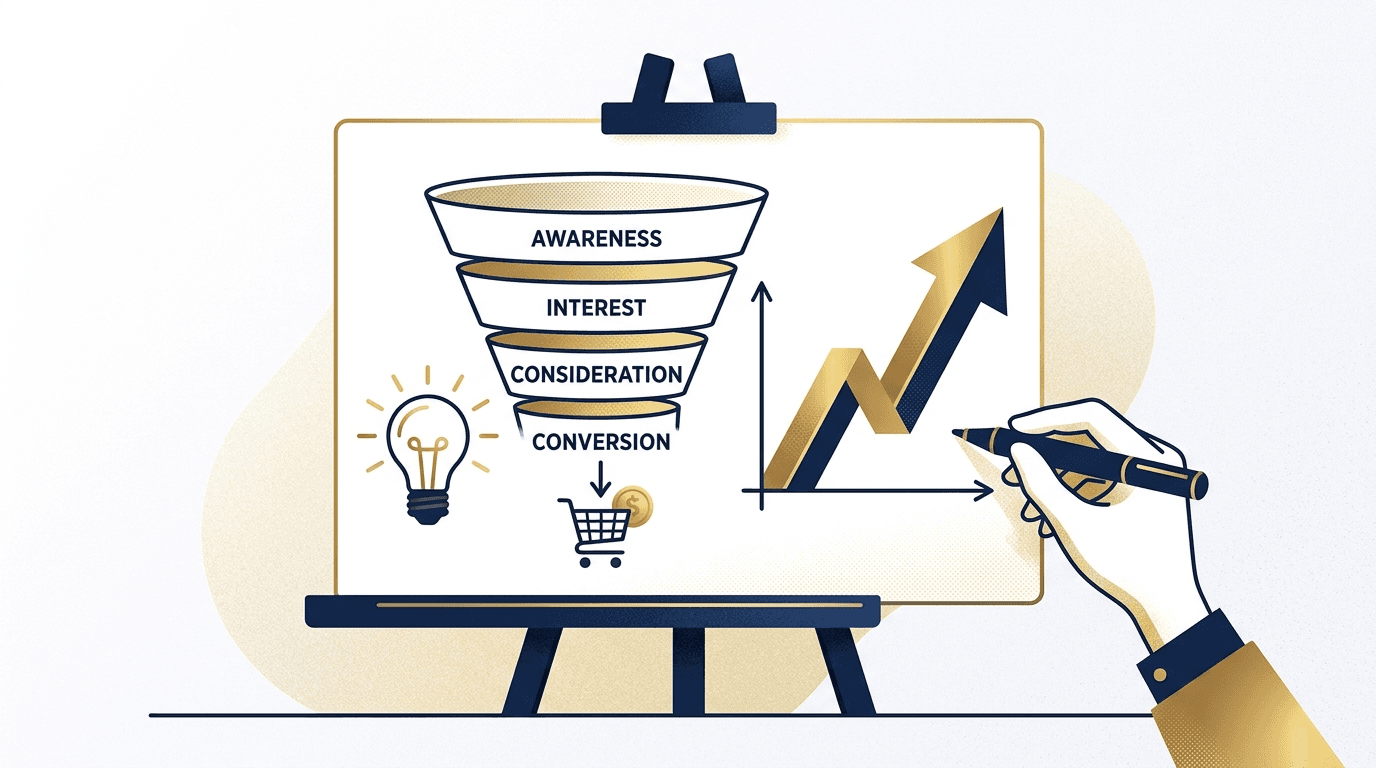
Stage 1: Awareness and problem recognition. They realise they need help and begin searching broadly. Terms like "ATO audit help Melbourne" or "what to do if ATO audits your business" reflect this phase. They are not yet ready to engage a firm. They want to understand the landscape.
Stage 2: Consideration and research. They compare options. They visit three to five firm websites. They read blog articles. They check Google reviews. They look at staff profiles on LinkedIn. They may download a guide or read a case study. At this stage, content marketing and reputation signals do the heavy lifting.
Stage 3: Decision and shortlisting. They narrow to two or three options and begin direct engagement. They request consultations, assess responsiveness and communication quality, and make a final choice based on trust, fit, and perceived expertise.
Most professional services marketing fails at Stage 2 because firms invest heavily in brand awareness without providing the depth of content that moves a buyer from research to decision. A well-structured digital marketing strategy covers all three stages with deliberate channel and content choices.
SEO Strategy for Accountants, Lawyers, and Consultants
Search engine optimisation is the highest-leverage long-term investment available to most professional services firms. Once you rank consistently for the terms your prospective clients are searching, you generate inbound leads at a cost per acquisition that no paid channel can match over time.
For professional services, SEO strategy has a few specific requirements that differ from broader commercial SEO.
Keyword Research That Reflects How Clients Think, Not How Professionals Talk
The biggest mistake professional services firms make with SEO is optimising for jargon-heavy terms they use internally rather than the plain-language phrases their clients search. A family law practice might optimise for "property settlement legal advice" when their clients are searching "how to split assets in a divorce Australia." An accounting firm might target "CGT advisory services" when their clients type "do I pay capital gains tax when I sell my investment property."
Effective keyword research for professional services focuses on problem-aware queries and question-based searches that reflect how a non-specialist describes their situation. Tools like Ahrefs, SEMrush, or even Google Search Console data from your existing site will surface these opportunities quickly.
Service Pages That Do More Than List Capabilities
Most professional services websites have thin service pages that describe what the firm does in generic terms. "We provide tax planning, compliance, and advisory services." That content ranks for almost nothing and converts even less.
A high-performing service page for a professional services firm should include a clear explanation of what the service involves and who it is for, the specific outcomes a client can expect, a breakdown of the process or methodology, FAQs that address common concerns and objections, credibility signals including team credentials and client testimonials, and a clear, low-friction next step.
For our SEO service engagements with professional services clients, we typically begin by auditing existing service pages and building expanded versions that are three to five times longer, more structured, and answer the specific questions buyers ask at Stage 2 of their journey. The ranking improvements from this work alone are often significant within three to six months.
Technical SEO and Site Architecture
Professional services websites are frequently built on templates or CMS platforms that were chosen for aesthetics rather than performance. Slow page load times, poor mobile experience, and flat site architecture without clear internal linking are common issues that suppress rankings regardless of content quality.
For multi-service or multi-location firms, site architecture becomes particularly important. A Melbourne accounting firm that also has offices in Brisbane and Sydney needs separate location pages for each city with localised content, not a single generic "contact us" page with three addresses.
Content Marketing That Builds Authority and Generates Inbound Leads
Content marketing and SEO are inseparable for professional services firms in 2026. The reason is Google's E-E-A-T framework, which stands for Experience, Expertise, Authoritativeness, and Trustworthiness. These are the signals Google uses to assess whether content deserves to rank for high-stakes queries, and professional services queries are among the highest-stakes categories online. Legal, financial, and consulting advice that is wrong can cause real harm, so Google applies additional scrutiny to who is producing this content and why it should be trusted.
The good news is that the same signals that Google values are exactly the signals your prospective clients value. Demonstrating real-world experience, proven expertise, and trustworthiness is not just an SEO tactic. It is the core of effective professional services marketing.
What Content Actually Works for Professional Services
Our content marketing work for professional services clients has consistently shown that certain formats dramatically outperform generic blog posts.
In-depth explainer articles that answer specific questions a prospective client is asking during their research phase generate significant organic traffic and position the firm as a credible resource. An article titled "How the ATO Assesses Rental Property Deductions in 2026" written by a credentialed accountant and properly structured for search intent will outrank generic content every time.
Case studies with specific outcomes are the most powerful conversion tool available to professional services firms. A detailed case study explaining how your firm helped a specific type of client resolve a specific problem, with real (or anonymised) numbers attached, does more to move a prospect from consideration to decision than any other content format. The caveat here is important: professional services case studies must be careful with confidentiality and, in some regulated industries like financial planning, must comply with advertising guidelines around past performance claims.
Thought leadership pieces on industry developments signal currency and expertise. When the Federal Budget changes tax thresholds, a prominent accounting firm should have a clear, expert analysis published within 48 hours. When a significant court decision affects commercial contract law, a boutique law firm should have a client-facing explainer ready. This kind of reactive content builds authority quickly and often generates media interest and backlinks.
Video content is increasingly important for professional services, particularly for high-value or emotionally complex matters like family law, estate planning, or business advisory. A short video where a senior partner explains a common client concern in plain language humanises the firm and builds trust in a way that written content alone cannot replicate.
The Author Signal Problem
A major gap in professional services content marketing is that firms publish content without clearly attributing it to qualified individuals. Content published generically under a firm name or "admin" account carries no E-E-A-T signal. Every piece of content that is intended to build authority should be attributed to a named, credentialled professional with a complete author bio that includes qualifications, years of experience, and a link to their professional profile.
Google Ads and LinkedIn for Professional Services
Organic channels are the long-term foundation, but paid media gives professional services firms the ability to generate leads quickly, test messaging, and target specific client profiles with precision.
Google Search Ads for Professional Services
Google Ads works exceptionally well for professional services because it captures intent at the exact moment a prospect is actively searching for help. Someone searching "commercial litigation lawyer Sydney" is not browsing. They have a problem and they need a solution. Getting your firm in front of that query at that moment is enormously valuable.
The challenge with Google Ads for professional services is that cost-per-click in competitive categories can be extremely high. In legal services, CPC for top commercial terms in Sydney or Melbourne can exceed $30 to $60 per click. This means that campaign structure, targeting, and conversion rate optimisation are not optional. They are critical to making the economics work.
Effective Google Ads campaigns for professional services firms require tightly themed ad groups aligned to specific services rather than broad practice areas, compelling ad copy that addresses the prospect's problem and speaks to credibility, a dedicated landing page for each campaign rather than sending traffic to a generic homepage, and call tracking and conversion attribution so you can actually measure which campaigns are generating enquiries.
LinkedIn Advertising for B2B Professional Services
For professional services firms targeting other businesses, such as corporate advisory consultancies, HR and recruitment firms, or B2B accounting practices, LinkedIn Ads offers targeting capabilities that no other platform can match. You can target by job title, company size, industry, seniority level, and even specific companies.
LinkedIn is most effective at the awareness and consideration stages of the buyer journey, particularly for thought leadership content promotion and lead generation form campaigns. Conversion costs on LinkedIn are typically higher than Google Ads, but the quality of leads and the ability to build brand familiarity with decision-makers over time makes it worthwhile for mid-to-large professional services firms with appropriate budgets.
Local SEO and Google Business Profile Optimisation
For professional services firms with physical office locations, local SEO is one of the highest-return investments available. When someone searches "accountant near me" or "family lawyer Parramatta," Google's local pack appears prominently above the organic results. Appearing in that pack drives significant call and website traffic from highly intent-driven prospects.
Our dedicated resource on local SEO for professional services covers this in detail, but the core elements are as follows.
Google Business Profile (GBP) completeness and accuracy is the starting point. Every field in your GBP should be completed, including service categories, business description, service offerings, office hours including public holiday variations, and high-quality photos of your team and offices. Incomplete profiles rank worse and convert worse.
Review velocity and quality are the most significant local ranking factors after proximity and relevance. Firms that consistently generate new Google reviews with substantive content outrank those with older, fewer, or lower-rated reviews. A proactive review generation process, whether through post-engagement email sequences or direct client requests, is essential.
Location-specific landing pages for each office are required for multi-location firms. A generic page with multiple addresses does not signal local relevance to Google. Each location needs its own page with localised content, embedded Google Maps, local schema markup, and unique copy.
Local citation consistency across business directories, legal or accounting associations, and industry databases reinforces the signals Google uses to verify a business's legitimacy and location relevance. Inconsistencies in name, address, and phone number across the web actively suppress local rankings.
Reputation Management and Review Generation
For professional services, your online reputation is not a secondary concern. It is often the deciding factor between a prospect contacting you or your competitor. Research consistently shows that consumers and business buyers read online reviews as carefully as personal recommendations, and that response to reviews, both positive and negative, significantly affects how a business is perceived.
Building a Proactive Review Generation System
Most professional services firms collect reviews passively and inconsistently. The firms that dominate local rankings and conversion rates have systematised the review collection process. This means identifying the right moment in the client lifecycle to request a review (typically shortly after a positive outcome or at the close of a matter), using a simple, direct process such as a personalised email with a direct link to the Google review form, and following up once if no response is received.
In regulated industries such as financial planning or legal services, there are specific rules about testimonials and advertising claims. In financial services, ASIC's regulatory guidance on advertising means that review language must not imply guaranteed outcomes or make unsubstantiated performance claims. It is important that review generation programs in these industries are designed with compliance in mind.
Responding to Reviews Strategically
Every review on your Google Business Profile should receive a response. Positive reviews should be acknowledged warmly and specifically, referencing the matter type or outcome where appropriate without breaching confidentiality. Negative reviews require a measured, professional response that acknowledges the concern, avoids defensiveness, and offers to resolve the issue offline. How a professional services firm responds to criticism often tells a prospective client more about the firm's culture than the review itself.
Conversion Optimisation for High-Trust Services
Getting traffic to your website is only half the challenge. Converting that traffic into qualified enquiries is where most professional services firms leave significant revenue on the table. The conversion considerations for high-trust, high-consideration services are fundamentally different from e-commerce or transactional purchases.
Our conversion optimisation practice for professional services focuses on three core levers.
Reducing friction in the enquiry process. Professional services websites commonly bury their contact forms, require excessive information before a prospect can make initial contact, or direct all traffic to a generic contact page. The easier and faster you make it to take the first step, the higher your conversion rate will be. This means prominently placed phone numbers (click-to-call on mobile), short initial enquiry forms that ask for name, email, phone, and matter type only, and offering multiple contact options including live chat for firms with the capacity to manage it.
Building credibility signals on every page. Conversion optimisation for professional services is not primarily about button colours or page layouts. It is about ensuring that every page a prospective client visits reinforces their confidence in your firm. This includes team bios with photos and credentials on all key pages, client testimonials and case studies positioned near conversion points, trust badges such as professional association memberships, awards, and media appearances, and clear information about what happens after someone makes contact.
Nurture sequences for prospects who are not yet ready. Not every visitor to a professional services website is ready to engage immediately. A significant portion are at Stage 2 of their journey, still researching. Capturing these prospects through a lead magnet such as a checklist, guide, or video series, and then nurturing them through a structured email sequence, dramatically increases the eventual conversion rate. Email marketing for professional services clients consistently shows some of the highest ROI of any channel we manage at 3P Digital, precisely because the sales cycle is long and relationship-building through regular, valuable communication pays dividends.
Case Study 1: Sydney Accounting Practice Increases Inbound Leads by 187% in 12 Months
A mid-size Sydney accounting firm with four partners and a focus on SME tax and business advisory came to 3P Digital with a classic professional services problem. They had a strong client base built over fifteen years but no digital presence to speak of. Their website was generating fewer than 200 visits per month and almost no organic enquiries. The partner group was spending significant time on business development that was not producing proportional results.
We began with the Profile phase of our framework, conducting a comprehensive ideal client profile exercise and competitive audit. The firm's core differentiator was deep expertise in property investment taxation for high-net-worth individuals, a niche that was underserved by their larger competitors but highly searched online.
Over the following twelve months, we executed a focused strategy: rebuilding eight core service pages with structured, E-E-A-T-optimised content, launching a monthly article programme targeting high-intent property investment tax queries, implementing a Google Ads campaign targeting specific investment property tax terms in the Sydney metro area, completing full Google Business Profile optimisation across two office locations, and deploying a post-engagement email sequence to generate Google reviews.
The results at the twelve-month mark were clear. Organic traffic increased from 190 sessions per month to 1,480 sessions per month. Inbound enquiries via the website increased by 187 percent. The firm's Google Business Profile accumulated 34 new five-star reviews over the period, moving them from position 8 to position 2 in the local pack for their primary target suburb. The Google Ads campaign maintained a cost per lead of $142, which against an average client lifetime value of over $8,000 represented a strong return on ad spend.
Case Study 2: National Consulting Firm Builds B2B Pipeline Through LinkedIn and Content Strategy
A management consulting firm with offices in Melbourne, Brisbane, and Perth engaged 3P Digital to build a B2B lead generation programme targeting mid-market manufacturing and logistics businesses. Unlike consumer-facing professional services, this firm's buyer journey involved multiple stakeholders including CEOs, operations directors, and CFOs, and sales cycles of three to nine months.
The strategy centred on LinkedIn as the primary channel, supported by a robust content programme designed to generate awareness among senior decision-makers. We developed a twelve-piece thought leadership series on supply chain optimisation, authored and attributed to the firm's senior principals with full professional credentials included. These were promoted via LinkedIn Ads to tightly segmented audiences of operations and supply chain directors at Australian manufacturing companies with 50 to 500 employees.
Each LinkedIn ad drove traffic to a dedicated content hub with a gated diagnostic tool, an interactive supply chain efficiency assessment that provided personalised output in exchange for contact details. This approach generated leads that were self-qualified by virtue of the assessment topic, ensuring the sales team was only following up with prospects who had a demonstrated interest in supply chain improvement.
Over a nine-month period, the campaign generated 214 content downloads, 38 consultation requests, and 6 signed engagements with an average contract value of $65,000. The LinkedIn Ads cost per consultation request was $318, well within the firm's acceptable acquisition cost given deal value.
Client Testimonial
"Before working with 3P Digital, our marketing was basically hoping referrals kept coming. Within eight months they had built us a proper digital presence that was actually generating enquiries from clients we had never met before. The strategy was clear, the reporting was transparent, and the results were exactly what they promised. I wish we had done this three years ago."
Managing Partner, Sydney Boutique Law Firm
How 3P Digital's 3P Framework Applies to Professional Services
Every engagement at 3P Digital runs through our proprietary 3P Framework: Profile, Plan, Perform. For professional services firms, this framework addresses the specific challenges of marketing high-trust, high-complexity services in a competitive and often regulated environment.
Profile is where we define who you are marketing to and how you are different. For professional services, this means developing a precise Ideal Client Profile that goes beyond industry and firm size to capture the specific problems, triggers, and decision criteria of your best prospective clients. It also means establishing your competitive positioning so that your marketing communicates a genuine point of difference, not just a list of services that every firm in your category offers.
Plan is where we translate the profile work into a prioritised, budgeted marketing strategy. Not every channel works for every firm. A boutique family law firm in Adelaide has a different optimal channel mix than a national IT consultancy targeting ASX-listed companies. The plan is specific, measurable, and designed around your actual revenue goals and budget constraints.
Perform is where the strategy is executed, measured, and continuously optimised. We establish clear KPIs, build reporting dashboards that connect marketing activity to commercial outcomes, and run regular review cycles to refine what is working and eliminate what is not. This is where the rubber meets the road, and it is the phase that separates firms that generate consistent inbound leads from those that run occasional campaigns and hope for the best.
You can explore our full approach to professional services marketing or get in touch to discuss how the 3P Framework applies to your firm specifically.
FAQs
How much should a professional services firm spend on digital marketing in Australia?
There is no universal answer, but a useful starting benchmark is to allocate between five and ten percent of your annual revenue target from new clients to marketing. For a firm seeking $1 million in new revenue annually, a marketing budget of $50,000 to $100,000 per year is a reasonable starting point. Firms in highly competitive markets like corporate law in Sydney or financial advisory in Melbourne may need to invest at the higher end or above this range to achieve meaningful visibility. The critical discipline is measuring cost per lead and cost per acquisition, not just total spend, so that the investment can be justified against real commercial outcomes.
How long does it take to see results from professional services digital marketing?
The timeline depends on the channels you are investing in. Google Ads and LinkedIn Ads can begin generating enquiries within four to eight weeks of campaign launch, provided the campaigns are well structured and the landing pages are optimised. SEO and content marketing are longer-term investments, with meaningful organic traffic and ranking improvements typically visible at four to six months and material lead generation impact at nine to twelve months. Local SEO improvements tend to appear faster, often within two to four months of optimising your Google Business Profile and implementing a review generation programme. A blended strategy that combines paid media for short-term results with SEO and content for long-term organic growth is the most resilient approach.
Which digital marketing channels work best for professional services firms?
For most Australian professional services firms, SEO and Google Ads search campaigns form the most effective core. SEO delivers compounding returns over time, while paid search captures intent-driven prospects immediately. Content marketing underpins both by building the depth of material that drives organic rankings and converts paid traffic. For firms with a B2B focus targeting corporate clients, LinkedIn Ads adds significant value. Local SEO is essential for any firm with physical office locations. The precise mix should be determined by your firm's target client profile, competitive environment, and available budget.
How do I measure the ROI of professional services marketing?
ROI measurement for professional services marketing requires connecting digital activity to commercial outcomes, not just traffic or clicks. The core metrics to track are total inbound enquiries (calls, form submissions, live chats) sourced through digital channels, cost per lead by channel, lead-to-consultation conversion rate, consultation-to-engagement conversion rate, average client value and lifetime value, and total cost per acquired client by channel. Google Analytics 4 with goal tracking, call tracking software, and a CRM or matter management system that records lead sources are the minimum infrastructure required. At 3P Digital, we build reporting dashboards for every client that surface these numbers monthly so investment decisions are based on data, not intuition.
Should professional services firms manage marketing in-house or outsource to an agency?
For most Australian professional services firms under 50 staff, outsourcing to a specialist agency is more cost-effective and produces better results than building in-house capability. The reason is that effective digital marketing across SEO, paid media, content, and conversion optimisation requires a range of specialist skills that are expensive to hire individually. A senior SEO specialist, a Google Ads expert, a content strategist, and a CRO analyst together would cost well over $300,000 per year in salaries. A specialist agency providing the same capability costs a fraction of that. The trade-off is that in-house teams have deeper institutional knowledge of the firm, which is why a hybrid model, where an agency handles execution and strategy while an internal marketing coordinator manages relationship and content input, often works best for larger firms.
Are there compliance or regulatory considerations for professional services marketing in Australia?
Yes, and these vary significantly by profession. Financial services firms are subject to ASIC's advertising and licensing requirements under the Corporations Act, which restrict claims about past performance, returns, and specific product recommendations in advertising. Legal practitioners must comply with the advertising rules in their respective state's legal profession legislation, which generally prohibit false or misleading claims and restrict certain forms of solicitation. Accounting firms making tax-related claims must ensure their content is not construed as personal tax advice without appropriate disclaimers. Healthcare-adjacent professional services such as physiotherapy or psychology practices are subject to the Australian Health Practitioner Regulation Agency's advertising guidelines. Any professional services marketing programme should be reviewed against these obligations. A good marketing agency working in the professional services space will understand these constraints and build compliant campaigns from the outset.
Can content marketing actually generate leads for a professional services firm, or is it just brand awareness?
Content marketing generates leads directly when it is structured correctly. The key distinction is between content that is designed to rank for and answer the specific queries your prospective clients are searching during their research phase, versus brand content that is designed for awareness among an existing audience. A well-researched article that ranks on the first page of Google for "commercial lease negotiation advice Melbourne" and includes a clear call to action and an optimised enquiry form will generate direct leads. We have seen content programmes for professional services clients generate between 30 and 60 percent of total inbound enquiries from organic search alone within twelve months of a structured content strategy being implemented. The caveat is that this takes time, consistency, and content that is genuinely expert rather than generic.
What makes professional services marketing different from other industries?
Several factors make professional services marketing distinctly challenging and requiring a specialist approach. First, the sales cycle is long and trust-dependent, meaning you cannot rush a prospect through a funnel the way you might in retail or e-commerce. Second, the services are intangible, so credibility signals, credentials, and demonstrated expertise must do the work that a product demonstration would do in other categories. Third, professional services are often regulated, which creates advertising constraints that do not apply to most other industries. Fourth, relationship and reputation are central to client acquisition and retention in ways that differ from transactional businesses. A successful professional services marketing strategy must account for all of these factors, which is why generic digital marketing agencies often underdeliver when working with law firms, accounting practices, or consulting firms.
References
Australian Bureau of Statistics, Australian Industry Report (Professional, Scientific and Technical Services): The ABS publishes annual industry data on the professional, scientific, and technical services sector, including gross value added, employment figures, and business count by state. This data supports the sector's significance as one of Australia's largest service industries and informs market sizing for marketing investment decisions.
Google, The Changing Face of B2B Marketing (Think with Google): Google's Think with Google research hub publishes extensive data on B2B buyer behaviour, including the finding that buyers complete the majority of their research before first vendor contact. This research underpins the strategic case for investing in organic search visibility and content marketing for professional services.
HubSpot, State of Marketing Report (Annual): HubSpot's annual marketing benchmarks report covers channel performance, cost per lead by industry, and lead generation conversion rates across B2B service categories. These benchmarks are useful reference points for professional services firms establishing marketing KPIs and budget allocations.
BrightLocal, Local Consumer Review Survey (Annual): BrightLocal's annual survey provides data on how consumers and business buyers use online reviews in their purchase decisions, including what percentage read reviews before choosing a local professional service. This underpins the strategic importance of Google Business Profile optimisation and proactive review generation for professional services firms.
ASIC, Regulatory Guide 234: Advertising Financial Products and Services: ASIC's regulatory guidance on advertising for financial services firms outlines the legal requirements for marketing financial products and services in Australia. This is essential reference material for any financial planning, mortgage broking, or investment advisory firm developing a digital marketing strategy.
Ahrefs Blog, The State of Search (Annual Industry Report): Ahrefs' research on search behaviour, keyword trends, and content performance provides data-backed insights into how organic search strategies can be structured for competitive professional services categories, including legal, financial, and consulting.